
[Paper Review] Identifying and Explaining the Resilience of Ecological Networks
This study adapts tools from biochemical regulatory networks to identify and explain robust perfect adaptation—resilience where a species' abundance exactly returns to its original level after disturbance—in three-species ecological networks under a generalized Lotka-Volterra framework. From over 20,000 possible network structures, 23 networks were found to exhibit this resilience, revealing structural motifs involving sequential one-way interactions and intraspecific competition as key mechanisms.
Resilient ecological systems will be better able to maintain their structure and function in the emerging Anthropocene. Estimating the resilience of different systems will therefore provide valuable insight for conservation decision-makers, and is a priority goal of resilience theory. Current estimation methods rely on the accurate parameterisation of ecosystem models, or the identification of important motifs in the structure of the ecological system network. However, both of these methods face significant empirical and theoretical challenges. In this paper, we adapt tools developed for the analysis of biochemical regulatory networks to prove that a form of resilience - robust perfect adaptation - is a property of particular ecological networks, and to explain the specific process by which the ecosystem maintains its resilience. We undertake an exhaustive search for robust perfect adaptation across all possible three-species ecological networks, under a generalised Lotka-Volterra framework. From over 20,000 possible network structures, we identify 23 network structures that are capable of robust perfect adaptation. The resilient properties of these networks provide important insights into the potential mechanisms that could promote resilience in ecosystems, and suggest new avenues for measuring and understanding the property of ecological resilience in larger, more realistic socioecological networks.
Motivation & Objective
- To identify ecological network structures capable of robust perfect adaptation, a form of resilience where species abundances return exactly to pre-disturbance levels.
- To overcome challenges in parameter estimation for ecological models by focusing on structural properties rather than dynamic parameters.
- To explain the mechanistic basis of resilience in ecological networks by adapting methods from biochemical reaction network theory.
- To explore whether network motifs with perfect resilience can inform conservation management and ecosystem design in socioecological systems.
- To establish a foundation for identifying such resilient structures in larger, more realistic ecological networks.
Proposed method
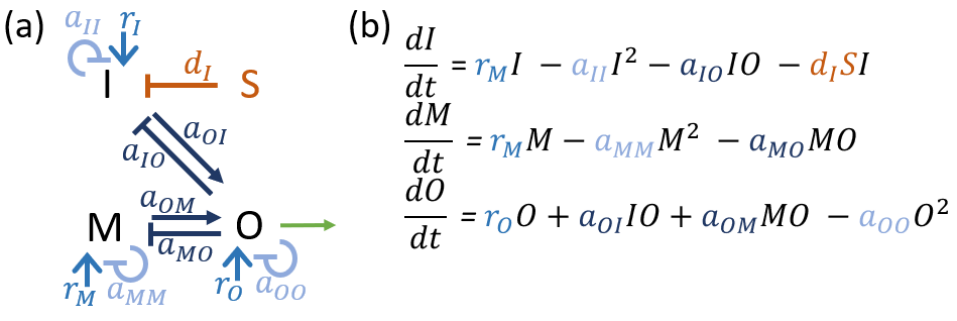
- Conducted an exhaustive search across all possible three-species ecological network topologies under the generalized Lotka-Volterra framework.
- Applied algebraic techniques, including Gröbner basis computation, to analytically determine conditions for robust perfect adaptation.
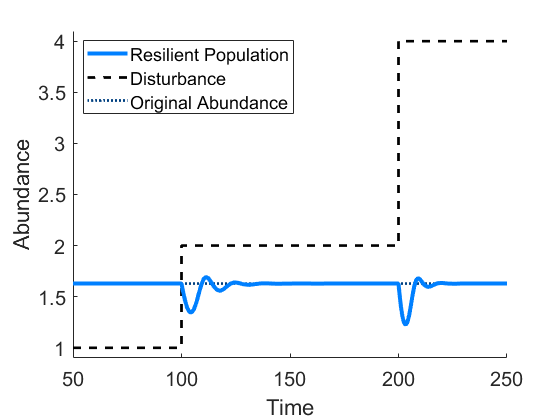
- Used a stimulus-based perturbation model to simulate disturbances and assess return-to-original-state behavior.
- Identified network motifs where the target species' abundance precisely returns to its pre-disturbance level regardless of parameter values.
- Analyzed structural features of resilient networks, such as sequences of one-way interactions and inclusion of intraspecific competition terms.
- Validated results through numerical simulations to confirm perfect adaptation dynamics and assess oscillatory behavior.
Experimental results
Research questions
- RQ1Which three-species ecological network structures exhibit robust perfect adaptation under the generalized Lotka-Volterra model?
- RQ2What structural features or network motifs are consistently associated with robust perfect adaptation in ecological systems?
- RQ3How do one-way interactions and intraspecific competition contribute to the mechanism of perfect resilience?
- RQ4Can disturbances that affect all populations simultaneously support robust perfect adaptation, and why or why not?
- RQ5To what extent can the analytical framework used in biochemical networks be adapted to identify resilience in ecological networks?
Key findings
- Out of over 20,000 possible three-species network structures, 23 were identified as capable of robust perfect adaptation.
- All resilient networks featured sequences of one-way interactions, where one species affects another without being affected in return.
- Intraspecific competition terms were present in all resilient networks and played a critical role in stabilizing oscillatory dynamics.
- Networks with disturbances affecting all populations directly could not achieve perfect resilience, indicating limitations in buffering global shocks.
- The identified motifs exhibited highly oscillatory behavior, increasing vulnerability to successive stochastic perturbations.
- The analytical framework based on Gröbner basis computation successfully identified resilience without requiring precise parameter values, overcoming a major empirical challenge in ecological modeling.
Better researchstarts right now
From reading papers to final review, dramatically reduce your research time.
No credit card · Free plan available
This review was created by AI and reviewed by human editors.