
[Paper Review] Image-Based Virtual Try-on System With Clothing-Size Adjustment
This paper proposes an image-based virtual try-on system that dynamically adjusts clothing size by integrating body and clothing measurements into the segmentation map generation process. Using OpenPose for keypoint detection and ratio-based scaling of clothing regions, the method corrects boundary distortions during resizing, producing more accurate, size-appropriate fitting images than VITON-HD, especially in collar and overlapping areas.
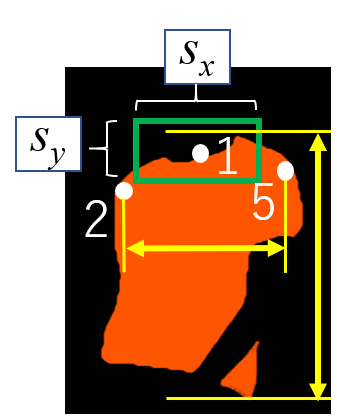
The conventional image-based virtual try-on method cannot generate fitting images that correspond to the clothing size because the system cannot accurately reflect the body information of a person. In this study, an image-based virtual try-on system that could adjust the clothing size was proposed. The size information of the person and clothing were used as the input for the proposed method to visualize the fitting of various clothing sizes in a virtual space. First, the distance between the shoulder width and height of the clothing in the person image is calculated based on the coordinate information of the key points detected by OpenPose. Then, the system changes the size of only the clothing area of the segmentation map, whose layout is estimated using the size of the person measured in the person image based on the ratio of the person and clothing sizes. If the size of the clothing area increases during the drawing, the details in the collar and overlapping areas are corrected to improve visual appearance.
Motivation & Objective
- Address the limitation in existing virtual try-on systems that fail to reflect actual clothing sizes in generated images.
- Improve visual fidelity in resized clothing regions, particularly collars and overlapping areas with limbs.
- Enable accurate virtual fitting by incorporating measured body and clothing dimensions as input parameters.
- Maintain structural consistency between clothing and body parts during size scaling to avoid visual artifacts.
- Develop a method that generates photorealistic try-on images tailored to specific clothing sizes without relying on the original garment's size in the input image.
Proposed method
- Utilizes OpenPose to detect keypoint coordinates (e.g., shoulders, torso) from the person image to estimate body dimensions.
- Calculates the ratio between the person’s measured shoulder width and height and the corresponding clothing dimensions to determine scaling factors.
- Applies ratio-based resizing to only the clothing region in the segmentation map, preserving the body’s segmentation.
- Corrects boundary distortions in overlapping regions (e.g., collar, arm intersections) by tracking the shortest distance between clothing and body parts before and after enlargement.
- Adjusts the center coordinates of clothing regions based on the difference in shortest distances pre- and post-enlargement to maintain spatial consistency.
- Integrates the modified segmentation map into the VITON-HD framework to generate size-adjusted, high-resolution virtual try-on images.
Experimental results
Research questions
- RQ1Can virtual try-on systems generate fitting images that reflect actual clothing sizes rather than defaulting to the size of the input garment?
- RQ2How can clothing region resizing be performed without distorting critical structural features like collars and arm overlaps?
- RQ3To what extent does incorporating measured body and clothing dimensions improve the realism and accuracy of virtual try-on results?
- RQ4Can boundary correction techniques preserve spatial relationships between clothing and body parts during size scaling?
- RQ5Does the proposed method outperform VITON-HD in perceived size accuracy and visual naturalness in user evaluations?
Key findings
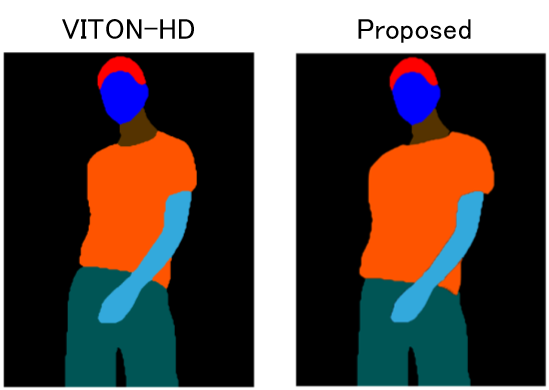
- The proposed method successfully generates virtual try-on images that reflect the actual size of the target clothing, unlike VITON-HD, which defaults to the input garment’s size.
- Subjective evaluation showed that 10 out of 10 users preferred the proposed method for size accuracy, with 8 to 10 users per tester rating it superior in naturalness and fit.
- The system maintains visual quality in critical areas like collars and arm overlaps by correcting boundary distortions through shortest-distance tracking and coordinate adjustment.
- The segmentation map is effectively resized based on the ratio of person-to-clothing dimensions, enabling accurate size mapping without altering the underlying pose or body structure.
- The method improves upon VITON-HD by decoupling clothing size from the input garment’s size, allowing for dynamic size adjustment independent of the original clothing in the image.
- The correction mechanism ensures that the distance between clothing and body parts (e.g., arm and collar) is preserved during enlargement, preventing unnatural separations or overlaps.
Read this paper
Open the full text in the Nubint reader and ask about any passage as you read.
Read this paper on NubintThis review was generated by AI from the original paper. Please check the paper before citing it.