
[Paper Review] Improved motif-scaffolding with SE(3) flow matching
The paper extends FrameFlow with motif-conditioned amortization and motif guidance to perform motif-scaffolding, achieving higher scaffold diversity while maintaining strong designability compared to RFdiffusion.
Protein design often begins with the knowledge of a desired function from a motif which motif-scaffolding aims to construct a functional protein around. Recently, generative models have achieved breakthrough success in designing scaffolds for a range of motifs. However, generated scaffolds tend to lack structural diversity, which can hinder success in wet-lab validation. In this work, we extend FrameFlow, an SE(3) flow matching model for protein backbone generation, to perform motif-scaffolding with two complementary approaches. The first is motif amortization, in which FrameFlow is trained with the motif as input using a data augmentation strategy. The second is motif guidance, which performs scaffolding using an estimate of the conditional score from FrameFlow without additional training. On a benchmark of 24 biologically meaningful motifs, we show our method achieves 2.5 times more designable and unique motif-scaffolds compared to state-of-the-art. Code: https://github.com/microsoft/protein-frame-flow.
Motivation & Objective
- Improve motif-scaffolding by extending SE(3) flow matching to two strategies: motif amortization and motif guidance.
- Compare conditional (amortized) and unconditional (guidance) approaches on a PDB-based motif-scaffolding benchmark.
- Show that FrameFlow variants achieve equivalent or better designability with greater scaffold diversity than RFdiffusion.
- Demonstrate that the lightweight FrameFlow model requires fewer parameters and training resources than current state-of-the-art methods.
Proposed method
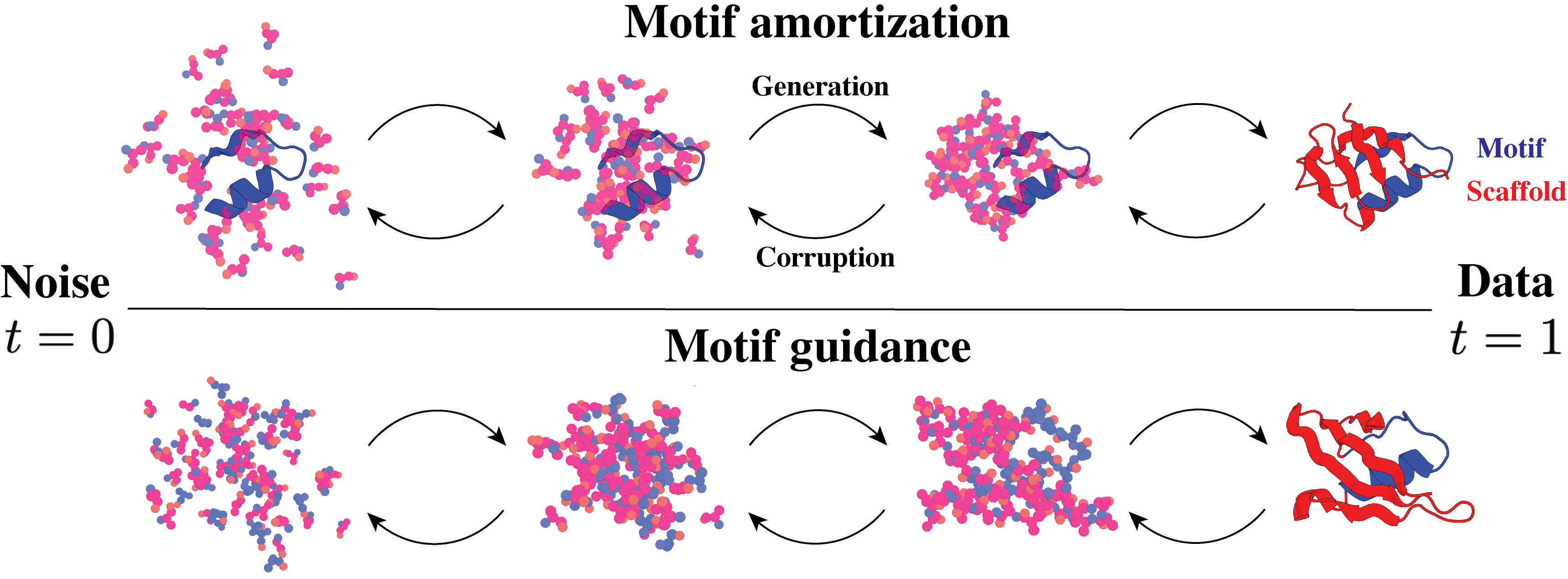
- Extend FrameFlow with motif conditioning to generate scaffolds around a given motif (motif amortization).
- Develop motif guidance by conditioning the sampling trajectory on the motif using an unconditional FrameFlow model (no extra training).
- Model SE(3) backbone representations via Riemannian flow matching with a decomposed vector field over translations and SO(3) rotations.
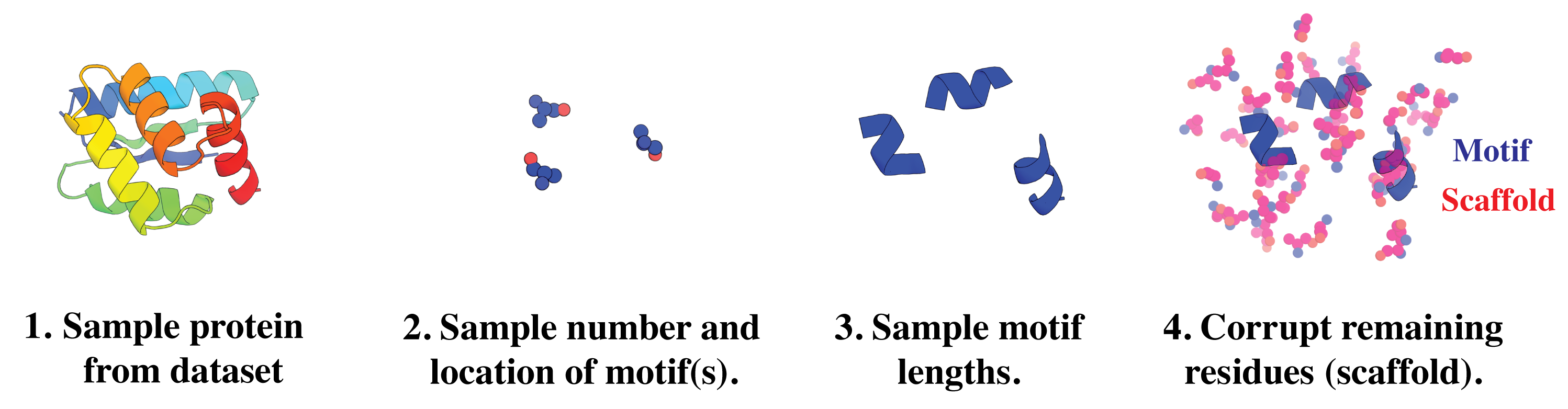
- Train motif-amortized FrameFlow with motif data augmentation to simulate motif distributions from unlabeled PDBs.
- Use 500 timesteps Euler-Maruyama sampling for generation and evaluate using designability and diversity metrics.
- Compare against RFdiffusion and TDS on a motif-scaffolding benchmark.
Experimental results
Research questions
- RQ1Can motif amortization or motif guidance improve motif-scaffolding performance over prior state-of-the-art (RFdiffusion) for SE(3) flow matching?
- RQ2Do conditional (amortized) and unconditional (guidance) approaches differ in designability and scaffold diversity?
- RQ3Does FrameFlow deliver more unique, designable scaffolds per motif while remaining lightweight and trainable?
- RQ4How do unconditional backbone results support the reliability of motif-scaffolding with FrameFlow-guidance?
Key findings
- FrameFlow with motif amortization solves 21 motifs versus 20 for RFdiffusion on the benchmark.
- FrameFlow-guidance solves 20 motifs, matching RFdiffusion performance.
- Across motifs, FrameFlow methods yield 2.5x more unique designable scaffolds than RFdiffusion.
- Unconditional FrameFlow provides comparable designability to RFdiffusion while achieving higher diversity and novelty.
- FrameFlow-conditioned approach uses a 3x smaller network (16.8M vs 59.8M parameters) and no pre-training.
- Motif-scaffolding with FrameFlow achieves larger scaffold diversity than RFdiffusion and TDS in aggregate.
Better researchstarts right now
From reading papers to final review, dramatically reduce your research time.
No credit card · Free plan available
This review was created by AI and reviewed by human editors.