
[Paper Review] Improving Assessment of Tutoring Practices using Retrieval-Augmented Generation
The paper evaluates prompting strategies for GPT models to automatically assess tutors’ social-emotional learning competencies, finding RAG-based prompts best balance accuracy (low hallucination) and cost, especially with GPT-4.
One-on-one tutoring is an effective instructional method for enhancing learning, yet its efficacy hinges on tutor competencies. Novice math tutors often prioritize content-specific guidance, neglecting aspects such as social-emotional learning. Social-emotional learning promotes equity and inclusion and nurturing relationships with students, which is crucial for holistic student development. Assessing the competencies of tutors accurately and efficiently can drive the development of tailored tutor training programs. However, evaluating novice tutor ability during real-time tutoring remains challenging as it typically requires experts-in-the-loop. To address this challenge, this preliminary study aims to harness Generative Pre-trained Transformers (GPT), such as GPT-3.5 and GPT-4 models, to automatically assess tutors' ability of using social-emotional tutoring strategies. Moreover, this study also reports on the financial dimensions and considerations of employing these models in real-time and at scale for automated assessment. The current study examined four prompting strategies: two basic Zero-shot prompt strategies, Tree of Thought prompt, and Retrieval-Augmented Generator (RAG) based prompt. The results indicate that the RAG prompt demonstrated more accurate performance (assessed by the level of hallucination and correctness in the generated assessment texts) and lower financial costs than the other strategies evaluated. These findings inform the development of personalized tutor training interventions to enhance the the educational effectiveness of tutored learning.
Motivation & Objective
- Motivate accurate assessment of tutor social-emotional learning to guide personalized training.
- Explore whether GPT models can reliably evaluate novice tutors’ social-emotional practices from tutoring transcripts.
- Compare prompting strategies (zero-shot, Tree of Thought, RAG) for accuracy and cost in real-time assessment.
Proposed method
- Use real-world middle-school tutoring transcripts (Grade 6-8) from Zoom sessions with novice tutors.
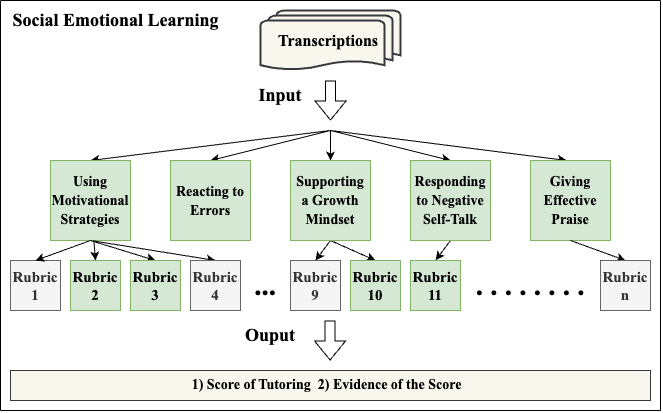
- Develop a rubric based on five social-emotional learning principles to assess tutoring practices.
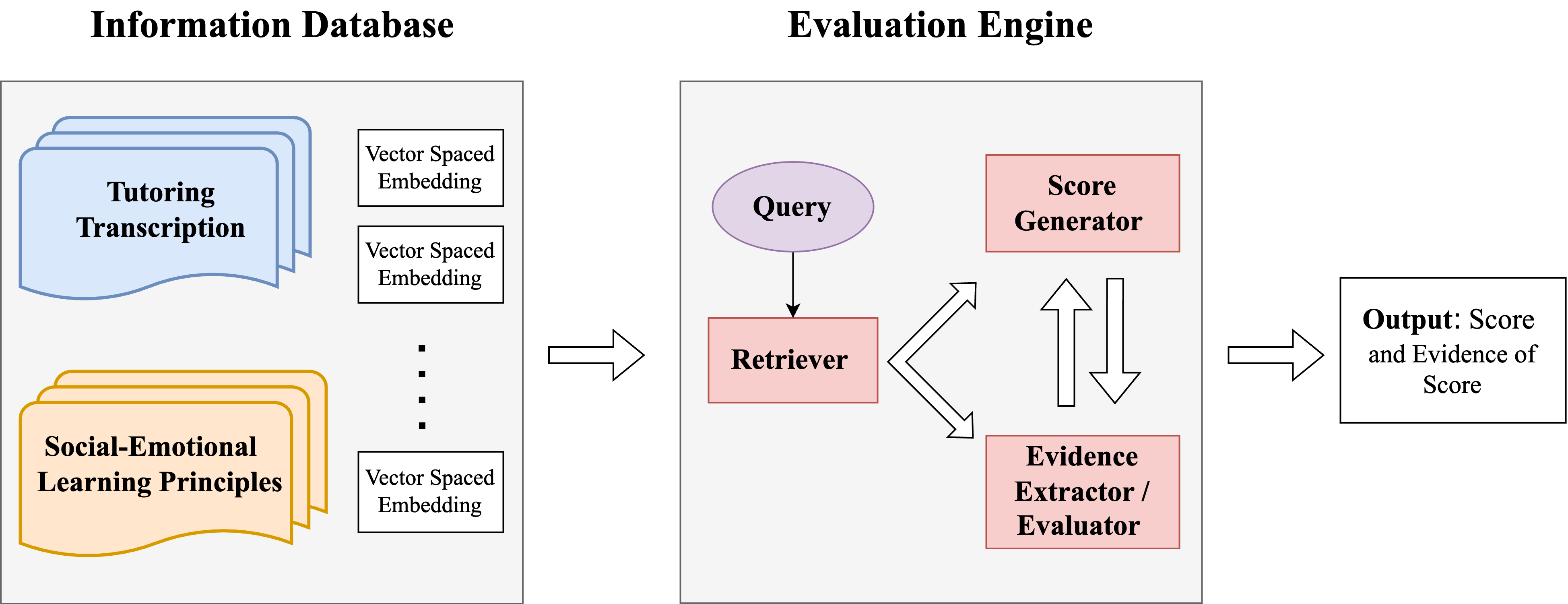
- Design and compare four prompting strategies: two basic zero-shot prompts, Tree of Thought prompt, and Retrieval-Augmented Generator (RAG) prompt.
- Annotate GPT outputs for correctness and hallucination against human judgments.
- Compute cost per evaluation for GPT-3.5 Turbo and GPT-4 Turbo using API pricing.
Experimental results
Research questions
- RQ1RQ1: Can GPT models accurately assess the social-emotional learning competencies of human tutors?
- RQ2RQ2: How do the performance and cost of GPT-3.5 compare to GPT-4 for this task?
Key findings
- RAG prompting yields fewer hallucinations and more correct assessments than other prompts across models.
- GPT-4 generally provides more accurate evaluations than GPT-3.5, with RAG and zero-shot (P1) prompts performing best.
- RAG prompts offer the most cost-efficient evaluation strategy for both GPT-3.5 and GPT-4.
- GPT-3.5 showed occasional hallucinations (e.g., misidentifying responses to negative self-talk).
- GPT-4 results indicate higher overall alignment with human judgments across prompting strategies.
Read this paper
Open the full text in the Nubint reader and ask about any passage as you read.
Read this paper on NubintThis review was generated by AI from the original paper. Please check the paper before citing it.