
[Paper Review] Improving visual image reconstruction from human brain activity using latent diffusion models via multiple decoded inputs
This paper enhances visual image reconstruction from human fMRI data by integrating latent diffusion models (Stable Diffusion) with multiple decoded inputs—text captions, GAN-generated images, and depth maps—derived from brain activity. The method significantly improves reconstruction accuracy across subjects, with average two-way identification accuracy rising from 74.3% to 86.4% when combining all three decoding techniques.
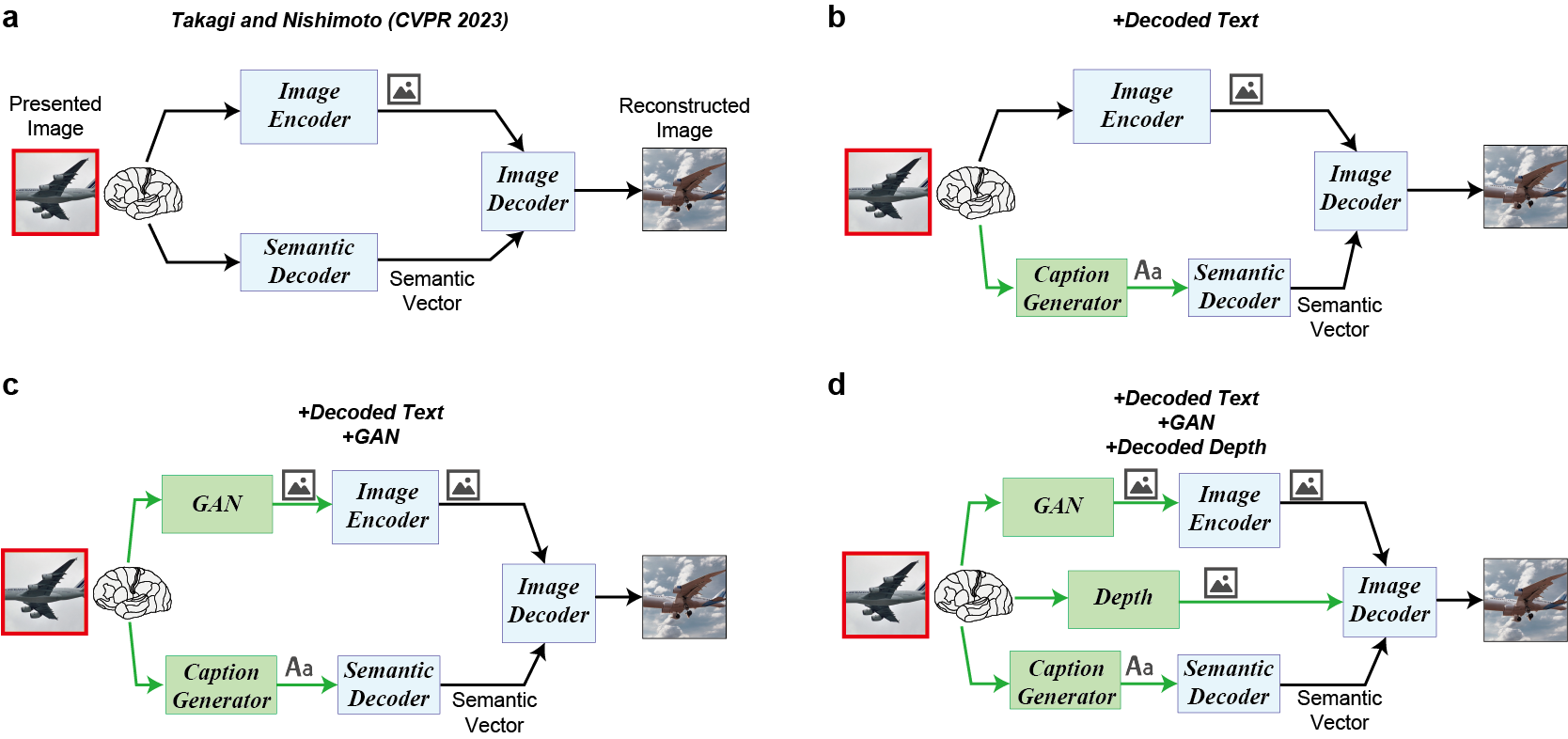
The integration of deep learning and neuroscience has been advancing rapidly, which has led to improvements in the analysis of brain activity and the understanding of deep learning models from a neuroscientific perspective. The reconstruction of visual experience from human brain activity is an area that has particularly benefited: the use of deep learning models trained on large amounts of natural images has greatly improved its quality, and approaches that combine the diverse information contained in visual experiences have proliferated rapidly in recent years. In this technical paper, by taking advantage of the simple and generic framework that we proposed (Takagi and Nishimoto, CVPR 2023), we examine the extent to which various additional decoding techniques affect the performance of visual experience reconstruction. Specifically, we combined our earlier work with the following three techniques: using decoded text from brain activity, nonlinear optimization for structural image reconstruction, and using decoded depth information from brain activity. We confirmed that these techniques contributed to improving accuracy over the baseline. We also discuss what researchers should consider when performing visual reconstruction using deep generative models trained on large datasets. Please check our webpage at https://sites.google.com/view/stablediffusion-with-brain/. Code is also available at https://github.com/yu-takagi/StableDiffusionReconstruction.
Motivation & Objective
- To improve the quality and accuracy of visual image reconstruction from human fMRI data using deep generative models.
- To investigate the impact of incorporating multiple decoded brain activity signals—text, structural image, and depth—on reconstruction performance.
- To provide a quantitative benchmark for evaluating the contribution of each decoding technique in a unified, generalizable framework.
- To assess potential data leakage artifacts from training datasets (e.g., LAION-5B) in fMRI-to-image reconstruction tasks.
- To offer methodological guidance for researchers using large-scale generative models in neuroimaging applications.
Proposed method
- Adapts a prior framework [30] that uses CLIP embeddings from fMRI to condition Stable Diffusion for image generation.
- Introduces text decoding by training a BLIP-based model to predict natural language captions from fMRI activity, which are then used as text prompts for Stable Diffusion.
- Applies GAN-based image reconstruction to generate a structural image prior from fMRI, which is fused with the diffusion model's latent space.
- Incorporates depth map decoding from fMRI using a dedicated regression model, enhancing 3D structural consistency in reconstructions.
- Combines all three decoded inputs (text, GAN image, depth) as multi-modal conditioning signals in the latent diffusion process.
- Employs two-way identification accuracy using Inception-v3, CLIP, and AlexNet features to evaluate reconstruction fidelity across multiple metrics and subjects.
Experimental results
Research questions
- RQ1To what extent does incorporating decoded text from brain activity improve visual image reconstruction quality compared to baseline CLIP embedding conditioning?
- RQ2How does adding a GAN-generated image prior from fMRI activity affect the realism and structural fidelity of reconstructed images?
- RQ3What is the contribution of decoded depth information from brain activity to the perceptual quality and accuracy of reconstructed images?
- RQ4How do the combined effects of multiple decoding techniques compare across different subjects and evaluation metrics?
- RQ5To what extent might data leakage from training datasets (e.g., LAION-5B) bias the evaluation of reconstruction performance?
Key findings
- The integration of decoded text from brain activity (via BLIP) improved two-way identification accuracy by 12.6 percentage points on average (from 74.3% to 88.5%) across subjects.
- Adding GAN-generated image priors further increased accuracy, with the best-performing method (+T+G) achieving 86.4% average accuracy using Inception-v3 features.
- Incorporating depth information from fMRI activity led to a modest but consistent improvement, particularly in structural consistency, with accuracy rising to 84.3% on average.
- The method remained robust to potential data leakage: excluding images from LAION-5B did not alter quantitative results, with identification accuracy remaining stable at 74.3% (previous) and 74.5% (new) using Inception-v3.
- The improvement varied across subjects and feature extractors, indicating that the effectiveness of each decoding technique is not uniform and depends on individual neural representation patterns.
- The combination of all three decoding techniques (+T+G+D) yielded the highest average accuracy (84.3% with Inception-v3), demonstrating synergistic gains from multi-modal brain signal integration.

Read this paper
Open the full text in the Nubint reader and ask about any passage as you read.
Read this paper on NubintThis review was generated by AI from the original paper. Please check the paper before citing it.