
[Paper Review] Incoherent mode division multiplexing for high-security information encryption
This paper proposes incoherent mode division multiplexing using the degree of coherence of structured random light beams as generalized modes for high-security, high-capacity optical information encryption. Unlike coherent methods, it eliminates mode crosstalk and achieves robust, noise-immune image recovery even at signal-to-noise ratios as low as -13.55 dB, with structural similarity indices (SSIM) exceeding 0.90 in experiments and 0.92 in simulations.
In the age of information explosion, the conventional optical communication protocols are rapidly reaching the limits of their capacity, as almost all available degrees of freedom (e.g., wavelength, polarization) for division multiplexing have been explored to date. Recent advances in coherent mode division multiplexing have greatly facilitated high-speed optical communications and secure, high-capacity information storage and transfer. However, coherent mode division multiplexing is quite vulnerable to even minute environmental disturbances which can cause significant information loss. Here, we propose and experimentally demonstrate a paradigm shift to incoherent mode division multiplexing for high-security optical information encryption by harnessing the degree of coherence of structured random light beams. In contrast to the conventional techniques, our approach does not require mode orthogonality to circumnavigate unwanted mode crosstalk. In addition, our protocol has, in principle, no upper bound on its capacity. Thanks to the extreme robustness of structured random light to external perturbations, we are able to achieve highly accurate information encryption and decryption in the adverse environment. The proposed protocol opens new horizons in an array of fields, such as optical communications and cryptography, and it can be relevant for information processing with acoustical, matter as well as other types of waves.
Motivation & Objective
- To overcome the limitations of coherent mode division multiplexing, which suffers from severe mode crosstalk and environmental sensitivity in practical optical communication systems.
- To develop a noise-resilient optical encryption protocol that maintains high fidelity under strong environmental disturbances such as turbulence or scattering.
- To exploit the inherent robustness of structured random light beams—characterized by their degree of coherence—to enable high-capacity, secure information encoding without requiring mode orthogonality.
- To demonstrate a practical, experimentally validated method for optical information encryption and decryption that is resilient to signal degradation and does not require pre- or post-correction.
- To extend the applicability of this technique beyond optics to other wave systems, including acoustical, seismic, and matter waves, via metasurface-based control.
Proposed method
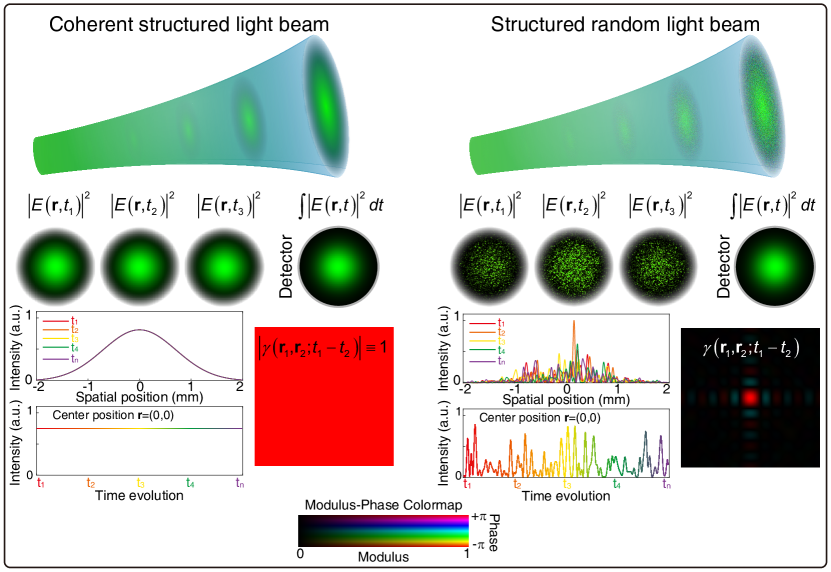
- The protocol uses the complex degree of coherence of a random light beam as a generalized mode, replacing traditional orthogonal modes such as orbital angular momentum states.
- Spatial light modulators (SLMs) are employed to shape the degree of coherence of the light beam on demand, enabling customizable encoding of information.
- Optical holography principles are applied to control and tailor the second-order correlation functions of the light field, forming the basis of the encryption key.
- The information is encoded in the spatial and temporal correlation functions of the light field, which are inherently immune to phase distortions and amplitude fluctuations.
- Decryption involves reconstructing both the magnitude and phase of the degree of coherence from measured intensity patterns through mathematical inversion, ensuring security.
- The method is extendable to multiplexing with additional degrees of freedom such as wavelength or polarization to further increase capacity.
Experimental results
Research questions
- RQ1Can the degree of coherence of structured random light beams serve as a stable, high-capacity degree of freedom for optical information encoding without requiring mode orthogonality?
- RQ2To what extent can incoherent mode division multiplexing maintain information fidelity under strong environmental noise and signal degradation?
- RQ3How does the security of the encryption protocol compare to conventional methods, particularly in terms of resistance to direct measurement of the ciphertext?
- RQ4Can the proposed method be generalized to other wave systems such as acoustical or seismic waves using metasurface technology?
- RQ5What is the theoretical and practical upper bound on information capacity in such a system, given the unlimited number of generalized modes?
Key findings
- The protocol achieves high-fidelity image recovery even at a signal-to-noise ratio (SNR) of -13.55 dB, where only 4.2% of the total energy is signal, demonstrating extreme robustness to noise.
- The structural similarity index (SSIM) for the experimentally recovered image reached 0.9077, indicating high visual quality and accuracy despite severe noise.
- The SSIM decreased only slightly from 0.9314 to 0.9077 as the signal energy fraction dropped from 100% to 4.2%, confirming resilience to signal degradation.
- The method enables secure information encryption because the ciphertext is encoded in the second-order correlation function (degree of coherence), which cannot be directly measured and requires full phase and amplitude reconstruction for decryption.
- The experimental results closely match simulations, with SSIM values of 0.92 in simulations and 0.90 in experiments, validating the protocol's reliability.
- The approach is inherently scalable with no theoretical upper limit on capacity due to the unlimited number of generalized modes defined by the degree of coherence.
Better researchstarts right now
From reading papers to final review, dramatically reduce your research time.
No credit card · Free plan available
This review was created by AI and reviewed by human editors.