
[Paper Review] Information-Theoretic Limits on Compression of Semantic Information
This paper establishes information-theoretic limits for lossless and lossy compression of semantic sources modeled as correlated random variables via Bayesian networks. It proves that optimal compression under side information is achieved by separately optimizing conditionally independent subsets, deriving closed-form rate-distortion functions for binary and Gaussian semantic sources.
As conventional communication systems based on classic information theory have closely approached the limits of Shannon channel capacity, semantic communication has been recognized as a key enabling technology for the further improvement of communication performance. However, it is still unsettled on how to represent semantic information and characterise the theoretical limits. In this paper, we consider a semantic source which consists of a set of correlated random variables whose joint probabilistic distribution can be described by a Bayesian network. Then we give the information-theoretic limit on the lossless compression of the semantic source and introduce a low complexity encoding method by exploiting the conditional independence. We further characterise the limits on lossy compression of the semantic source and the corresponding upper and lower bounds of the rate-distortion function. We also investigate the lossy compression of the semantic source with side information at both the encoder and decoder, and obtain the rate distortion function. We prove that the optimal code of the semantic source is the combination of the optimal codes of each conditional independent set given the side information.
Motivation & Objective
- To establish theoretical foundations for semantic source compression, addressing the lack of formal information theory for semantic communication.
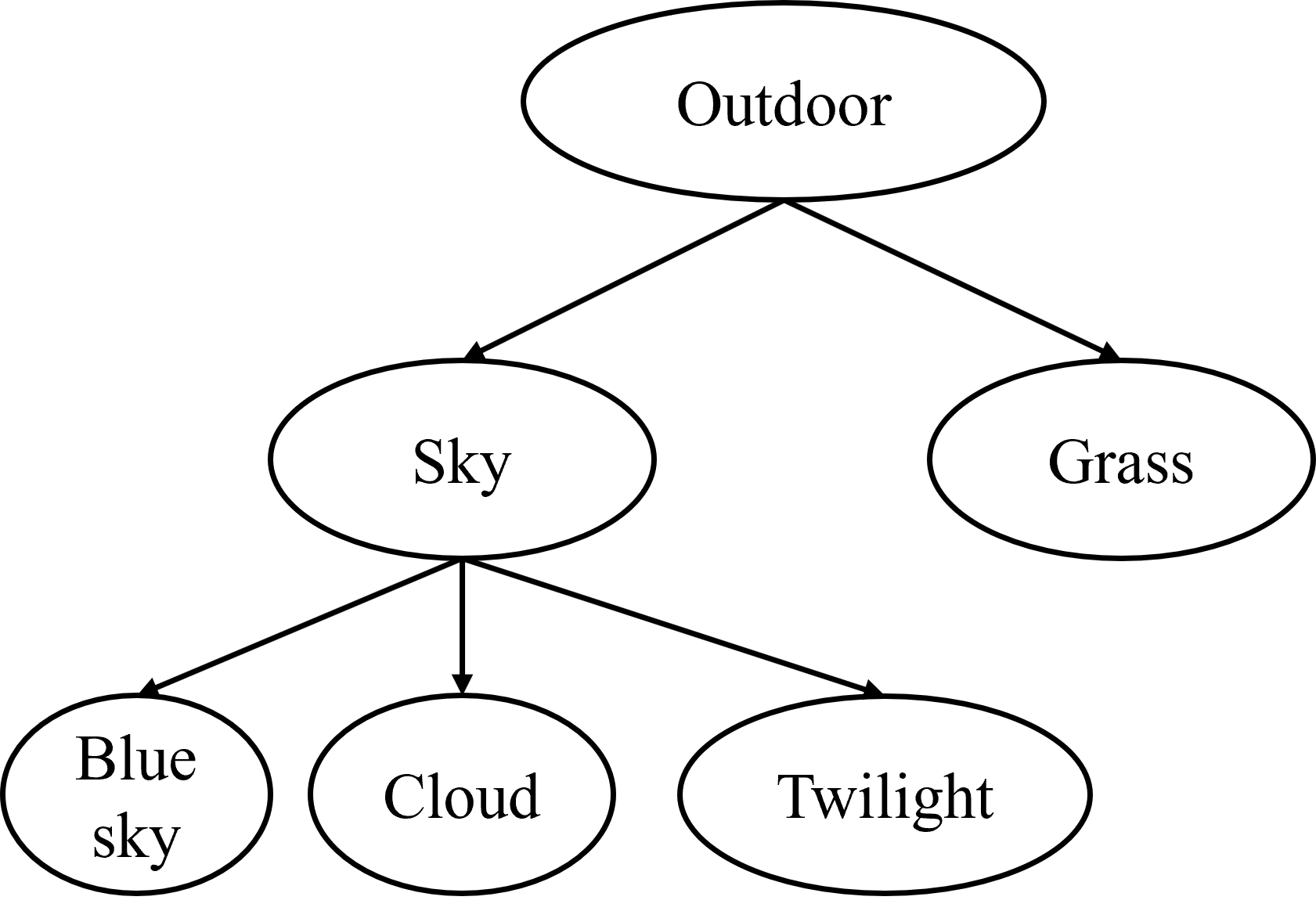
- To model semantic sources as correlated random variables with joint distributions described by Bayesian networks (BNs).
- To characterize the information-theoretic limits of lossless and lossy compression of such semantic sources.
- To investigate lossy compression with side information at both encoder and decoder, and derive the corresponding rate-distortion function.
- To prove that optimal compression is achieved by independently encoding conditionally independent subsets given side information.
Proposed method
- Models semantic sources as a set of correlated random variables whose joint distribution is represented by a Bayesian network (BN).
- Uses conditional independence structure in the BN to decompose the compression problem into independent subproblems.
- Derives the rate-distortion function for lossy compression by leveraging conditional entropy and distortion measures.
- Applies Shannon's rate-distortion theory to conditionally independent subsets given side information, proving additivity of optimal rates.
- Derives closed-form expressions for the conditional rate-distortion function for binary sources using binary entropy function $ h_b(p) $.
- Derives the rate-distortion function for Gaussian sources using mean-squared error distortion and multivariate Gaussian conditional distributions.
Experimental results
Research questions
- RQ1What are the information-theoretic limits on lossless compression of a semantic source modeled as a Bayesian network?
- RQ2How can the rate-distortion function be characterized for lossy compression of semantic sources with correlated semantic elements?
- RQ3What is the optimal compression strategy when side information is available at both encoder and decoder?
- RQ4Can the rate-distortion function be decomposed into independent components based on conditional independence in the BN?
- RQ5What are the closed-form expressions for the rate-distortion function when semantic elements follow binary or Gaussian distributions?
Key findings
- The optimal code for a semantic source with side information at both encoder and decoder is the sum of the optimal codes for each conditionally independent set given the side information.
- For binary semantic sources, the conditional rate-distortion function is $ R_{X_i|Y}(D_i) = [h_b(p_i) - h_b(D_i)] $ for $ 0 \leq D_i \leq p_i $, where $ h_b $ is the binary entropy function.
- For Gaussian semantic sources, the conditional rate-distortion function is $ R_{X_i|Y}(D_i) = \left[\frac{1}{2}\log\frac{\sigma_{X_i}^2(1-r_i^2)}{D_i}\right] $ for $ 0 \leq D_i \leq \sigma_{X_i}^2(1-r_i^2) $.
- The rate-distortion function for the full semantic source is the sum of the individual conditional rate-distortion functions of the conditionally independent components.
- The theoretical bounds on the rate-distortion function are tight and achievable under the proposed encoding strategy.
- The framework provides a principled, information-theoretic foundation for designing semantic communication systems with provable performance limits.
Read this paper
Open the full text in the Nubint reader and ask about any passage as you read.
Read this paper on NubintThis review was generated by AI from the original paper. Please check the paper before citing it.