
[Paper Review] Investigating the $M_{GCS}-M_h$ Relation in the Most Massive Galaxies
This study investigates the $M_{GCS}$-$M_h$ relation in the most massive galaxies using a standardized method to measure globular cluster system (GCS) mass within 0.1$R_{\text{vir}}$ and weak-lensing calibrated halo masses for 11 brightest cluster galaxies (BCGs). It finds a nearly linear $M_{GCS}/M_h = (3.0 \pm 1.8) \times 10^{-5}$ ratio at the high-mass end, confirming the relation's continuation into the $10^{14}M_\odot$ halo mass regime and supporting a dominant role for accreted globular clusters in massive galaxy assembly.
The relation between the total mass contained in the globular clusters of a galaxy and the mass of its dark matter halo has been found observationally to be nearly linear over five decades of mass. However, the high-mass end of this relation is not well determined from previous data and shows large scatter. We analyze the globular cluster systems (GCSs) of a homogeneous sample of 11 brightest cluster galaxies (BCGs) through DOLPHOT photometry of their deep Hubble Space Telescope (HST) images in the F814W filter. We standardize the definition of $M_{GCS}$, the total GCS mass, by using the GC total population within a limiting radius of $0.1 R_{virial}$, while the dark-matter halo mass $M_h$ is determined from the weak-lensing calibration of $M_h$ versus $M_{bary}$. When these 11 BCGs are added to the previously studied homogeneous catalogue of Virgo member galaxies, a total value for $η= M_{GCS}/M_h$ is found to be $(3.0\pm1.8_{internal}) imes10^{-5}$, slightly higher than previous estimates but with much reduced uncertainty. Perhaps more importantly, the results suggest that the relation continues to have a near-linear shape at the highest galaxy masses, strongly reinforcing the conclusion that accreted GCs make a major contribution to the GC populations at high galaxy mass.
Motivation & Objective
- To constrain the $M_{GCS}$-$M_h$ relation at the high-mass end, where observational data are sparse and scatter is large.
- To standardize the definition of $M_{GCS}$ using a consistent limiting radius ($0.1R_{\text{vir}}$) across BCGs to reduce measurement bias.
- To improve the accuracy of $M_h$ estimates by applying weak-lensing calibrated $M_h$ versus $M_{\text{bary}}$ relations.
- To test whether the $M_{GCS}$-$M_h$ relation remains linear at halo masses above $10^{14}M_\odot$, challenging previous uncertainties.
- To assess the implications for galaxy formation, particularly the role of accretion in building massive galaxy halos.
Proposed method
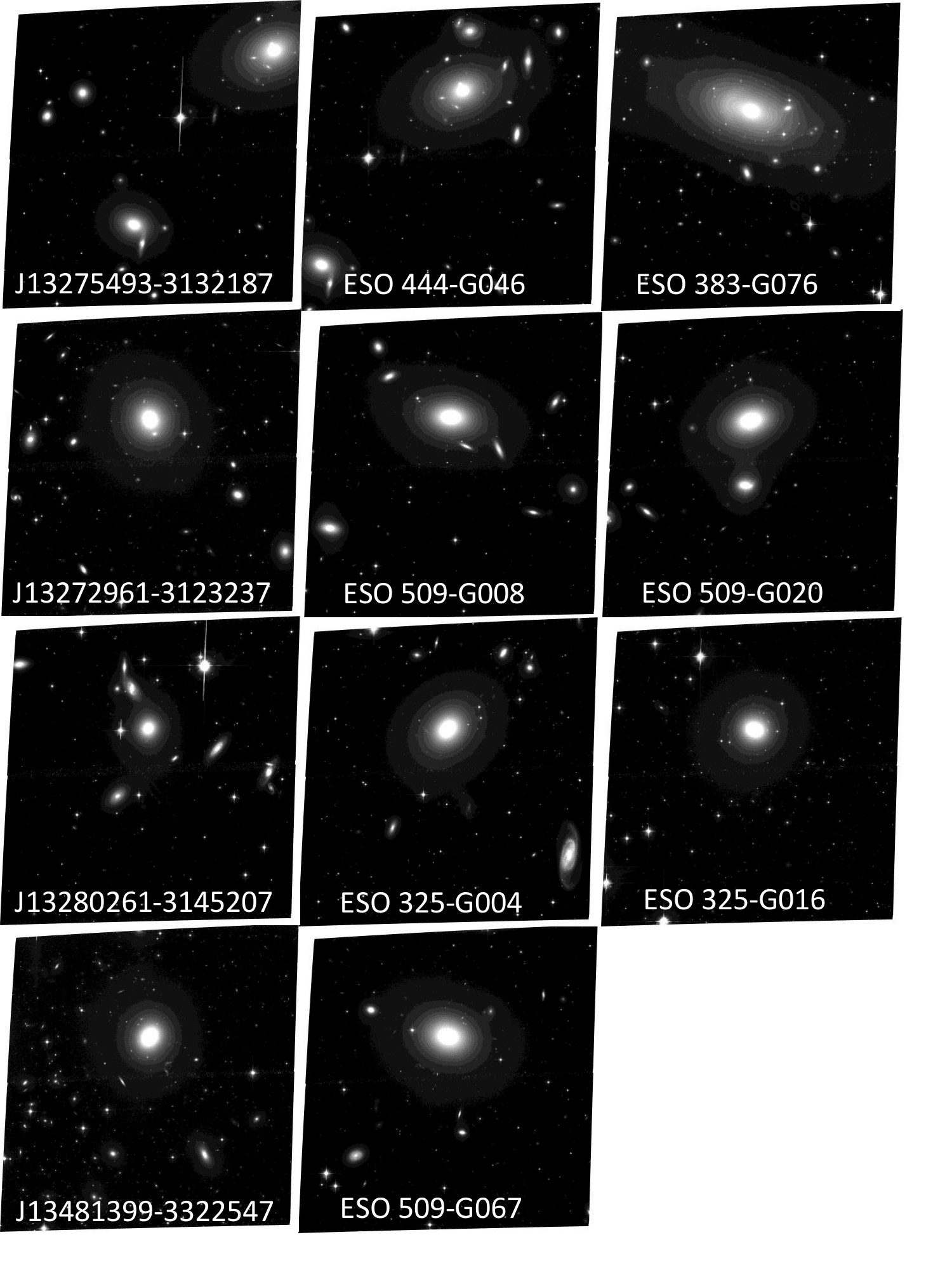
- Acquired deep Hubble Space Telescope (HST) F814W images for 11 BCGs from program ID 10429 and the Hubble Frontier Fields.
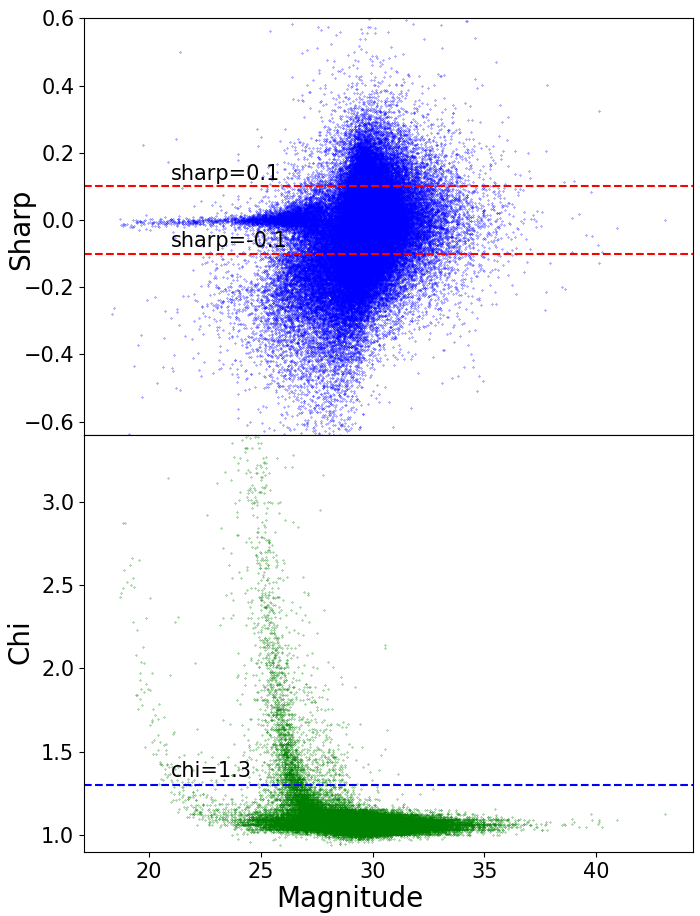
- Used DOLPHOT photometry to detect and measure individual globular clusters in the HST images.
- Defined $M_{GCS}$ as the total mass of GCs within $0.1R_{\text{vir}}$ to standardize the measurement and minimize contamination from intracluster medium GCs.
- Calculated halo masses ($M_h$) via weak-lensing calibrated $M_h$-$M_{\text{bary}}$ relations, using stellar mass estimates from photometry.
- Combined the new BCG data with a literature catalog of Virgo cluster galaxies to extend the dynamic range of the $M_{GCS}$-$M_h$ relation.
- Performed log-log regression to assess the linearity and scatter of the $M_{GCS}$-$M_h$ relation across the full mass range.
Experimental results
Research questions
- RQ1Does the $M_{GCS}$-$M_h$ relation remain linear at the highest galaxy masses, specifically above $10^{14}M_\odot$?
- RQ2How does standardizing the $M_{GCS}$ definition within $0.1R_{\text{vir}}$ affect the consistency and accuracy of the $M_{GCS}$-$M_h$ relation?
- RQ3What is the revised value of the mass ratio $\eta = M_{GCS}/M_h$ when using homogeneous data and standardized methods?
- RQ4To what extent do accreted globular clusters contribute to the GCSs of the most massive galaxies?
- RQ5How does the intrinsic scatter of the $M_{GCS}$-$M_h$ relation behave at the high-mass end, and what does it imply for galaxy formation models?
Key findings
- The $M_{GCS}/M_h$ ratio is measured as $(3.0 \pm 1.8_{\text{internal}}) \times 10^{-5}$, slightly higher than prior estimates but with significantly reduced uncertainty due to standardized methodology.
- The $M_{GCS}$-$M_h$ relation maintains a nearly linear shape across the full mass range, from $M_h \sim 10^{11}M_\odot$ to $M_h > 10^{14}M_\odot$, confirming linearity at the high-mass end.
- The standardization of $M_{GCS}$ within $0.1R_{\text{vir}}$ reduces contamination from intracluster medium GCs and enables more consistent cross-study comparisons.
- The results strongly support the hypothesis that accreted globular clusters make a major contribution to the GC populations of massive galaxies, especially BCGs.
- The intrinsic scatter of the relation remains poorly constrained, with external uncertainties dominated by stellar mass-to-light ratio and $M_{\text{bary}}$-$M_h$ calibration.
- The findings are consistent with theoretical models predicting a linear $M_{GCS}$-$M_h$ relation at $z=0$ due to the central limit theorem, even if the relation was not linear at formation.
Read this paper
Open the full text in the Nubint reader and ask about any passage as you read.
Read this paper on NubintThis review was generated by AI from the original paper. Please check the paper before citing it.