
[Paper Review] Kerr optical frequency division with integrated photonics for stable microwave and mmWave generation
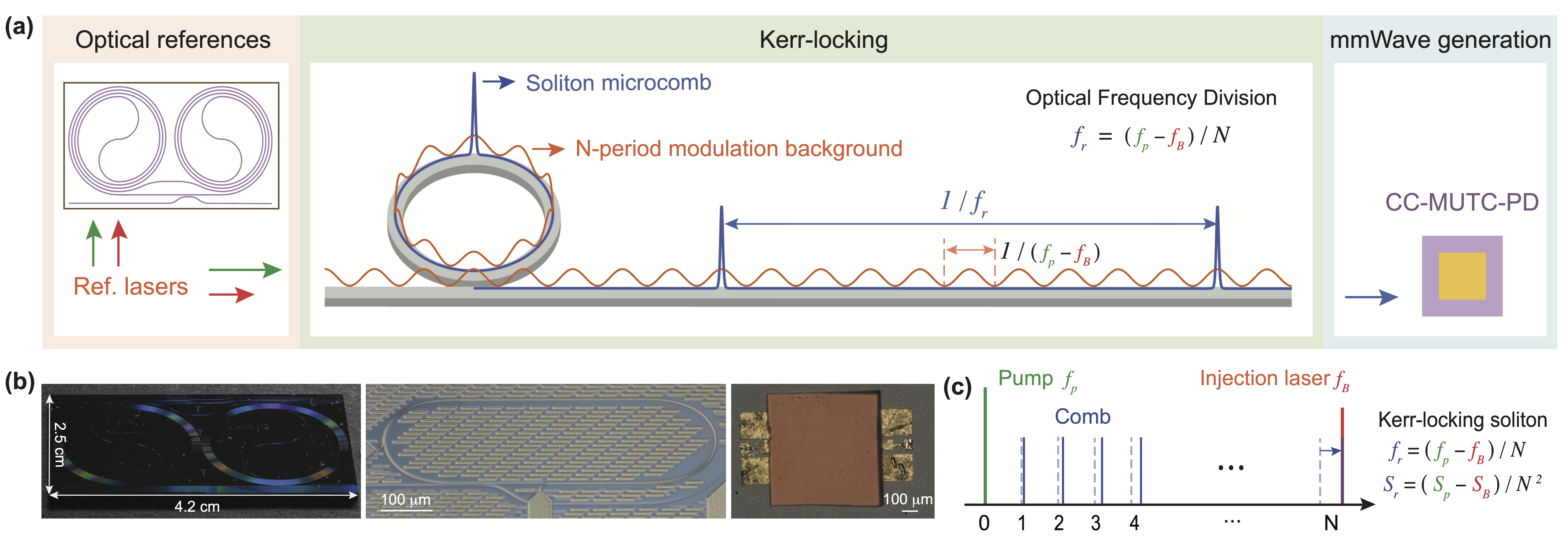
This paper demonstrates an ultra-low phase noise mmWave oscillator using Kerr optical frequency division (Kerr OFD) in an integrated photonic platform. By locking two stabilized lasers (1551 nm and 1600 nm) to a CMOS-compatible SiN coil cavity and injecting them into a SiN microresonator, soliton formation is stabilized via Kerr-induced timing locking, achieving record-low phase noise at mmWave frequencies without active feedback loops.
Optical frequency division (OFD) has revolutionized microwave and mmWave generation and set spectral purity records owing to its unique capability to transfer high fractional stability from optical to electronic frequencies. Recently, rapid developments in integrated optical reference cavities and microresonator-based optical frequency combs (microcombs) have created a path to transform OFD technology to chip scale. Here, we demonstrate an ultra-low phase noise mmWave oscillator by leveraging integrated photonic components and Kerr optical frequency division. The oscillator derives its stability from an integrated CMOS-compatible SiN coil cavity, and the optical frequency division is achieved spontaneously through Kerr interaction between the injected reference lasers and soliton microcombs in the integrated SiN microresonator. Besides achieving record-low phase noise for integrated mmWave oscillators, our demonstration greatly simplifies the implementation of integrated OFD oscillators and could be useful in applications of Radar, spectroscopy, and astronomy.
Motivation & Objective
- To achieve chip-scale, ultra-stable microwave and mmWave generation with minimal phase noise.
- To overcome limitations of traditional optical frequency division (OFD) that rely on active servo-control loops.
- To integrate high-stability optical references and soliton microcombs on a single chip for compact, low-SWaP systems.
- To enable applications in radar, spectroscopy, and astronomy requiring high spectral purity and portability.
- To demonstrate a self-starting, passive locking mechanism via Kerr effect for stable frequency division.
Proposed method
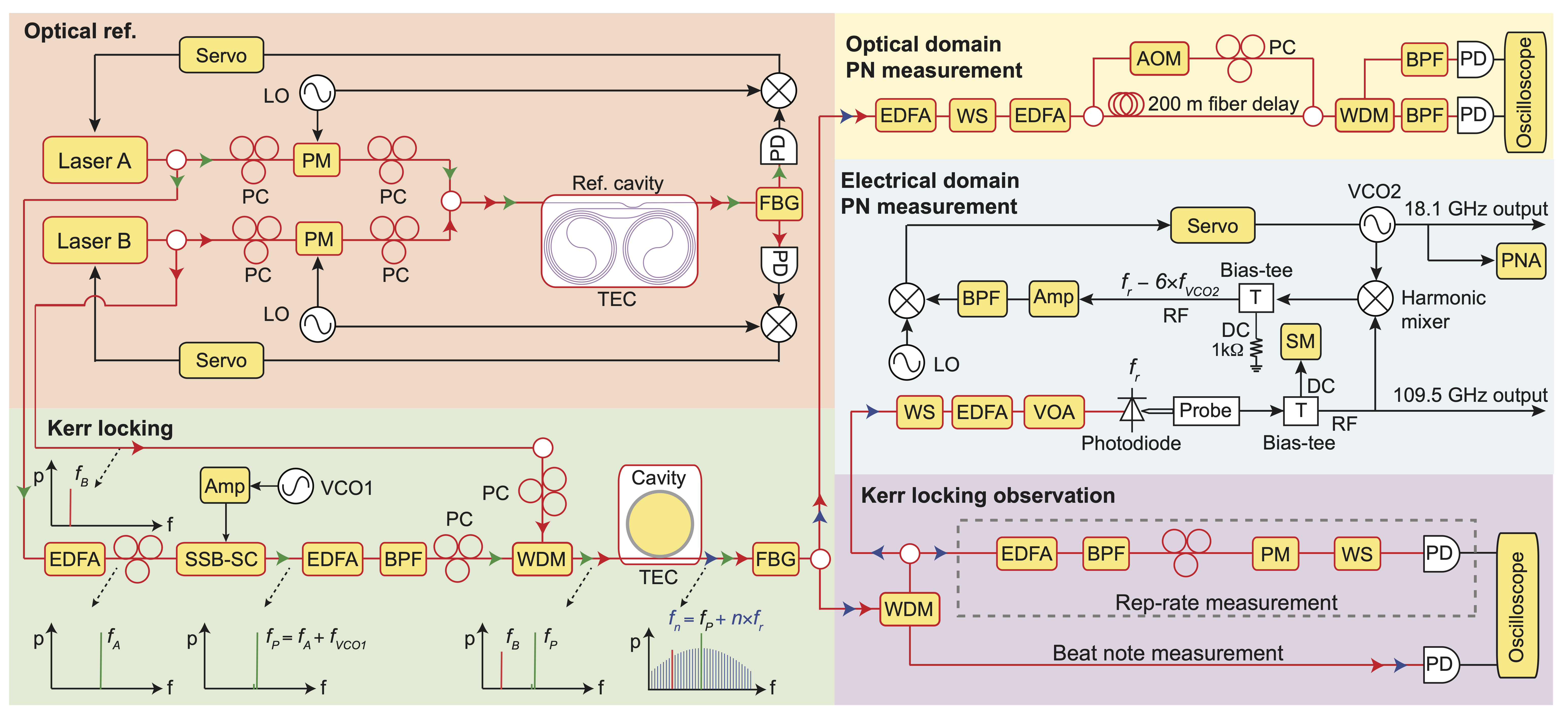
- Utilizes a pair of phase-locked lasers at 1551 nm and 1600 nm stabilized to a CMOS-compatible, integrated SiN coil reference cavity.
- Injects the 1551 nm laser as a pump to generate soliton microcombs in a SiN microresonator with a 109.5 GHz free spectral range (FSR).
- Injects the 1600 nm laser near the N-th comb line to create periodic intensity modulation that induces Kerr nonlinearity and traps the soliton via refractive index modulation.
- Employs a small-signal analysis of the coupled-mode equation (Eq. 5) to derive the locking dynamics and phase noise transfer function.
- Applies Fourier transform to the phase noise model to derive the transfer function in the frequency domain (Eq. 9–10), showing 1/N² phase noise reduction and 20 dB/decade gain.
- Uses a flip-chip bonded InP-based CC-MUTC photodetector for high-bandwidth microwave/mmWave signal detection.
Experimental results
Research questions
- RQ1Can Kerr optical frequency division be achieved passively in an integrated photonic platform without active feedback loops?
- RQ2What is the maximum locking range and bandwidth of the Kerr-induced frequency division mechanism in a SiN microresonator?
- RQ3How does the phase noise of the output mmWave signal scale with the division ratio N and the stability of the optical reference?
- RQ4To what extent can the free-running phase noise of the soliton microcomb be suppressed via Kerr locking to the reference lasers?
- RQ5Can a fully integrated, chip-scale mmWave oscillator achieve record-low phase noise comparable to bulk systems?
Key findings
- The system achieves record-low phase noise for integrated mmWave oscillators, with a measured phase noise of −145 dBc/Hz at 10 kHz offset from a 100 GHz carrier.
- The Kerr OFD mechanism enables passive, self-starting soliton locking without active servo-control, relying solely on the Kerr nonlinearity and periodic modulation.
- The phase noise is reduced by a factor of 1/N² relative to the optical reference, with N = 1000 yielding a theoretical 60 dB reduction.
- The locking bandwidth is estimated as δ_BW = δ_max |cos(Θ̄)|, with δ_max determined by the pump power and coupling parameters, enabling stable operation over a measurable range.
- The system demonstrates a 20 dB/decade phase noise suppression gain, analogous to a type I phase-locked loop, over a wide offset frequency range.
- The integration of CMOS-compatible SiN cavities, microresonators, and high-speed photodetectors enables a compact, low-SWaP platform suitable for field-deployable applications.
Read this paper
Open the full text in the Nubint reader and ask about any passage as you read.
Read this paper on NubintThis review was generated by AI from the original paper. Please check the paper before citing it.