
[Paper Review] Knowledge of cultural moral norms in large language models
This study investigates whether monolingual English large language models (LLMs) encode cultural moral norms across 55 countries using World Values Survey and Pew Global Attitudes data. Fine-tuning on cross-cultural survey data improves LLMs' accuracy in predicting global moral norms—especially for non-Western countries—but at the cost of reduced accuracy on English-specific moral norms, revealing a trade-off between cultural diversity and homogeneous norm representation.
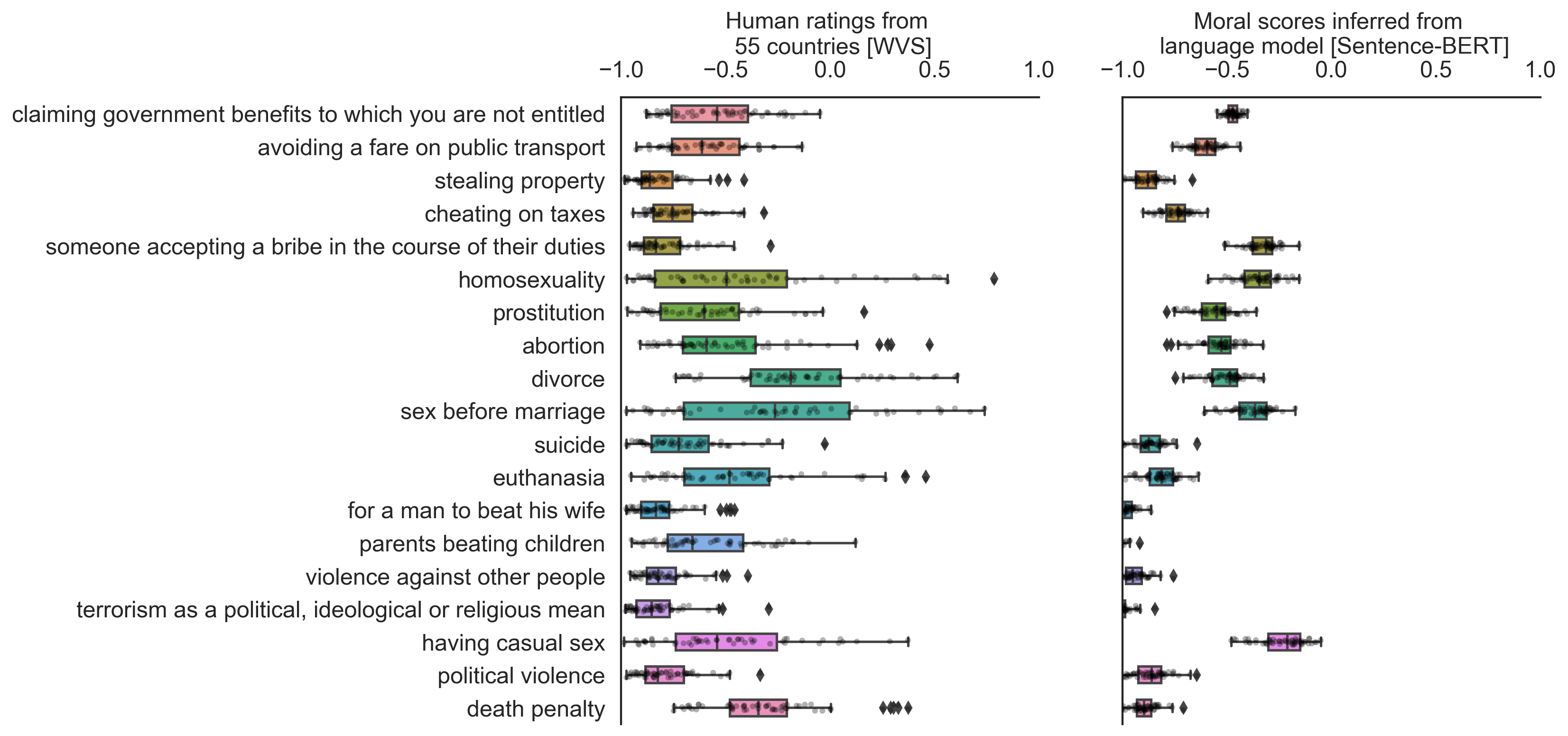
Moral norms vary across cultures. A recent line of work suggests that English large language models contain human-like moral biases, but these studies typically do not examine moral variation in a diverse cultural setting. We investigate the extent to which monolingual English language models contain knowledge about moral norms in different countries. We consider two levels of analysis: 1) whether language models capture fine-grained moral variation across countries over a variety of topics such as ``homosexuality'' and ``divorce''; 2) whether language models capture cultural diversity and shared tendencies in which topics people around the globe tend to diverge or agree on in their moral judgment. We perform our analyses with two public datasets from the World Values Survey (across 55 countries) and PEW global surveys (across 40 countries) on morality. We find that pre-trained English language models predict empirical moral norms across countries worse than the English moral norms reported previously. However, fine-tuning language models on the survey data improves inference across countries at the expense of a less accurate estimate of the English moral norms. We discuss the relevance and challenges of incorporating cultural knowledge into the automated inference of moral norms.
Motivation & Objective
- To assess whether monolingual English LLMs encode knowledge of cultural moral norms across diverse countries.
- To investigate whether LLMs can capture both fine-grained moral variation and shared moral tendencies across cultures.
- To evaluate the trade-off between accurate representation of English moral norms and broader cultural diversity in LLMs.
- To explore the risks of bias introduction when fine-tuning LLMs on global moral survey data.
Proposed method
- Probing pre-trained English LLMs (e.g., GPT-2, Sentence-BERT) using country-specific moral statements from the World Values Survey (WVS) and Pew Global Attitudes Survey.
- Using country-level average moral ratings from surveys as a proxy for cultural moral norms.
- Fine-tuning LLMs on WVS and Pew datasets using random and class-balanced sampling strategies to improve cross-cultural inference.
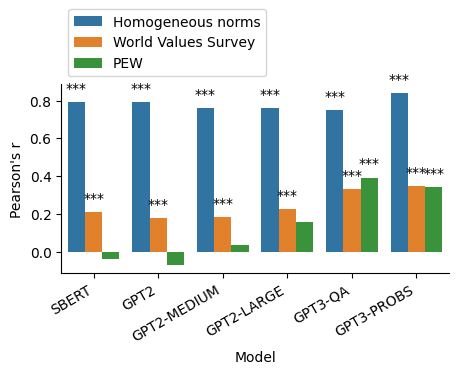
- Evaluating model performance via Pearson correlation (r) between model-estimated and empirical moral norms across countries.
- Comparing model predictions across cultural groups (Western vs. non-Western) to assess bias and generalization.
- Analyzing the trade-off between performance on homogeneous (English) norms and cross-cultural norms after fine-tuning.
Experimental results
Research questions
- RQ1To what extent do English pre-trained language models reflect fine-grained moral variation across 55 countries?
- RQ2Can English LLMs infer shared moral universals and cultural divergences in moral judgments across global populations?
- RQ3How does fine-tuning on global moral survey data affect the model’s ability to predict both English-specific and cross-cultural moral norms?
- RQ4What biases are introduced when LLMs are fine-tuned on survey data reflecting potentially skewed or perspective-laden cultural narratives?
Key findings
- Pre-trained English LLMs predict global moral norms with lower accuracy than previously reported for English norms, particularly for non-Western countries.
- Fine-tuning on WVS and Pew datasets significantly improves cross-cultural moral norm prediction, achieving Pearson correlation coefficients of r = 0.893 (WVS, Random strategy) and r = 0.944 (PEW, Random strategy).
- The best-performing fine-tuned model (WVS with Random strategy) outperforms others in predicting norms across all country groups, including non-Western nations.
- Despite improvements, a performance gap remains between Western and non-Western countries, indicating persistent bias in model representations.
- Fine-tuning reduces the model’s accuracy in estimating English-specific moral norms, demonstrating a clear trade-off between cultural diversity and homogeneous norm representation.
- The study identifies a risk of introducing new social and cultural biases through fine-tuning on survey data, especially when data reflects dominant cultural perspectives.
Read this paper
Open the full text in the Nubint reader and ask about any passage as you read.
Read this paper on NubintThis review was generated by AI from the original paper. Please check the paper before citing it.