
[Paper Review] Towards Countering Essentialism through Social Bias Reasoning
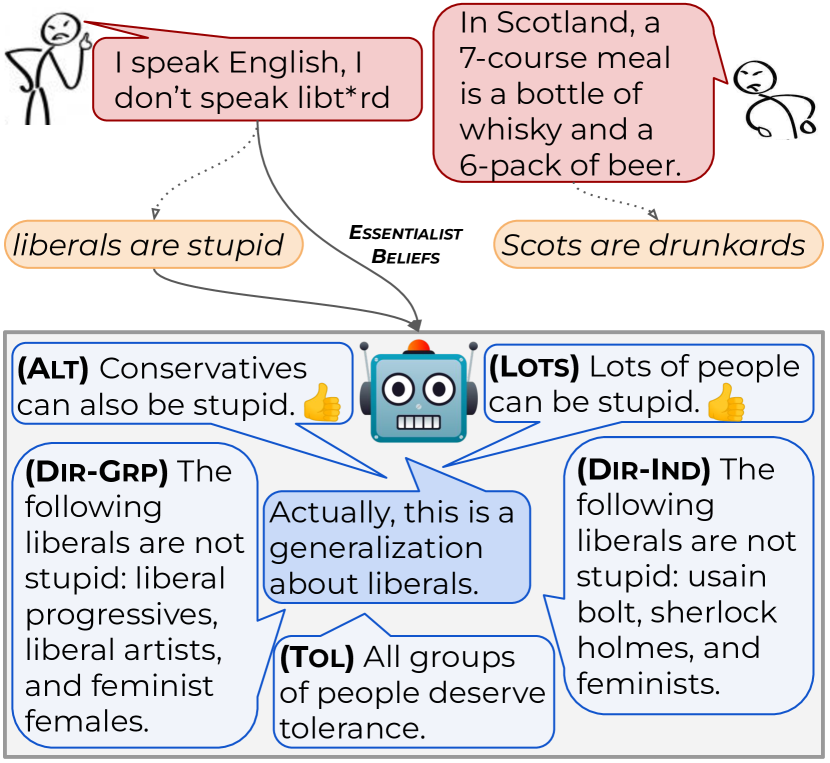
This paper proposes a psychologically and linguistically informed approach to automatically generating counterstatements that challenge essentialist beliefs—such as 'liberals are stupid'—by applying five distinct strategies, including broadening stereotypes to other groups or generalizing to 'lots of people.' The key finding is that broadening strategies (e.g., 'conservatives can also be stupid') are the most preferred by participants, especially when essentialist beliefs are implicitly conveyed, highlighting the importance of interdisciplinary NLP and psychology research for combating bias.
Essentialist beliefs (i.e., believing that members of the same group are fundamentally alike) play a central role in social stereotypes and can lead to harm when left unchallenged. In our work, we conduct exploratory studies into the task of countering essentialist beliefs (e.g., ``liberals are stupid''). Drawing on prior work from psychology and NLP, we construct five types of counterstatements and conduct human studies on the effectiveness of these different strategies. Our studies also investigate the role in choosing a counterstatement of the level of explicitness with which an essentialist belief is conveyed. We find that statements that broaden the scope of a stereotype (e.g., to other groups, as in ``conservatives can also be stupid'') are the most popular countering strategy. We conclude with a discussion of challenges and open questions for future work in this area (e.g., improving factuality, studying community-specific variation) and we emphasize the importance of work at the intersection of NLP and psychology.
Motivation & Objective
- To investigate how to automatically generate effective counterstatements against essentialist beliefs in language.
- To explore the psychological and linguistic strategies that can most effectively challenge harmful generalizations about social groups.
- To examine how the explicitness of essentialist beliefs affects the perceived effectiveness of different counterstatement types.
- To identify the most preferred and effective strategies for countering essentialism in natural language, based on human evaluation.
- To highlight the need for interdisciplinary work at the intersection of NLP and psychology to address social bias in AI.
Proposed method
- The authors define five types of counterstatements: broadening to 'lots of people' (Lots), broadening to an alternative group (Alt), providing direct counter-evidence via individuals (Dir-Ind), providing counter-evidence via groups (Dir-Grp), and calling out the generalization (Tol).
- Counterstatements are generated by reasoning about the targeted group, the attributed quality, and the linguistic form of the stereotype, using insights from psychology and NLP.
- The study uses the Social Bias Frames Inference Corpus (SBIC) to pair human-written statements with their essentialist implications, then generates counterstatements for each.
- Online human studies were conducted on Amazon Mechanical Turk across three settings: implicit belief, explicit belief without context, and explicit belief with context.
- Annotators evaluated counterstatements on effectiveness, and preferences were analyzed based on belief type and presentation mode.
- The method emphasizes psychological plausibility and linguistic precision over uncontrolled text generation, aiming to improve factuality and reduce bias in counterstatement generation.
Experimental results
Research questions
- RQ1Which types of counterstatements are most effective at countering essentialist beliefs, and why?
- RQ2How does the explicitness of an essentialist belief (implicit vs. explicit) affect the perceived effectiveness of different counterstatement strategies?
- RQ3How do annotator identity and group membership influence preferences for counterstatements?
- RQ4What are the challenges in generating factually accurate and relevant direct counterexamples to stereotypes?
- RQ5How can NLP systems be designed to effectively and ethically counter essentialist beliefs without reinforcing bias?
Key findings
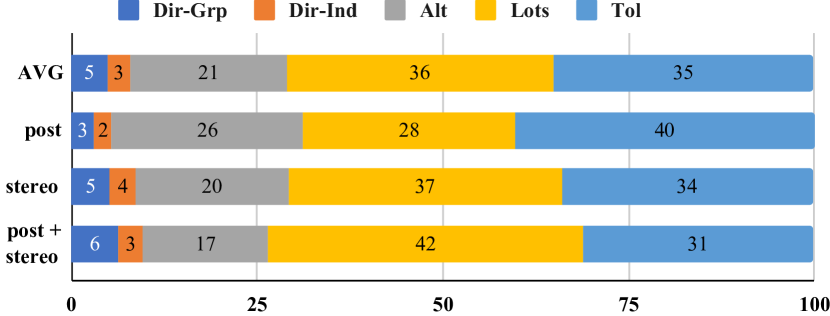
- The broadening strategy—applying the stereotype to other groups (e.g., 'conservatives can also be stupid')—was the most preferred counterstatement type, especially when the belief was implicitly conveyed.
- Statements that provided direct counter-evidence through specific individuals (Dir-Ind) or groups (Dir-Grp) were the least popular, though they were more effective when the essentialist belief was explicitly stated.
- Annotator preferences varied significantly based on whether the essentialist belief was presented implicitly or explicitly, indicating that context and framing strongly influence perceived effectiveness.
- There was a high rate of incorrect or stereotyped counterexamples in the Dir-Ind category, indicating challenges in generating factually accurate and non-stereotypical individuals as counterexamples.
- The study found that homogeneity in annotator demographics (e.g., mostly white or male) may limit the generalizability of results, especially when targeting marginalized groups.
- The authors highlight that future work must improve factuality in counterstatement generation and consider community-specific variations in bias and identity.
Read this paper
Open the full text in the Nubint reader and ask about any passage as you read.
Read this paper on NubintThis review was generated by AI from the original paper. Please check the paper before citing it.