
[Paper Review] KS-GNNExplainer: Global Model Interpretation Through Instance Explanations On Histopathology images
KS-GNNExplainer is a novel model-level graph neural network explainer for histopathology images that enhances instance-level explainers like GNNExplainer by incorporating global pattern extraction through pairwise subgraph similarity and a Kolmogorov-Smirnov (KS) test-based objective. It achieves superior performance in identifying consistent, clinically relevant substructures—such as lymph-vascular invasion—across multiple samples, significantly improving faithfulness and interpretability in cancer diagnosis.
Instance-level graph neural network explainers have proven beneficial for explaining such networks on histopathology images. However, there has been few methods that provide model explanations, which are common patterns among samples within the same class. We envision that graph-based histopathological image analysis can benefit significantly from such explanations. On the other hand, current model-level explainers are based on graph generation methods that are not applicable in this domain because of no corresponding image for their generated graphs in real world. Therefore, such explanations are communicable to the experts. To follow this vision, we developed KS-GNNExplainer, the first instance-level graph neural network explainer that leverages current instance-level approaches in an effective manner to provide more informative and reliable explainable outputs, which are crucial for applied AI in the health domain. Our experiments on various datasets, and based on both quantitative and qualitative measures, demonstrate that the proposed explainer is capable of being a global pattern extractor, which is a fundamental limitation of current instance-level approaches in this domain.
Motivation & Objective
- To address the lack of global model-level explainers in graph neural network (GNN)-based histopathology image analysis that can extract consistent, class-level patterns across multiple samples.
- To overcome the limitations of instance-level explainers, which fail to identify shared substructures among similar samples, by enabling model-level interpretation.
- To develop a benchmark framework using the Kolmogorov-Smirnov (KS) test to objectively evaluate explainer effectiveness based on node importance removal.
- To integrate instance-level explainability (via GNNExplainer) with global pattern discovery through subgraph similarity and KS-score optimization, creating a unified objective function.
Proposed method
- Proposes a benchmark framework that evaluates explainers by iteratively removing the most and least important nodes based on explanation scores, then applying the KS test on the resulting cumulative distribution of label changes.
- Introduces a novel objective function for model-level explanation that combines three components: (1) fidelity to the original GNN prediction, (2) pairwise cosine similarity of subgraph embeddings from the same class, and (3) sum of KS test statistics across samples.
- Minimizes variance in KS scores across samples to ensure consistent, reliable pattern detection, with a regularized loss function incorporating hyperparameters λ₁, λ₂, and λ₃.
- Uses HACT-Net to generate fixed-size graph embeddings from cell-graphs derived from nuclei segmentation (via Hover-Net), enabling GNN-based classification and explanation.
- Applies the GNNExplainer framework as a base, extending it to generate subgraphs across a batch of same-class samples that maximize the KS score and subgraph similarity.
- Employs a multi-stage optimization process to identify subgraphs that are both locally faithful and globally consistent across similar histopathology cases.
Experimental results
Research questions
- RQ1Can a model-level explainer be effectively designed for GNNs in histopathology by leveraging instance-level explanation methods?
- RQ2How can the faithfulness and consistency of graph-based explanations be objectively measured across multiple samples?
- RQ3To what extent does incorporating subgraph similarity and KS-test-based evaluation improve the reliability and clinical relevance of GNN explanations?
- RQ4Does the proposed objective function enhance the detection of biologically meaningful patterns—such as lymph-vascular invasion—compared to existing explainers?
Key findings
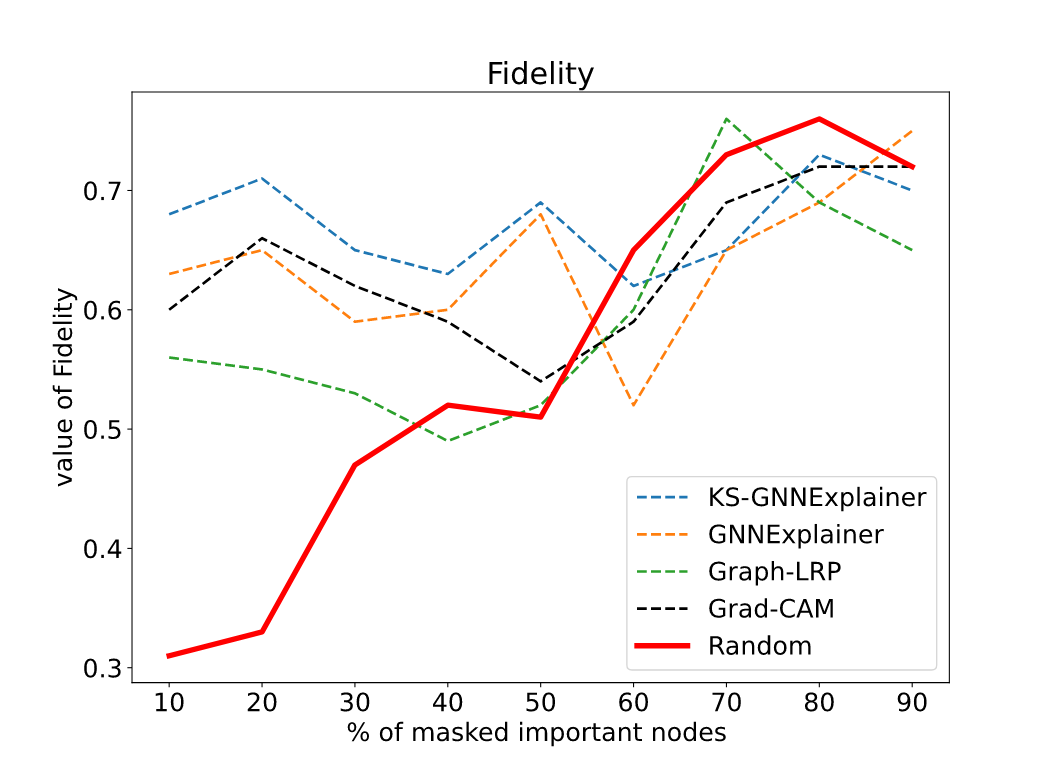
- KS-GNNExplainer achieved a macro-averaged F1 score of 0.697 on the BreCaHAD dataset for tumor vs. non-tumor nucleus classification, outperforming GNNExplainer (0.687), GraphLRP (0.489), and Grad-CAM (0.549).
- On the BRACS dataset, KS-GNNExplainer achieved a Fidelity score of 0.63, significantly higher than the ablated version without KS terms (0.28), demonstrating the critical role of the KS test in performance.
- Ablation studies showed that removing the KS test component reduced Fidelity by 0.35 on BRACS and 0.36 on BACH, confirming its importance in improving explanation reliability.
- The inclusion of pairwise subgraph similarity (term P) improved Fidelity by 0.19 on BACH and 0.23 on BRACS, indicating that consistent subgraph structures enhance model interpretability.
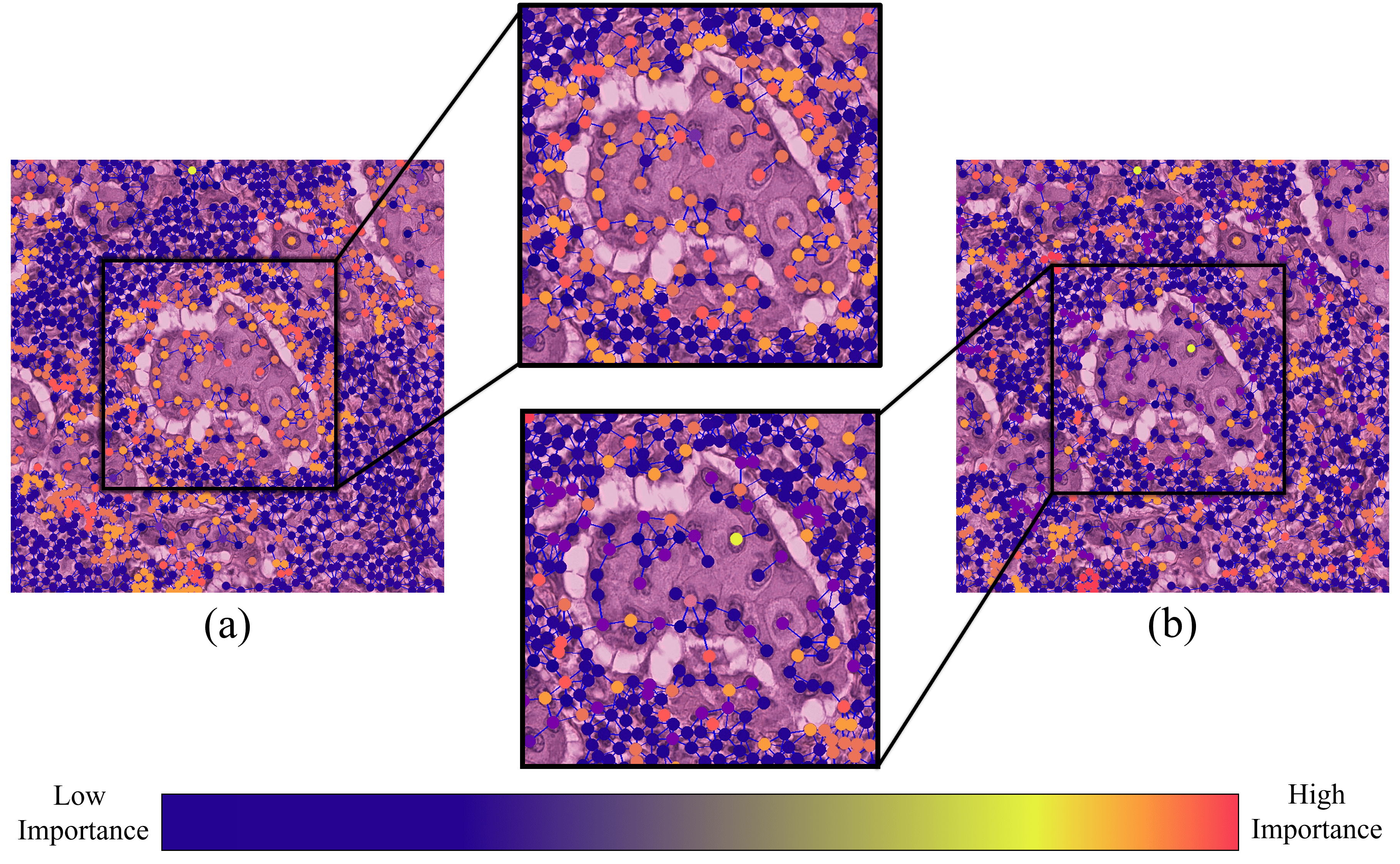
- Qualitative results showed that KS-GNNExplainer more effectively highlighted lymph-vascular invasion regions in ductal carcinoma in situ (DCIS) cases, with pathologists confirming better integration of critical diagnostic features.
- The method achieved a 0.16–0.18 improvement in Fidelity when including the KS sum and variance terms, showing that uniform, high KS scores across samples are essential for robust global explanation.
Read this paper
Open the full text in the Nubint reader and ask about any passage as you read.
Read this paper on NubintThis review was generated by AI from the original paper. Please check the paper before citing it.