
[Paper Review] Large Language Models as Urban Residents: An LLM Agent Framework for Personal Mobility Generation
The paper presents LLMob, an LLM agent framework that generates personal mobility trajectories by combining semantic pattern extraction, self-consistency evaluation, and motivation-driven, retrieval-augmented generation, validated on real Tokyo data.
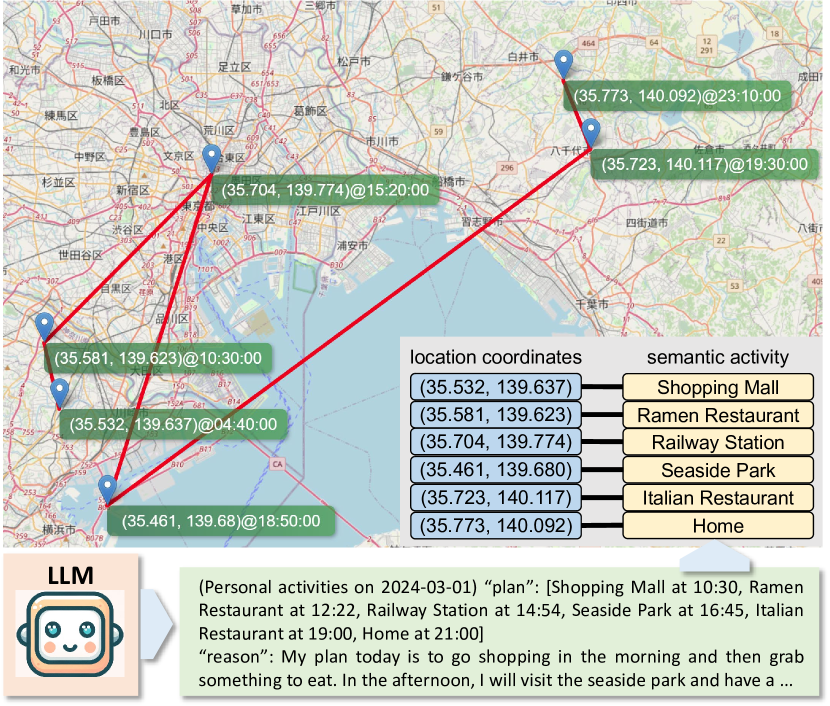
This paper introduces a novel approach using Large Language Models (LLMs) integrated into an agent framework for flexible and effective personal mobility generation. LLMs overcome the limitations of previous models by effectively processing semantic data and offering versatility in modeling various tasks. Our approach addresses three research questions: aligning LLMs with real-world urban mobility data, developing reliable activity generation strategies, and exploring LLM applications in urban mobility. The key technical contribution is a novel LLM agent framework that accounts for individual activity patterns and motivations, including a self-consistency approach to align LLMs with real-world activity data and a retrieval-augmented strategy for interpretable activity generation. We evaluate our LLM agent framework and compare it with state-of-the-art personal mobility generation approaches, demonstrating the effectiveness of our approach and its potential applications in urban mobility. Overall, this study marks the pioneering work of designing an LLM agent framework for activity generation based on real-world human activity data, offering a promising tool for urban mobility analysis.
Motivation & Objective
- Align LLMs with semantically rich activity data for personal mobility generation.
- Develop reliable, interpretable strategies to generate activity trajectories.
- Incorporate habitual patterns and dynamic motivations to simulate urban mobility.
- Validate the framework with real-world data and compare against traditional models.
Proposed method
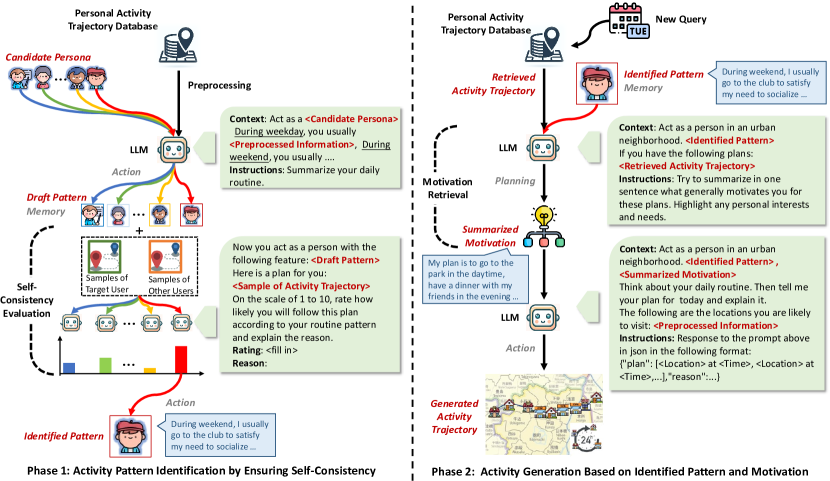
- Two-phase pipeline: (i) self-consistent activity pattern identification from historical data using LLMs and persona-induced prompts; (ii) motivation-driven activity generation with retrieval-augmented prompts.
- Self-consistency scoring compares candidate patterns against target and other users to select the best pattern.
- Two retrieval strategies for motivations: evolving-based and learning-based, including a contrastive learning model f_theta to estimate date similarity.
- Integration of patterns with summarized motivations to generate daily activity trajectories.
- Use of GPT-3.5-Turbo-0613 as the LLM core for generation and analysis.
Experimental results
Research questions
- RQ1RQ1: How can LLMs be aligned with semantically rich data about daily individual activities?
- RQ2RQ2: What are effective strategies for reliable and meaningful activity generation using LLMs?
- RQ3RQ3: What are potential applications of LLMs in enhancing urban mobility?
Key findings
- LLMob achieves superior temporal pattern generation (ST-ACT, ST-LOC) compared to baselines like Markov, LSTM, and DeepMove.
- The framework maintains competitive spatial patterns and demonstrates robustness under abnormal pandemic-like scenarios.
- Motivation-aware generation enables LLM agents to produce realistic daily trajectories and adapt to external factors (e.g., pandemic prompts).
- Retrieval-augmented strategies improve interpretability and reliability of generated activity trajectories.
- Self-consistency evaluation helps align LLM outputs with real-world daily activity data.
Read this paper
Open the full text in the Nubint reader and ask about any passage as you read.
Read this paper on NubintThis review was generated by AI from the original paper. Please check the paper before citing it.