
[Paper Review] Large Language Models Meet User Interfaces: The Case of Provisioning Feedback
This paper proposes Feedback Copilot, a user-friendly application that leverages Large Language Models (LLMs) via APIs to generate personalized, rubric-based feedback for student assignments at scale. By shifting from conversational interfaces to structured, pedagogically guided tools, the approach reduces prompting complexity, enhances ethical and reliable feedback generation, and demonstrates strong effectiveness in generating high-quality feedback across 338 student assignments.
Incorporating Generative AI (GenAI) and Large Language Models (LLMs) in education can enhance teaching efficiency and enrich student learning. Current LLM usage involves conversational user interfaces (CUIs) for tasks like generating materials or providing feedback. However, this presents challenges including the need for educator expertise in AI and CUIs, ethical concerns with high-stakes decisions, and privacy risks. CUIs also struggle with complex tasks. To address these, we propose transitioning from CUIs to user-friendly applications leveraging LLMs via API calls. We present a framework for ethically incorporating GenAI into educational tools and demonstrate its application in our tool, Feedback Copilot, which provides personalized feedback on student assignments. Our evaluation shows the effectiveness of this approach, with implications for GenAI researchers, educators, and technologists. This work charts a course for the future of GenAI in education.
Motivation & Objective
- To address the limitations of conversational user interfaces (CUIs) for LLMs in education, including prompting complexity, ethical risks, and hallucination in complex tasks.
- To develop a human-centered, pedagogically sound framework for integrating Generative AI into educational tools that ensures ethical and effective use.
- To design and evaluate a novel application, Feedback Copilot, that enables instructors to generate scalable, high-quality qualitative feedback using LLMs through structured interfaces.
- To assess the practical viability and perceived quality of LLM-generated feedback in real educational settings, particularly in comparison to human feedback.
Proposed method
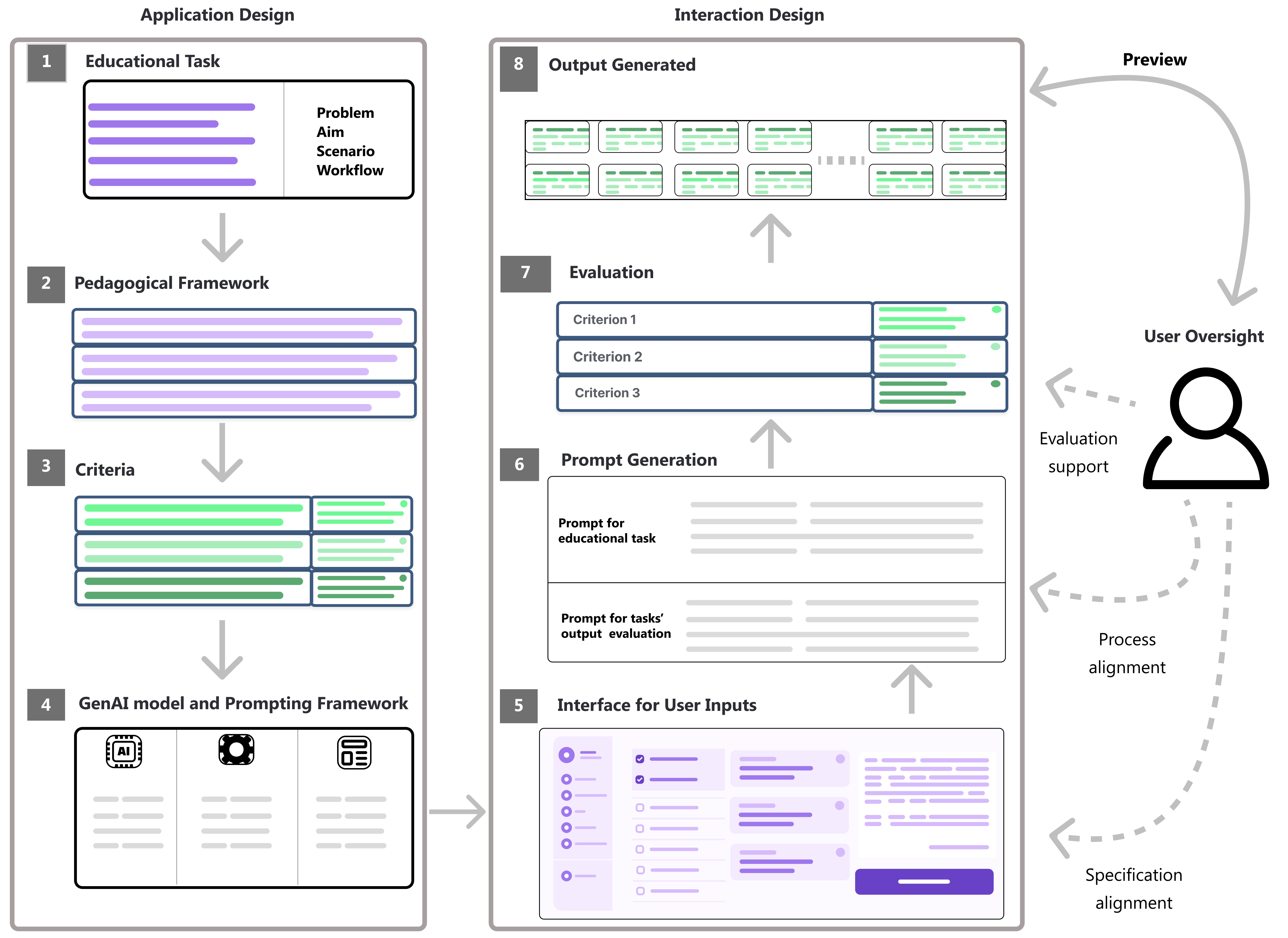
- Proposed a framework for ethically and pedagogically responsible integration of GenAI into educational tools, emphasizing human-centered design and structured interaction.
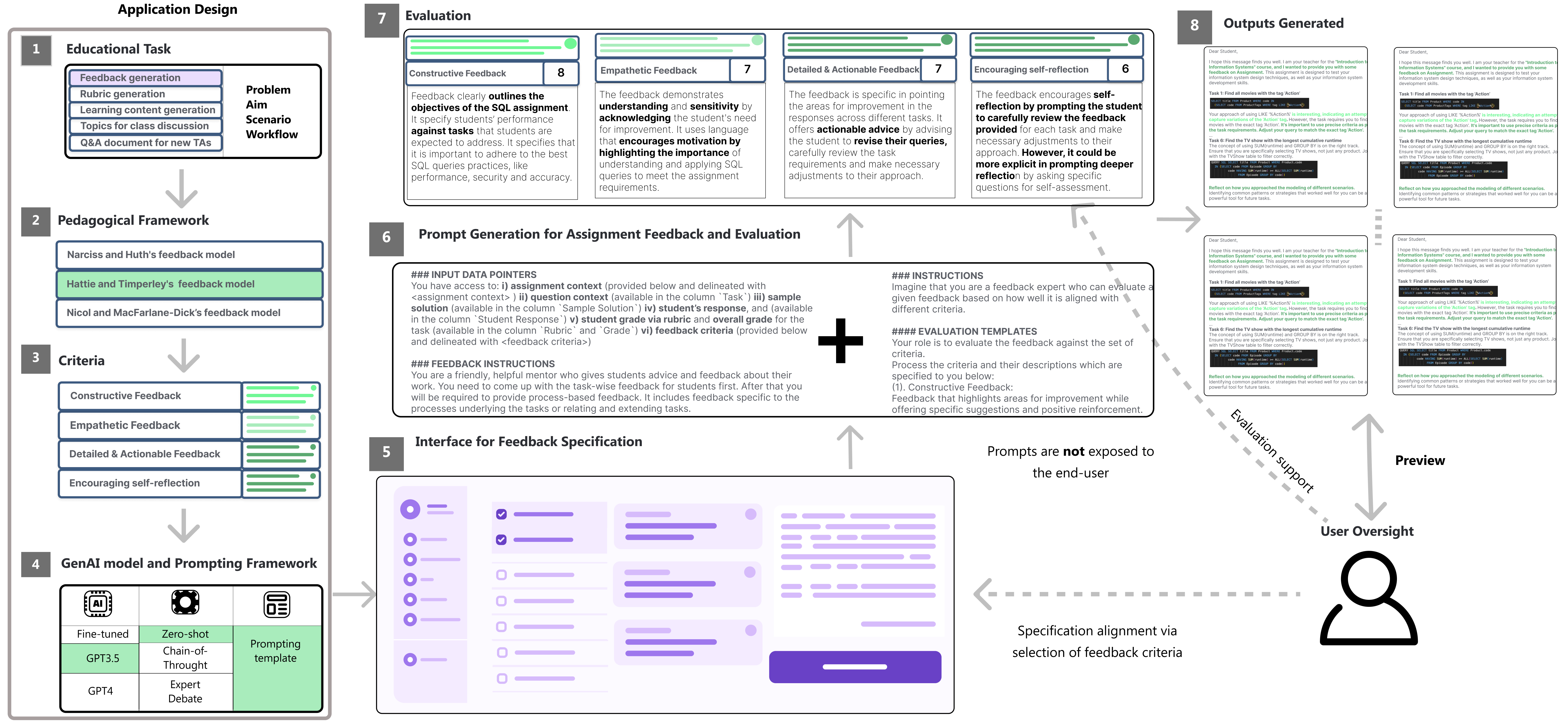
- Designed Feedback Copilot as a web-based application that uses LLMs via API calls, embedding pedagogical rubrics and instructional design principles into the feedback generation process.
- Implemented two variations of Feedback Copilot: one with minimal instructor input and one with guided, structured prompts to evaluate impact on feedback quality.
- Integrated learning analytics to monitor feedback generation processes and ensure consistency and traceability in output.
- Used a controlled evaluation with 338 student assignments to compare feedback quality across the two Feedback Copilot variants and assess instructor usability.
- Applied qualitative and quantitative analysis to evaluate feedback accuracy, constructiveness, and alignment with rubrics.
Experimental results
Research questions
- RQ1How can LLMs be effectively and ethically integrated into educational feedback workflows beyond conversational interfaces?
- RQ2To what extent can a structured, application-based interface improve the reliability and pedagogical soundness of LLM-generated feedback compared to CUIs?
- RQ3What is the impact of guided prompting and rubric integration on the quality and consistency of feedback generated by LLMs in real educational settings?
- RQ4How do instructors perceive the usability and trustworthiness of LLM-generated feedback when delivered through a purpose-built application?
- RQ5Can LLM-generated feedback match the perceived quality and impact of human-written feedback, particularly for diverse student performance levels?
Key findings
- Feedback Copilot successfully generated personalized, rubric-aligned qualitative feedback for 338 student assignments, demonstrating scalability and practical viability in real-world educational settings.
- The application significantly reduced the cognitive and technical burden on instructors by replacing complex prompting with structured, guided input, enhancing usability and consistency.
- Instructors reported higher confidence in the generated feedback when using the guided prompting variant of Feedback Copilot, indicating improved trust and reliability.
- Students demonstrated high trust in AI-generated feedback, with some perceiving it as equally or more credible than human feedback, suggesting strong potential for adoption.
- The evaluation revealed that LLM-generated feedback was perceived as constructive and pedagogically valid, especially when supported by clear rubrics and human oversight.
- The study confirms that moving from CUIs to application-based GenAI tools mitigates risks related to hallucination, privacy, and ethical misuse, while enhancing educational outcomes.
Read this paper
Open the full text in the Nubint reader and ask about any passage as you read.
Read this paper on NubintThis review was generated by AI from the original paper. Please check the paper before citing it.