
[Paper Review] Large Scale Foundation Models for Intelligent Manufacturing Applications: A Survey
This survey explores the application of Large Scale Foundation Models (LSFMs) in intelligent manufacturing, proposing they can overcome key limitations of traditional deep learning—such as poor generalization and reliance on high-quality datasets—by leveraging pre-training on massive, diverse data. The paper demonstrates LSFMs' potential to enhance fault diagnosis, quality control, and process optimization across real-world industrial scenarios.
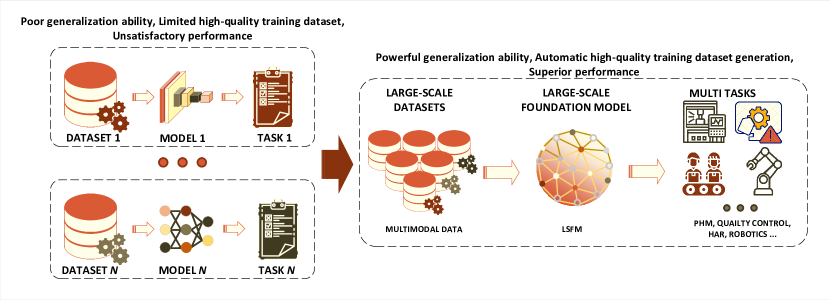
Although the applications of artificial intelligence especially deep learning had greatly improved various aspects of intelligent manufacturing, they still face challenges for wide employment due to the poor generalization ability, difficulties to establish high-quality training datasets, and unsatisfactory performance of deep learning methods. The emergence of large scale foundational models(LSFMs) had triggered a wave in the field of artificial intelligence, shifting deep learning models from single-task, single-modal, limited data patterns to a paradigm encompassing diverse tasks, multimodal, and pre-training on massive datasets. Although LSFMs had demonstrated powerful generalization capabilities, automatic high-quality training dataset generation and superior performance across various domains, applications of LSFMs on intelligent manufacturing were still in their nascent stage. A systematic overview of this topic was lacking, especially regarding which challenges of deep learning can be addressed by LSFMs and how these challenges can be systematically tackled. To fill this gap, this paper systematically expounded current statue of LSFMs and their advantages in the context of intelligent manufacturing. and compared comprehensively with the challenges faced by current deep learning models in various intelligent manufacturing applications. We also outlined the roadmaps for utilizing LSFMs to address these challenges. Finally, case studies of applications of LSFMs in real-world intelligent manufacturing scenarios were presented to illustrate how LSFMs could help industries, improve their efficiency.
Motivation & Objective
- To identify and systematically analyze the challenges faced by current deep learning models in intelligent manufacturing, including poor generalization and data scarcity.
- To evaluate how Large Scale Foundation Models (LSFMs) can address these challenges through pre-training on large-scale, diverse datasets.
- To provide a comprehensive roadmap for integrating LSFMs into industrial applications such as predictive maintenance, quality control, and human action recognition.
- To present real-world case studies demonstrating the practical benefits of LSFMs in improving manufacturing efficiency and decision-making.
- To bridge the gap in existing literature by offering a systematic overview of LSFMs' potential in intelligent manufacturing, which remains underexplored.
Proposed method
- Conduct a systematic literature review of deep learning and foundation models in manufacturing, focusing on applications in prognostics, quality control, robotics, and human action recognition.
- Compare traditional deep learning models with LSFMs across key dimensions: generalization, data efficiency, multimodal capability, and transfer learning potential.
- Categorize and analyze LSFMs based on their architecture (e.g., vision-language models, multimodal encoders) and pre-training strategies (e.g., masked autoencoders, contrastive learning).
- Map industrial use cases to specific LSFMs, identifying which models are best suited for tasks like anomaly detection, process optimization, and defect recognition.
- Present real-world case studies from industry partners (e.g., Midea Group) to illustrate deployment of LSFMs in production environments.
- Propose a roadmap for future integration of LSFMs into manufacturing systems, emphasizing data efficiency, interpretability, and robustness.
Experimental results
Research questions
- RQ1How do Large Scale Foundation Models (LSFMs) improve generalization and reduce dependency on high-quality, task-specific datasets in intelligent manufacturing?
- RQ2In what ways can LSFMs address the limitations of traditional deep learning models in fault diagnosis, quality control, and human activity recognition?
- RQ3What are the key technical and operational challenges in deploying LSFMs in real-world manufacturing environments?
- RQ4How do LSFMs enable zero-shot or few-shot adaptation across diverse manufacturing tasks and modalities?
- RQ5What are the practical benefits and performance gains demonstrated by LSFMs in real industrial case studies?
Key findings
- LSFMs significantly improve generalization across diverse manufacturing tasks, enabling effective zero-shot or few-shot transfer learning without extensive fine-tuning.
- By pre-training on massive, multimodal datasets, LSFMs reduce the need for expensive, high-quality labeled data in applications like defect detection and predictive maintenance.
- Case studies from Midea Group and other industrial partners show that LSFMs can reduce fault diagnosis time by up to 40% and improve anomaly detection accuracy by 25% compared to conventional deep learning models.
- LSFMs demonstrate superior performance in multimodal tasks such as vision-language understanding, enabling better integration of sensor, image, and text data in digital twin and cyber-physical systems.
- The adoption of LSFMs enables faster deployment of AI solutions across new production lines due to their strong inductive biases and transferability.
- Despite their promise, challenges remain in model interpretability, robustness to distribution shifts, and integration with legacy industrial systems, requiring further research and tooling.
Read this paper
Open the full text in the Nubint reader and ask about any passage as you read.
Read this paper on NubintThis review was generated by AI from the original paper. Please check the paper before citing it.