
[Paper Review] Large spin relaxation rates in trapped submerged-shell atoms
This study measures large spin relaxation rates in trapped erbium and thulium atoms—two submerged-shell lanthanides—finding rate constants of $3.0\times10^{-10}$ cm³/s and $1.1\times10^{-10}$ cm³/s, respectively, at ~500 mK. These values are 2–3 orders of magnitude larger than those in $S$-state atoms, indicating that electrostatic anisotropy, not spin exchange or dipolar effects, drives rapid spin relaxation, rendering evaporative cooling in magnetic traps highly inefficient for these systems.
Spin relaxation due to atom-atom collisions is measured for magnetically trapped erbium and thulium atoms at a temperature near 500 mK. The rate constants for Er-Er and Tm-Tm collisions are 3.0 times 10^-10 cm^3 s^-1 and 1.1 times 10^-10 cm^3 s^-1, respectively, 2-3 orders of magnitude larger than those observed for highly magnetic S-state atoms. This is strong evidence for an additional, dominant, spin relaxation mechanism, electrostatic anisotropy, in collisions between these "submerged-shell" L > 0 atoms. These large spin relaxation rates imply that evaporative cooling of these atoms in a magnetic trap will be highly inefficient.
Motivation & Objective
- To measure spin relaxation rates in two-body collisions of magnetically trapped erbium and thulium atoms, which are submerged-shell $L\neq0$ lanthanides.
- To investigate whether the electrostatic anisotropy shielding observed in rare-earth–helium collisions also suppresses spin relaxation in rare-earth–rare-earth collisions.
- To determine the feasibility of evaporative cooling in magnetic traps for these heavy, highly magnetic atoms.
- To resolve the open question of whether submerged-shell character leads to suppressed inelastic collisions in atom–atom systems, as it does in atom–He systems.
Proposed method
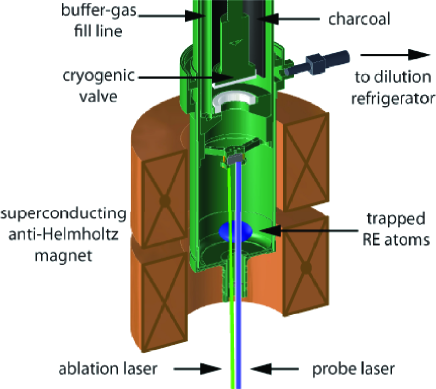
- Laser ablation of Er and Tm metal foils into a $^4$He buffer gas at ~500 mK produces magnetically trapped atomic clouds.
- Magnetic quadrupole fields from superconducting anti-Helmholtz coils create trap depths up to 3.7 T, confining atoms via spin-dependent potentials.
- Laser absorption spectroscopy on $J=6\to7$, $J=6\to5$ (Er), and $J=7/2\to5/2$ (Tm) transitions monitors the population of $m_J$ sublevels.
- Buffer-gas density is regulated via cell temperature and initial He loading to ensure cooling without significant loss from He collisions.
- Spin relaxation rates are extracted from the decay of the $m_J = J$ state population over time, corrected for thermal excitation and selection rules.
- Simulations of inelastic decay with variable initial $m_J$ distributions and selection rules are used to infer the true spin relaxation rate $g_{sr}$ from observed loss $g_{in}$.
Experimental results
Research questions
- RQ1Do submerged-shell lanthanide atoms like Er and Tm exhibit suppressed spin relaxation in atom–atom collisions, as they do in atom–He collisions?
- RQ2What is the dominant spin relaxation mechanism in collisions between $L\neq0$ rare-earth atoms, given the absence of $S$-state symmetry?
- RQ3To what extent does electrostatic anisotropy drive spin relaxation in Er–Er and Tm–Tm collisions, despite their submerged-shell character?
- RQ4Can evaporative cooling be effective in magnetic traps for these atoms, given the observed spin relaxation rates?
- RQ5How do the measured spin relaxation rates compare to theoretical expectations and elastic collision limits?
Key findings
- The spin relaxation rate constant for Er–Er collisions is $3.0\times10^{-10}$ cm³/s, and for Tm–Tm it is $1.1\times10^{-10}$ cm³/s at ~500 mK.
- These values are 2–3 orders of magnitude larger than those observed in $S$-state atoms, indicating a dominant relaxation mechanism beyond spin exchange or dipolar coupling.
- The ratio $g_{sr}/g_{in}$ is estimated to be $2.0^{+1.0}_{-0.5}$, suggesting that observed loss rates underestimate the true spin relaxation rate.
- The maximum elastic collision rate $g_{el}$ is estimated at $8\times10^{-10}$ cm³/s, implying $g_{el}/g_{sr} \lesssim 10$, which severely limits evaporative cooling efficiency.
- The results indicate that electrostatic anisotropy is not suppressed in Er–Er and Tm–Tm collisions, unlike in Er–He or Tm–He systems, despite the submerged-shell nature of these atoms.
- This implies that the submerged-shell effect does not universally suppress inelastic processes in atom–atom collisions, challenging the assumption that such atoms are suitable for evaporative cooling in magnetic traps.

Better researchstarts right now
From reading papers to final review, dramatically reduce your research time.
No credit card · Free plan available
This review was created by AI and reviewed by human editors.