
[Paper Review] Lasting Diversity and Superior Runtime Guarantees for the $(μ+1)$ Genetic Algorithm
This paper proves that the $(\mu+1)$ GA maintains population diversity on Jump functions for an exponential time in $\mu$, significantly extending prior quadratic bounds. This leads to superior runtime guarantees: for $\mu \geq C\ln n$, the algorithm optimizes $\textsc{Jump}_k$ in $O(n^{k-1})$ time, achieving an $\Omega(n)$ speed-up from crossover even with logarithmic population sizes.
Most evolutionary algorithms (EAs) used in practice employ crossover. In contrast, only for few and mostly artificial examples a runtime advantage from crossover could be proven with mathematical means. The most convincing such result shows that the $(μ+1)$ genetic algorithm (GA) with population size $μ=O(n)$ optimizes jump functions with gap size $k \ge 3$ in time $O(n^k / μ+ n^{k-1}\log n)$, beating the $Θ(n^k)$ runtime of many mutation-based EAs. This result builds on a proof that the GA occasionally and then for an expected number of $Ω(μ^2)$ iterations has a population that is not dominated by a single genotype. In this work, we show that this diversity persist with high probability for a time exponential in $μ$ (instead of quadratic). From this better understanding of the population diversity, we obtain stronger runtime guarantees, among them the statement that for all $c\ln(n)\leμ\le n/\log n$, with $c$ a suitable constant, the runtime of the $(μ+1)$ GA on $\mathrm{Jump}_k$, with $k \ge 3$, is $O(n^{k-1})$. Consequently, already with logarithmic population sizes, the GA gains a speed-up of order $Ω(n)$ from crossover.
Motivation & Objective
- To understand why crossover in the $(\mu+1)$ GA provides a runtime advantage on Jump functions.
- To analyze the persistence of population diversity during optimization, especially on the plateau of Jump functions.
- To improve runtime guarantees by rigorously establishing longer-lasting diversity than previously known.
- To investigate whether stronger diversity leads to better performance, particularly for small population sizes.
- To empirically validate the theoretical findings on Hamming distance distributions in the population.
Proposed method
- Analyzing the largest genotype class size as a Markov process to model population diversity dynamics.
- Proving a constant negative drift in the largest genotype class size once it drops below $\frac{3}{4}\mu$, implying exponential persistence of diversity.
- Using stochastic domination and drift analysis to show that diversity persists for $\exp(\Omega(\mu))$ iterations.
- Deriving runtime bounds via the interplay between diversity duration and the probability of generating the optimum via crossover.
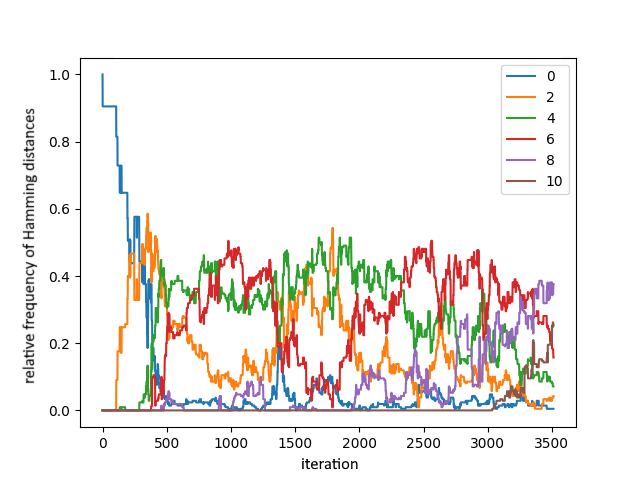
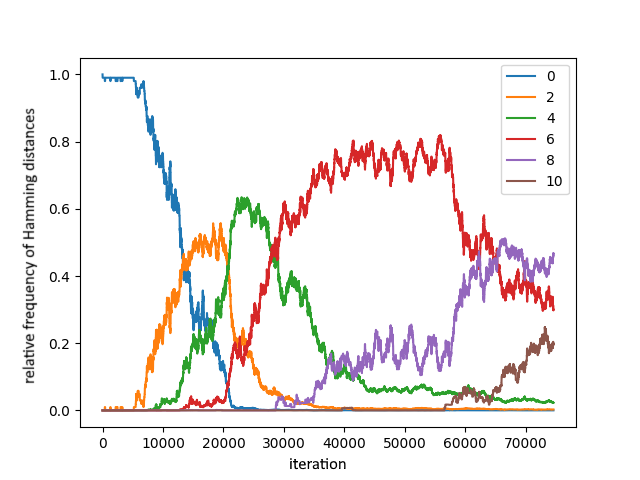
- Conducting empirical experiments to track pairwise Hamming distances in the population during plateau phases.
- Comparing empirical frequency trends of Hamming distances to theoretical expectations and prior work.
Experimental results
Research questions
- RQ1How long does the $(\mu+1)$ GA maintain a diverse population on the plateau of $\textsc{Jump}_k$?
- RQ2Can the duration of diversity be proven to be exponential in $\mu$, rather than quadratic as in prior work?
- RQ3What is the resulting impact on the runtime of the $(\mu+1)$ GA for small population sizes $\mu = \Omega(\ln n)$?
- RQ4Does the population diversity not only avoid dominance by a single genotype but also increase in pairwise Hamming distances?
- RQ5Can empirical observations of Hamming distance frequencies support the theoretical claims of sustained and growing diversity?
Key findings
- The largest genotype class size exhibits a constant negative drift once below $\frac{3}{4}\mu$, ensuring diversity persists for $\exp(\Omega(\mu))$ iterations.
- For all $\mu \geq C\ln n$ with a suitable constant $C$, the runtime of the $(\mu+1)$ GA on $\textsc{Jump}_k$ is $O(n^{k-1})$, achieving an $\Omega(n)$ speed-up from crossover.
- Even for $\mu = \Omega(\ln n)$, the algorithm achieves a runtime of $O(n^{k-1})$, significantly improving upon the $O(n^k / \mu)$ bound from Dang et al.
- The runtime for smaller $\mu$ is $O(e^{-\Omega(\mu)}n^k)$, showing a substantial improvement over the $O(n^k / \mu)$ guarantee from prior work.
- Empirical results confirm that Hamming distances between individuals grow over time, with higher distances becoming more frequent, indicating increasing diversity.
- The population dynamics show that diversity is not only maintained but also evolves toward larger pairwise distances, supporting the hypothesis of stronger performance.
Read this paper
Open the full text in the Nubint reader and ask about any passage as you read.
Read this paper on NubintThis review was generated by AI from the original paper. Please check the paper before citing it.