
[Paper Review] Learning Interactive Real-World Simulators
This paper proposes UniSim, a universal action-conditioned video diffusion model that combines diverse internet datasets to simulate real-world interactions and train vision-language and reinforcement learning policies that transfer to the real world without additional real-data training.
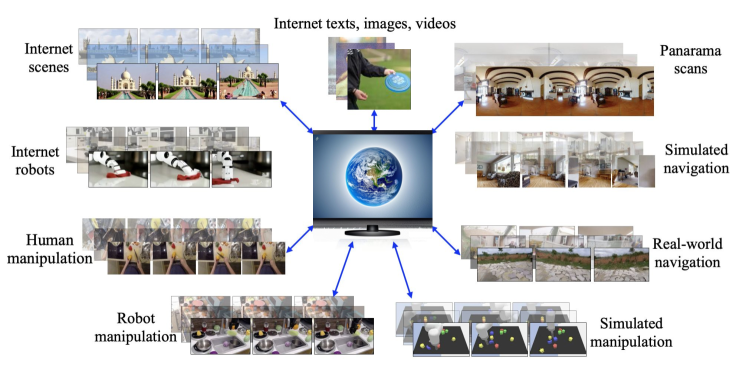
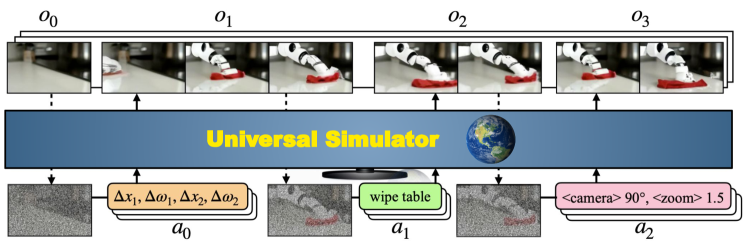
Generative models trained on internet data have revolutionized how text, image, and video content can be created. Perhaps the next milestone for generative models is to simulate realistic experience in response to actions taken by humans, robots, and other interactive agents. Applications of a real-world simulator range from controllable content creation in games and movies, to training embodied agents purely in simulation that can be directly deployed in the real world. We explore the possibility of learning a universal simulator (UniSim) of real-world interaction through generative modeling. We first make the important observation that natural datasets available for learning a real-world simulator are often rich along different dimensions (e.g., abundant objects in image data, densely sampled actions in robotics data, and diverse movements in navigation data). With careful orchestration of diverse datasets, each providing a different aspect of the overall experience, we can simulate the visual outcome of both high-level instructions such as "open the drawer" and low-level controls from otherwise static scenes and objects. We use the simulator to train both high-level vision-language policies and low-level reinforcement learning policies, each of which can be deployed in the real world in zero shot after training purely in simulation. We also show that other types of intelligence such as video captioning models can benefit from training with simulated experience, opening up even wider applications. Video demos can be found at https://universal-simulator.github.io.
Motivation & Objective
- Motivate the need for a universal, action-conditioned real-world simulator that can fuse diverse data sources.
- Propose a unified action-in-video-out framework to learn a predictive observation model.
- Show how long-horizon, multimodal simulations can train high-level and low-level policies transferable to real robots.
- Demonstrate additional applications such as training video captioning and broad vision-language models with simulated data.
Proposed method
- Formulate a unified action space by converting text, language descriptions, and motor controls into continuous embeddings.
- Train UniSim as an observation-prediction model p(o_t|h_{t-1},a_{t-1}) using a video diffusion model with a denoising network epsilon_theta.
- Condition the diffusion model with recent history frames to enable autoregressive long-horizon video generation.
- Use classifier-free guidance to incorporate action conditioning into the diffusion process.
- Replicate conditioning frames to future steps and apply a video U-Net architecture with interleaved temporal and spatial attention.
- Train on a combination of real-robot, human activity, panorama, and internet image-text datasets, leveraging domain identifiers to aid low-data domains.
Experimental results
Research questions
- RQ1Can a single, action-conditioned video diffusion model fuse diverse datasets to simulate realistic real-world interactions?
- RQ2Do long-horizon simulations enable effective training of high-level vision-language policies and low-level RL controllers that transfer to real-world tasks?
- RQ3Can simulated data improve non-embodied tasks like video captioning and broad vision-language models?
- RQ4What are the limitations of current universal simulators in memory, action realism, and out-of-domain generalization?
Key findings
- The UniSim can perform action-rich and long-horizon simulations across manipulation and navigation tasks.
- Autoregressive diffusion-based observation prediction yields temporally consistent video sequences conditioned on actions.
- Training vision-language policies and reinforcement learning controllers entirely in simulation can transfer to real robots in zero-shot deployments.
- Simulated data can improve video captioning models and value of simulated hindsight data for long-horizon tasks.
- Conditioning history frames improves generation quality; too much distant history can hurt performance.
Read this paper
Open the full text in the Nubint reader and ask about any passage as you read.
Read this paper on NubintThis review was generated by AI from the original paper. Please check the paper before citing it.