
[Paper Review] Likelihood Asymptotics in Nonregular Settings: A Review with Emphasis on the Likelihood Ratio
This paper reviews likelihood asymptotics in nonregular statistical models where classical regularity conditions fail, focusing on the likelihood ratio statistic. It identifies three main problem classes—boundary issues, indeterminate parameters, and change-points—and derives the limiting distributions of the likelihood ratio, showing that standard chi-squared approximations often fail, requiring specialized asymptotic theory or simulation-based inference for valid inference in modern applications such as finite mixtures and change-point models.
This paper reviews the most common situations where one or more regularity conditions which underlie classical likelihood-based parametric inference fail. We identify three main classes of problems: boundary problems, indeterminate parameter problems -- which include non-identifiable parameters and singular information matrices -- and change-point problems. The review focuses on the large-sample properties of the likelihood ratio statistic. We emphasize analytical solutions and acknowledge software implementations where available. We furthermore give summary insight about the possible tools to derivate the key results. Other approaches to hypothesis testing and connections to estimation are listed in the annotated bibliography of the Supplementary Material.
Motivation & Objective
- To address the failure of classical likelihood theory in nonregular settings where standard regularity conditions do not hold.
- To identify and categorize common nonregular problems, including boundary issues, non-identifiable parameters, and change-points.
- To provide analytical derivations of the limiting distributions of the likelihood ratio statistic under these nonregular conditions.
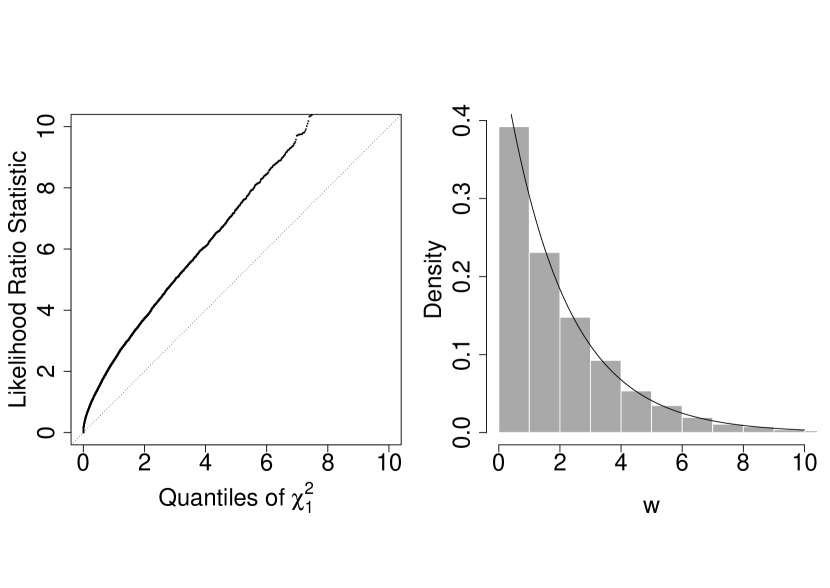
- To highlight cases where standard chi-squared approximations break down and alternative distributions (e.g., supremum of Gaussian processes) are required.
- To support practical inference by discussing available software implementations and simulation-based alternatives when analytical solutions are intractable.
Proposed method
- Classify nonregular problems into three main types: boundary problems, indeterminate parameter problems (including non-identifiability and singular Fisher information), and change-point problems.
- Use large-sample asymptotic theory to derive the limiting distribution of the likelihood ratio statistic under each class, emphasizing analytical solutions.
- Apply results from stochastic process theory, such as the supremum of a Gaussian process, to characterize the limiting null distribution in mixture and change-point models.
- Leverage block matrix inversion and score vector expansions to simplify the likelihood ratio statistic in constrained models.
- Use simulation-based methods, such as parametric bootstrap, when analytical approximations are infeasible, especially in non-identifiable models like normal mixtures.
- Provide conditions for convergence, such as bounded parameter spaces and Lipschitz conditions on score functions, to ensure asymptotic validity.
Experimental results
Research questions
- RQ1Under what conditions does Wilks’ theorem fail for the likelihood ratio statistic in nonregular models?
- RQ2What are the limiting distributions of the likelihood ratio statistic in models with boundary parameters, non-identifiable components, or change-points?
- RQ3How do the asymptotic properties of the likelihood ratio differ between identifiable models (e.g., von Mises mixtures) and non-identifiable ones (e.g., normal mixtures)?
- RQ4In what cases can penalized likelihood ratio statistics converge to a simple chi-squared distribution despite nonregularity?
- RQ5What are the implications for inference when the likelihood ratio statistic diverges in probability under the null, as in non-identifiable normal mixtures?
Key findings
- In von Mises mixture models with known concentration, the asymptotic null distribution of the likelihood ratio for testing homogeneity is the squared supremum of a truncated Gaussian process.
- For non-identifiable normal location-scale mixtures, the standard likelihood ratio statistic diverges to infinity in probability under the null, invalidating standard chi-squared approximations.
- Penalized likelihood ratio statistics in such models can converge to a chi-squared distribution, offering a valid alternative for inference.
- In change-point models with known variance, the likelihood ratio statistic reduces to the maximum of absolute values of normalized partial sums, whose null distribution is derived via order statistics and Markovian properties.
- The limiting distribution of the likelihood ratio in boundary problems depends on the behavior of the score vector and Fisher information matrix, particularly when the parameter lies on the boundary of the parameter space.
- Convergence of the likelihood ratio statistic to its limiting distribution requires bounded parameter spaces and Lipschitz continuity of the score vector components to ensure tightness and uniformity of approximation.
Read this paper
Open the full text in the Nubint reader and ask about any passage as you read.
Read this paper on NubintThis review was generated by AI from the original paper. Please check the paper before citing it.