
[Paper Review] Linear Ultrastrong Optomechanical Interaction
The paper demonstrates a purely linear cavity optomechanical system with coherent scattering that reaches ultrastrong coupling, achieving g_x/Omega_x up to 0.55 and revealing stable, tunable in situ coupling in a levitated nanoparticle setup.
Light-matter interaction in the ultrastrong coupling regime can be used to generate exotic ground states with two-mode squeezing and may be of use for quantum enhanced sensing. Current demonstrations of ultrastrong coupling have been performed in fundamentally nonlinear systems. We report a cavity optomechanical system that operates in the linear coupling regime, reaching a maximum coupling of $g_x/Ω_x=0.55\pm 0.02$. Such a system is inherently unstable, which may in the future enable strong mechanical squeezing.
Motivation & Objective
- Motivate exploration of ultrastrong coupling in linear, not nonlinear, light-mmatter interactions.
- Demonstrate in situ tunable linear optomechanical coupling via coherent scattering in levitated systems.
- Characterize the coupling regime and dynamical stability as g_x approaches and exceeds kappa/4.
- Show how coupling rate and mechanical frequency can be independently tuned.
- Lay groundwork for linear-system-based quantum sensing and squeezing using ultrastrong coupling.
Proposed method
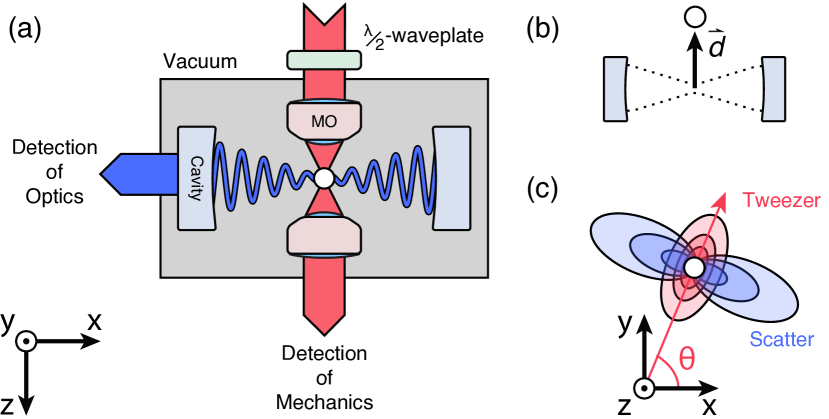
- Use an optically levitated dielectric nanoparticle coherently scattering light into a high-finesse optical cavity to realize a linear optomechanical Hamiltonian H/ħ = Ω_x b†b + Δa†a + g_x(a + a†)(b + b†).
- Tune g_x in situ by adjusting nanoparticle position d, polarization angle θ, and tweezer power.
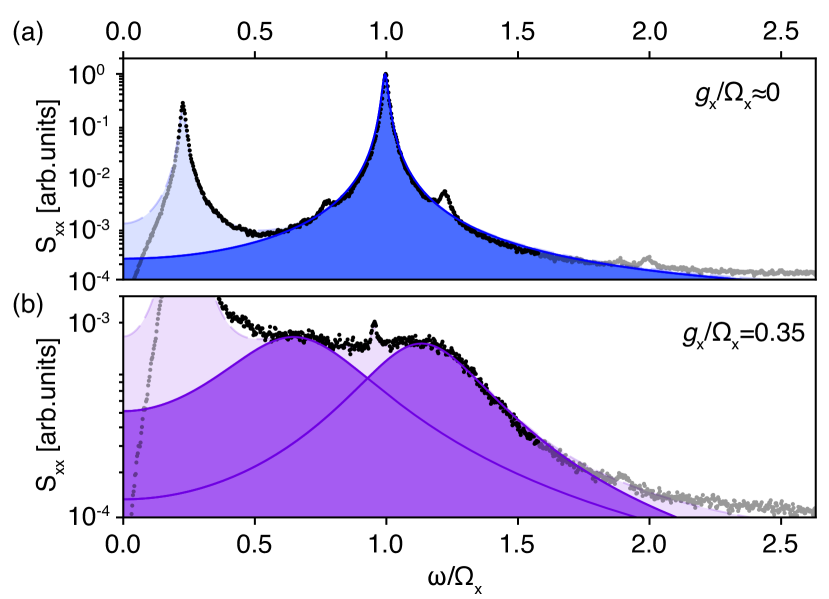
- Operate in sideband resolved regime with κ dominating γ, enabling observation of normal mode splitting and ultrastrong coupling where g_x/Ω_x ≈ 0.35–0.55.
- Analyze system dynamics via Fourier-domain solution and a 4x4 coupling matrix M(ω) incorporating optical and mechanical susceptibilities χ_l(ω) and χ_m(ω).
- Identify instability condition (g_x/Ω_x)^2 > ¼(Δ/Ω_x + κ^2/(4ΔΩ_x)) and relate to the observed detuning Δ ≈ Ω_x.
- Map spatial dependence of g_x through z_0 relative to cavity axis and compare with theoretical g_x(z_0) ∝ exp(-z_0^2/w_cav^2).
Experimental results
Research questions
- RQ1Can a purely linear optomechanical system reach ultrastrong coupling (g_x comparable to Ω_x) while remaining tunable in situ?
- RQ2What are the spectral signatures (normal mode splitting, avoided crossings) of linear ultrastrong coupling in a coherently scattered levitated system?
- RQ3How does the coupling rate g_x depend on the nanoparticle position and polarization, and how does this influence stability and potential for squeezing?
- RQ4What are the stability criteria and the implications for quantum sensing near the instability threshold?
- RQ5How can in situ tuning enable future quantum control and thermodynamics studies in ultrastrong linear coupling regimes?
Key findings
- A purely linear optomechanical system via coherent scattering reaches ultrastrong coupling with g_x/Ω_x up to 0.55 ± 0.02.
- Normal mode splitting and avoided crossings observed as g_x crosses κ/4, confirming strong-to-ultrastrong coupling in a linear setting.
- Coupling rate g_x can be tuned in situ by particle position, polarization, and tweezer power, with spatial dependence following the cavity mode profile.
- Instability emerges near Δ ≈ Ω_x at high coupling, consistent with linear-ultrastrong dynamics enabling potential mechanical squeezing.
- Evidence that g_x/Ω_x > 0.5 can enable ground-state cooling and entanglement in principle, within the linear regime.
- Measured g_x/Ω_x profile as a function of z_0 matches theoretical expectations over the cavity mode.
- The maximum reported coupling occurs when the particle is at the cavity node and directly on the axis (g_x/Ω_x = 0.55).
Read this paper
Open the full text in the Nubint reader and ask about any passage as you read.
Read this paper on NubintThis review was generated by AI from the original paper. Please check the paper before citing it.