
[Paper Review] LLM-based Human Simulations Have Not Yet Been Reliable
The paper argues that reliable LLM-based human simulations require addressing both intrinsic LLM limitations and flaws in simulation framework design, offering a unified framework, targeted solutions, and future directions.
Large Language Models (LLMs) are increasingly employed for simulating human behaviors across diverse domains. However, our position is that current LLM-based human simulations remain insufficiently reliable, as evidenced by significant discrepancies between their outcomes and authentic human actions. Our investigation begins with a systematic review of LLM-based human simulations in social, economic, policy, and psychological contexts, identifying their common frameworks, recent advances, and persistent limitations. This review reveals that such discrepancies primarily stem from inherent limitations of LLMs and flaws in simulation design, both of which are examined in detail. Building on these insights, we propose a systematic solution framework that emphasizes enriching data foundations, advancing LLM capabilities, and ensuring robust simulation design to enhance reliability. Finally, we introduce a structured algorithm that operationalizes the proposed framework, aiming to guide credible and human-aligned LLM-based simulations. To facilitate further research, we provide a curated list of related literature and resources at https://github.com/Persdre/awesome-llm-human-simulation.
Motivation & Objective
- Identify fundamental challenges in LLM-based human simulations arising from LLM limitations and simulation design drawbacks.
- Propose a unified simulation framework that clearly defines LLM actions and human participation.
- Offer targeted solutions to improve data, validation, and evaluation for reliable simulations.
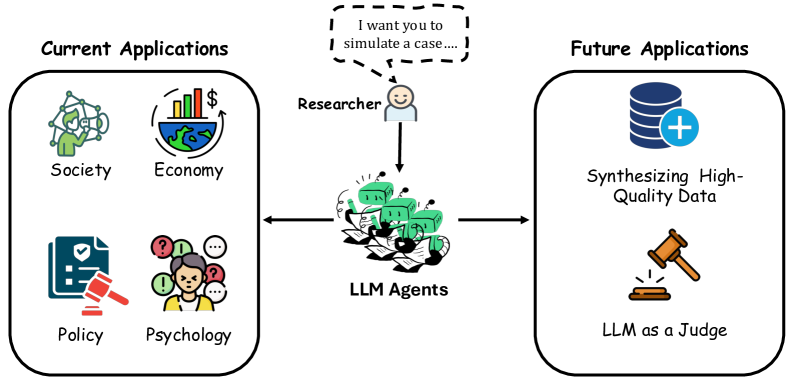
- Suggest future directions focusing on data collection, data synthesis, and LLM-as-a-judge for quality control.
Proposed method
- Formalize a general framework for LLM-based human simulation with environment, agents, and rules (Algorithm 1).
- Categorize existing simulations into social, economic, policy, and psychology domains and analyze LLM actions vs. human participation.
- Systematically analyze intrinsic LLM limitations (bias, cognitive consistency, memory, interaction mechanisms).
- Systematically analyze design drawbacks in simulation frameworks (oversimplified psychology, validation gaps, incentive modeling).
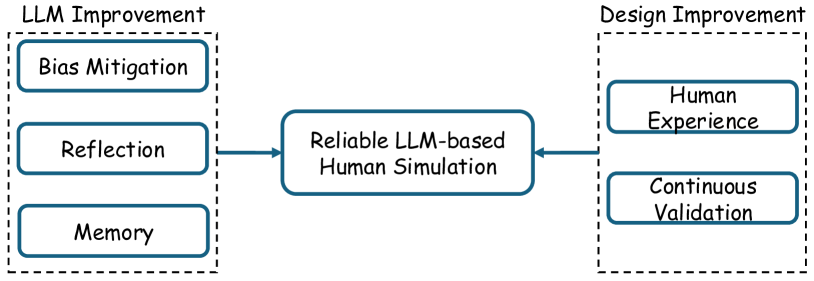
- Propose comprehensive solutions addressing both LLM limitations and framework design (Section 5).
- Outline future directions including multi-dimensional human data collection and LLM-based data quality evaluation.
Experimental results
Research questions
- RQ1What are the main intrinsic limitations of LLMs that hinder authentic human simulations?
- RQ2What design flaws in current simulation frameworks reduce the reliability and validity of LLM-based simulations?
- RQ3How can we jointly address LLM limitations and framework design to improve reliability, validation, and evaluation of simulations?
- RQ4What future directions and data strategies can elevate the quality and trustworthiness of LLM-based human simulations?
Key findings
- LLM-based human simulations suffer from biases, inconsistent cognition, memory/long-term consistency issues, and weak multi-agent interaction handling.
- Current simulation frameworks oversimplify complex human states and struggle with real-time validation, monitoring, and integration of expert knowledge.
- A unified framework is proposed to separate LLM actions from human participation and to guide systematic validation.
- Targeted solutions span bias-mitting training, cognitive-consistency improvements, external memory for LLMs, modular validation, and enhanced incentive modeling.
- Future directions emphasize richer multi-modal human data, high-quality synthetic data, and LLMs serving as judges for data quality.
Read this paper
Open the full text in the Nubint reader and ask about any passage as you read.
Read this paper on NubintThis review was generated by AI from the original paper. Please check the paper before citing it.