
[Paper Review] LM4HPC: Towards Effective Language Model Application in High-Performance Computing
LM4HPC is a framework designed to streamline the application of large language models (LLMs) in high-performance computing (HPC) by providing HPC-specific datasets, pipelines, and Hugging Face-compatible APIs. It enables standardized, reproducible evaluation of LLMs across HPC tasks like code similarity, parallelism detection, and question answering, demonstrating competitive performance with models like GPT-3 and identifying gaps in handling OpenMP questions and long input sequences.
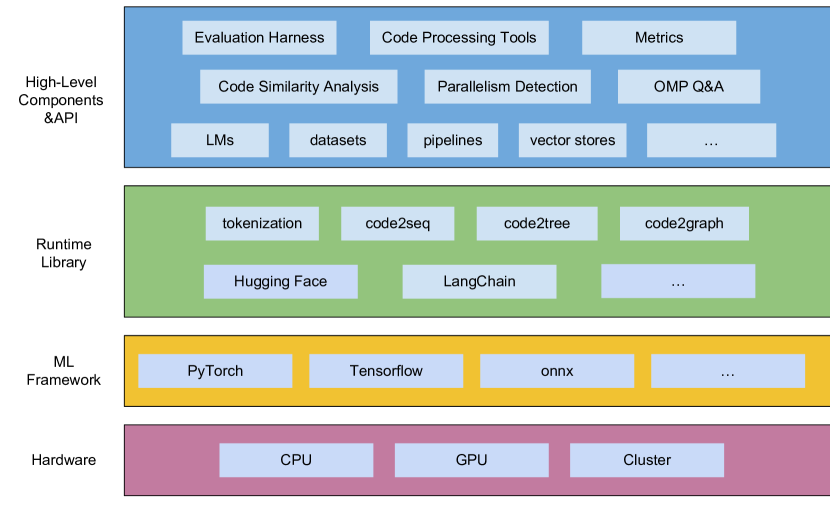
In recent years, language models (LMs), such as GPT-4, have been widely used in multiple domains, including natural language processing, visualization, and so on. However, applying them for analyzing and optimizing high-performance computing (HPC) software is still challenging due to the lack of HPC-specific support. In this paper, we design the LM4HPC framework to facilitate the research and development of HPC software analyses and optimizations using LMs. Tailored for supporting HPC datasets, AI models, and pipelines, our framework is built on top of a range of components from different levels of the machine learning software stack, with Hugging Face-compatible APIs. Using three representative tasks, we evaluated the prototype of our framework. The results show that LM4HPC can help users quickly evaluate a set of state-of-the-art models and generate insightful leaderboards.
Motivation & Objective
- To address the lack of HPC-specific support in mainstream LLM frameworks for analyzing and optimizing HPC software.
- To reduce the barrier for HPC researchers and developers in accessing, evaluating, and deploying LLMs for HPC tasks.
- To establish standardized, reproducible evaluation workflows and metrics for LLMs applied to HPC-specific challenges.
- To provide extensible, Hugging Face-compatible APIs for integrating HPC datasets, models, and pipelines into end-to-end workflows.
- To promote fair comparison and benchmarking of LLMs through leaderboards for representative HPC tasks.
Proposed method
- Designing an extensible framework that integrates HPC-specific datasets, models, and inference pipelines into a unified, API-driven interface.
- Implementing Hugging Face-compatible APIs to enable seamless integration with existing machine learning workflows and tools.
- Developing specialized pipelines for core HPC tasks, including code similarity analysis, parallelism detection, and question answering on OpenMP and MPI.
- Creating and releasing three new HPC-specific datasets: DRB-ML (code similarity), OMP4Par (parallelism detection), and OMPQA (OpenMP question answering).
- Integrating standardized evaluation metrics and reproducible workflows to enable fair benchmarking across different LLMs.
- Supporting both open-source models (e.g., CodeBERT, LLaMA) and proprietary models (e.g., GPT-4) via API access when available.
Experimental results
Research questions
- RQ1How can large language models be effectively and efficiently applied to high-performance computing software analysis and optimization tasks?
- RQ2What are the key challenges in adapting general-purpose language models to HPC-specific programming and performance analysis workloads?
- RQ3How can standardized, reproducible evaluation frameworks be established for LLMs in HPC to enable fair comparison across models?
- RQ4What role do domain-specific datasets play in improving LLM performance on HPC tasks such as code understanding and parallelism detection?
- RQ5How do input length limitations and model architecture choices affect the performance of LLMs on complex HPC code analysis tasks?
Key findings
- GPT-3 demonstrated competitive performance on HPC tasks despite not being specifically fine-tuned for HPC, indicating strong zero-shot generalization capabilities.
- Significant performance gaps were observed in answering OpenMP-related questions, highlighting the need for domain-specific fine-tuning or specialized datasets.
- Input size limitations in LLMs pose a major challenge for tasks involving large codebases or complex parallelism patterns, requiring model or input engineering solutions.
- The LM4HPC framework successfully enabled rapid evaluation of state-of-the-art models and generation of insightful leaderboards across multiple HPC tasks.
- The inclusion of HPC-specific datasets such as OMPQA and OMP4Par significantly improved model performance on targeted tasks compared to general-purpose benchmarks.
- The framework’s Hugging Face-compatible APIs and standardized evaluation pipelines enable reproducible, transparent, and extensible LLM benchmarking in HPC contexts.
Read this paper
Open the full text in the Nubint reader and ask about any passage as you read.
Read this paper on NubintThis review was generated by AI from the original paper. Please check the paper before citing it.