
[Paper Review] StarCoder: may the source be with you!
StarCoderBase and StarCoder are open-access 15.5B Code LLMs with 8K context, trained on The Stack, achieving strong open-model performance and matching or surpassing OpenAI's code-cushman-001, plus safety and attribution tooling for open releases.
The BigCode community, an open-scientific collaboration working on the responsible development of Large Language Models for Code (Code LLMs), introduces StarCoder and StarCoderBase: 15.5B parameter models with 8K context length, infilling capabilities and fast large-batch inference enabled by multi-query attention. StarCoderBase is trained on 1 trillion tokens sourced from The Stack, a large collection of permissively licensed GitHub repositories with inspection tools and an opt-out process. We fine-tuned StarCoderBase on 35B Python tokens, resulting in the creation of StarCoder. We perform the most comprehensive evaluation of Code LLMs to date and show that StarCoderBase outperforms every open Code LLM that supports multiple programming languages and matches or outperforms the OpenAI code-cushman-001 model. Furthermore, StarCoder outperforms every model that is fine-tuned on Python, can be prompted to achieve 40\% pass@1 on HumanEval, and still retains its performance on other programming languages. We take several important steps towards a safe open-access model release, including an improved PII redaction pipeline and a novel attribution tracing tool, and make the StarCoder models publicly available under a more commercially viable version of the Open Responsible AI Model license.
Motivation & Objective
- Develop open-access Code LLMs (StarCoderBase and StarCoder) with broad language support.
- Train on permissively licensed data from The Stack and curate data carefully.
- Conduct comprehensive evaluations against open and closed-code LLMs and assess safety tooling.
- Enable responsible deployment via attribution tracing, improved PII redaction, and an accessible license.
- Provide public release of models under a commercially viable open license with documentation.
Proposed method
- We use 15.5B parameter models with 8K token context and Fill-in-the-Middle infilling.
- StarCoderBase is trained on 1 trillion tokens from The Stack across 80+ languages, GitHub issues, commits, and notebooks.
- StarCoder is a fine-tuned variant trained on an additional 35B Python tokens.
- We implement fast large-batch inference via Multi-Query-Attention.
- Data curation filters include language selection, XML/HTML/JSON/YAML handling, and Jupyter notebook processing.
- A deduplication pipeline (MinHashes and LSH) is applied to code data; data volume is sampled for commits.
- PII redaction is enhanced using a dedicated dataset and a StarEncoder model; an attribution tool is integrated into a VSCode demo for training-data tracing.
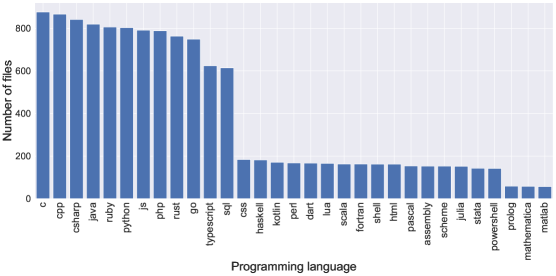
Experimental results
Research questions
- RQ1How do StarCoderBase and StarCoder compare to open Code LLMs across multi-language support?
- RQ2Do StarCoderBase and StarCoder match or surpass OpenAI code-cushman-001 in evaluation benchmarks?
- RQ3Does fine-tuning on Python give StarCoder an edge over other Python-tuned models while preserving cross-language performance?
- RQ4Can open-access releases be made safe and transparent via attribution tools and improved PII redaction?
Key findings
- StarCoderBase outperforms every open LLM that supports multiple programming languages.
- StarCoderBase matches or outperforms the OpenAI code-cushman-001 model.
- When fine-tuned on Python, StarCoder substantially outperforms existing Python-tuned LLMs.
- StarCoder outperforms every model that is fine-tuned on Python while retaining performance across other languages.
- The release includes OpenRAIL-M licensing, an attribution tracing tool, and an improved PII redaction pipeline with a trained StarEncoder.
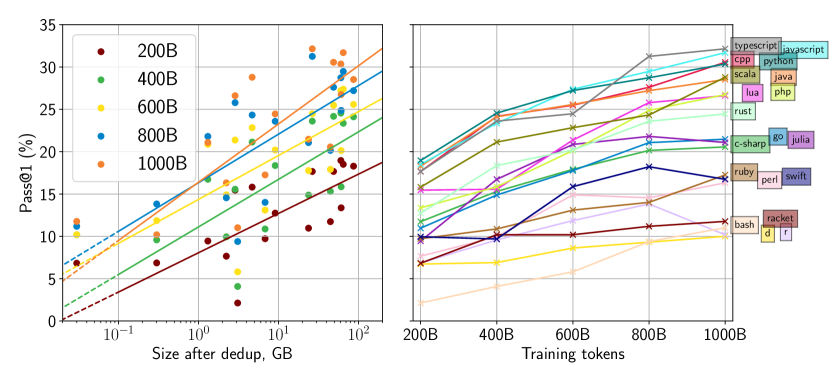
Read this paper
Open the full text in the Nubint reader and ask about any passage as you read.
Read this paper on NubintThis review was generated by AI from the original paper. Please check the paper before citing it.