
[Paper Review] Locosim: an Open-Source Cross-Platform Robotics Framework
Locosim is an open-source, cross-platform robotics framework that unifies simulation and real hardware control using ROS, Python, and C++ via a modular, extensible architecture. It enables rapid prototyping of robot controllers by abstracting low-level details, allowing identical code to run on Gazebo simulations or real robots like the UR5 and Aliengo quadruped, with built-in kinematics, dynamics, and visualization tools via Pinocchio and RViz.
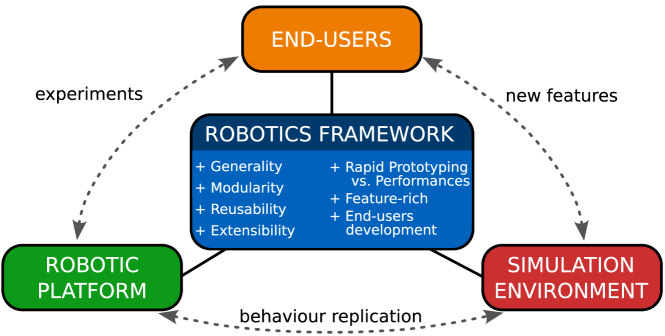
The architecture of a robotics software framework tremendously influences the effort and time it takes for end users to test new concepts in a simulation environment and to control real hardware. Many years of activity in the field allowed us to sort out crucial requirements for a framework tailored for robotics: modularity and extensibility, source code reusability, feature richness, and user-friendliness. We implemented these requirements and collected best practices in Locosim, a cross-platform framework for simulation and real hardware. In this paper, we describe the architecture of Locosim and illustrate some use cases that show its potential.
Motivation & Objective
- Address the challenge of fragmented robotics software development by creating a unified, reusable framework for simulation and real robot control.
- Enable rapid prototyping of robot controllers through high-level Python interfaces while maintaining low-level performance via C++.
- Support diverse robot morphologies—quadrupeds, arms, hybrid systems—through a modular, extensible architecture based on inheritance.
- Reduce development time and increase code reusability by providing out-of-the-box support for kinematics, dynamics, logging, plotting, and visualization.
- Bridge the gap between simulation and real hardware by allowing identical control code to run on both, minimizing porting effort.
Proposed method
- Implement a ROS control node in C++ for low-level hardware interfacing, abstracting real robot or Gazebo simulation interfaces.
- Use a high-level Python ROS node to manage planners and controllers, enabling rapid prototyping and user-friendly development.
- Integrate Pinocchio for efficient computation of robot kinematics and dynamics, including derivatives for optimization.
- Leverage Xacro for modular, human-readable robot description files that support reuse across different robot models.
- Employ ROS launch files to configure robot simulation or real hardware execution via a single flag (real_robot), ensuring code consistency.
- Use RViz for real-time visualization and interactive joint control, with support for saving and restoring configurations via .rviz files.
Experimental results
Research questions
- RQ1How can a robotics framework be designed to minimize the effort required to port control code from simulation to real hardware?
- RQ2What architectural principles enable a robotics framework to support diverse robot morphologies while maintaining modularity and reusability?
- RQ3To what extent can a framework reduce development time by providing built-in support for kinematics, dynamics, logging, and visualization?
- RQ4Can a unified software stack effectively support both high-level prototyping in Python and low-level performance-critical control in C++?
- RQ5How can extensibility and platform independence be achieved in a robotics framework without sacrificing ease of use or performance?
Key findings
- Locosim enables identical control code to be executed on both simulated robots in Gazebo and real hardware, such as the UR5 and Aliengo, with minimal configuration changes.
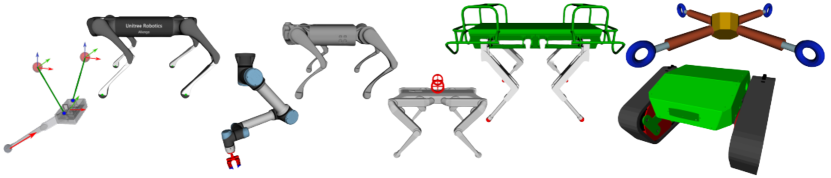
- The framework supports a wide range of robot types, including quadrupeds (Aliengo, HyQ), humanoid arms (UR5), and hybrid systems (Solo with flywheels), demonstrating broad morphological support.
- Using Xacro and modular C++/Python components, new robots can be added with minimal code duplication, significantly reducing the time to integrate new platforms.
- The integration of Pinocchio enables accurate and efficient computation of kinematics and dynamics, including derivatives essential for optimization-based control.
- The use of ROS launch files and a single real_robot flag allows seamless switching between simulation and real robot execution, enhancing development and debugging workflows.
- The framework’s modularity, based on inheritance, allows controllers for one robot type (e.g., fixed-base arm) to be reused for others (e.g., legged robot with flywheels), increasing code reuse.
Read this paper
Open the full text in the Nubint reader and ask about any passage as you read.
Read this paper on NubintThis review was generated by AI from the original paper. Please check the paper before citing it.