
[Paper Review] LogiCoT: Logical Chain-of-Thought Instruction-Tuning
LogiCoT introduces a large-scale, instruction-tuned dataset for logical chain-of-thought reasoning, generated using GPT-4 to produce diverse, multi-step reasoning examples. Fine-tuning LLaMA-7b with LogiCoT significantly improves performance on logical reasoning benchmarks, achieving 40.7% on LogiEval and 43.3% on MMLU, outperforming state-of-the-art instruction-tuned models.
Generative Pre-trained Transformer 4 (GPT-4) demonstrates impressive chain-of-thought reasoning ability. Recent work on self-instruction tuning, such as Alpaca, has focused on enhancing the general proficiency of models. These instructions enable the model to achieve performance comparable to GPT-3.5 on general tasks like open-domain text generation and paraphrasing. However, they fall short of helping the model handle complex reasoning tasks. To bridge the gap, this paper presents LogiCoT, a new instruction-tuning dataset for Logical Chain-of-Thought reasoning with GPT-4. We elaborate on the process of harvesting instructions for prompting GPT-4 to generate chain-of-thought rationales. LogiCoT serves as an instruction set for teaching models of logical reasoning and elicits general reasoning skills.
Motivation & Objective
- To address the lack of diverse, complex logical reasoning instruction data in open-source LLMs.
- To bridge the gap between proprietary models like GPT-4 and open models in multi-step logical reasoning.
- To develop a scalable, self-supervised method for generating high-quality CoT reasoning data using GPT-4.
- To demonstrate that instruction tuning with rich logical reasoning data enhances both specialized and general reasoning abilities in smaller LLMs.
- To release both the LogiCoT dataset and a fine-tuned LLaMA-7b model for community use and further research.
Proposed method
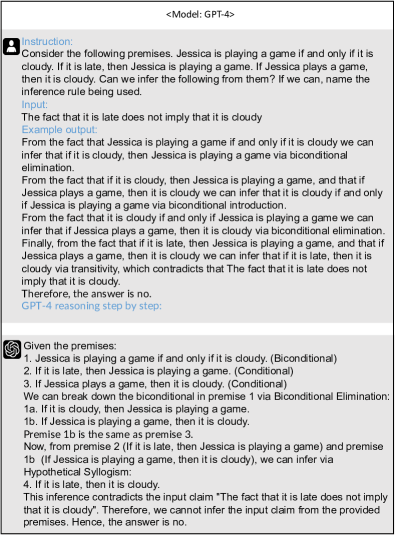
- Leveraged GPT-4 to generate chain-of-thought rationales by prompting it with existing logical reasoning datasets.
- Constructed a diverse instruction-tuning dataset by repurposing existing logical reasoning data and applying GPT-4 to generate structured, multi-step reasoning outputs.
- Designed instruction templates covering multiple reasoning types: language-to-logic mapping, one-step inference, inference chains, and multi-choice reasoning.
- Collected 70,000 training instances spanning symbolic reasoning and complex multi-step logical deductions.
- Fine-tuned the LLaMA-7b model using the LogiCoT dataset with a standard instruction-tuning objective to improve reasoning generalization.
- Conducted ablation studies to evaluate the contribution of each reasoning type to overall model performance.
Experimental results
Research questions
- RQ1Can GPT-4 be effectively used to generate high-quality, diverse chain-of-thought reasoning examples for instruction tuning?
- RQ2How does instruction tuning with a dataset focused on logical reasoning improve a model’s performance on reasoning benchmarks?
- RQ3What is the relative contribution of different reasoning types (e.g., inference chains, multi-choice) to overall reasoning performance?
- RQ4To what extent can a smaller open-weight LLM like LLaMA-7b achieve competitive reasoning performance when fine-tuned on a specialized CoT dataset?
- RQ5Can the LogiCoT dataset generalize to both specialized logical reasoning and broader human-centric benchmarks?
Key findings
- The LogiCoT instruction-tuned LLaMA-7b model achieved 40.7% accuracy on the LogiEval benchmark, significantly outperforming prior instruction-tuned models.
- On the MMLU benchmark, the model reached 43.3% accuracy, demonstrating strong generalization to diverse reasoning tasks.
- Ablation studies showed that removing 'inference chain' reasoning led to the largest performance drop (30.8% on LogiEval), highlighting its critical role in multi-step reasoning.
- The 'multi-choice' reasoning type had the most significant negative impact on MMLU (30.9% accuracy when removed), indicating its importance for multiple-choice logical tasks.
- Case studies revealed that the model generates coherent rationales in correct cases but occasionally introduces flawed constraints or skips option evaluation in complex problems.
- The model’s performance remains below that of GPT-4, indicating room for improvement, but it establishes a strong baseline for open-source reasoning models.

Read this paper
Open the full text in the Nubint reader and ask about any passage as you read.
Read this paper on NubintThis review was generated by AI from the original paper. Please check the paper before citing it.