
[Paper Review] LuSEE 'Night': The Lunar Surface Electromagnetics Experiment
LuSEE Night is a low-frequency radio astronomy experiment on the lunar farside designed to operate through the 14-Earth-day lunar night with 50 MHz bandwidth, using orthogonal 6 m dipoles and a 4-channel Nyquist baseband spectrometer to measure the global radio sky below 50 MHz in a EMI-free environment.
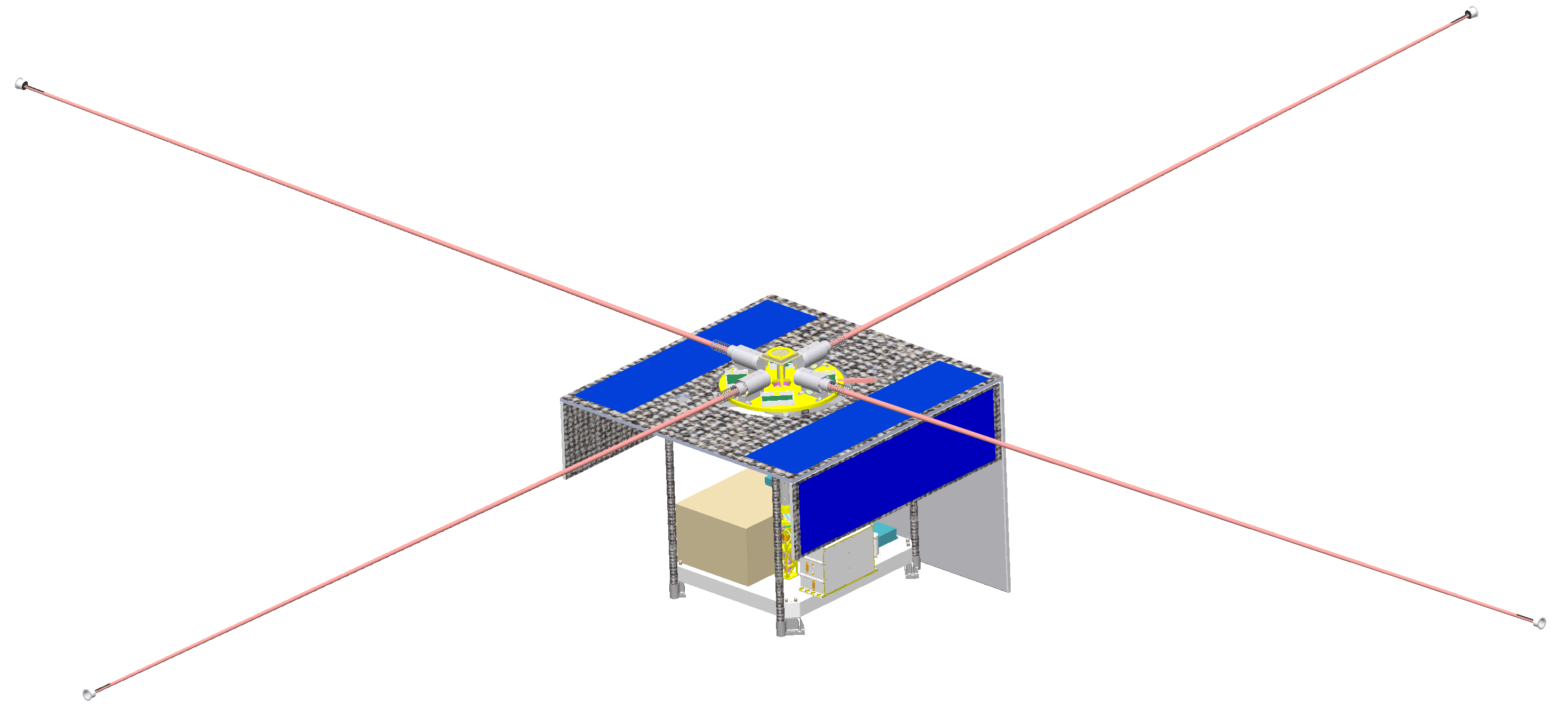
The Lunar Surface Electromagnetics Explorer 'LuSEE Night' is a low frequency radio astronomy experiment that will be delivered to the farside of the Moon by the NASA Commercial Lunar Payload Services (CLPS) program in late 2025 or early 2026. The payload system is being developed jointly by NASA and the US Department of Energy (DOE) and consists of a 4 channel, 50 MHz Nyquist baseband receiver system and 2 orthogonal $\sim$6m tip-to-tip electric dipole antennas. LuSEE Night will enjoy standalone operations through the lunar night, without the electromagnetic interference (EMI) of an operating lander system and antipodal to our noisy home planet.
Motivation & Objective
- Characterize the global radio sky below 50 MHz from the pristine lunar farside environment.
- Assess the feasibility of long-duration low-frequency radio observations during the lunar night without lander EMI.
- Provide calibration and system characterization to support future lunar radio astronomy endeavors.
- Contribute data towards understanding foregrounds for high-redshift 21 cm cosmology (Dark Ages).
- Inform design and operational lessons for future LuSEE-like missions.
Proposed method
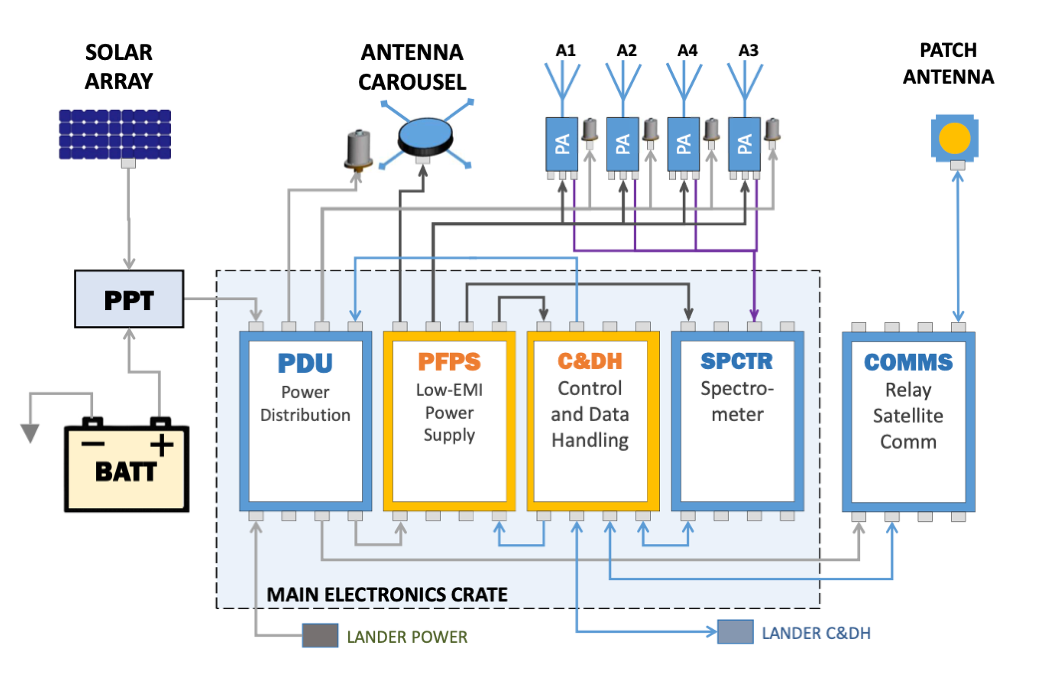
- Deploy a 4-channel, 50 MHz Nyquist baseband receiver system.
- Use two orthogonal ~6 m tip-to-tip electric dipole antennas configured on a rotating carousel for orientation studies.
- Record four single-ended antenna voltages at 102.4 Msamples/sec and compute auto- and cross-correlation spectra using an FPGA-based spectrometer.
- Compute Stokes parameters from cross-correlations to avoid antenna shotnoise.
- Employ a DC-DC converter with stable switching frequencies to facilitate digital signal processing and mitigate power-supply noise.
- Incorporate a large battery to power through the lunar night and a DCB to interface with lander C&DH and communications.
Experimental results
Research questions
- RQ1What is the global low-frequency radio sky spectrum below 50 MHz as observed from the lunar farside?
- RQ2How does the lunar environment (EMI-free, horizon, regolith) affect measurements and spectral chromaticity compared to Earth-based or other lunar experiments?
- RQ3Can LuSEE Night inform foreground models and calibration strategies relevant to high-redshift 21 cm cosmology (Dark Ages)?
Key findings
- LuSEE Night will operate through the lunar night with a ~40 kg battery and a rotating antenna carousel for in situ calibration studies.
- The spectrometer samples at 102.4 Msamples/sec and uses cross-correlations to produce spectral information and potential Stokes parameters.
- The payload architecture mirrors heritage from Parker Solar Probe instruments, adapted for lunar conditions and EMI-free observing.
- A far-field calibration source (FFCS) concept (CS-4) is proposed to provide known signals for antenna pattern and system response calibration over 30 passes in ~50 Earth days.
- Landing site and thermal design considerations aim to minimize terrestrial RFI influence and thermal challenges, enabling long-duration, autonomous operation.
Read this paper
Open the full text in the Nubint reader and ask about any passage as you read.
Read this paper on NubintThis review was generated by AI from the original paper. Please check the paper before citing it.