
[论文解读] Machine Learning-based Lung and Colon Cancer Detection using Deep Feature Extraction and Ensemble Learning
本研究提出了一种混合机器学习框架,结合基于迁移学习的深度特征提取(使用MobileNet)与集成学习(软投票),实现肺癌和结肠癌的自动化检测。在LC25000组织病理学数据集上评估,该模型在肺癌检测中达到99.05%的准确率,结肠癌检测中达到100%,联合检测准确率为99.30%,优于现有方法。
Cancer is a fatal disease caused by a combination of genetic diseases and a variety of biochemical abnormalities. Lung and colon cancer have emerged as two of the leading causes of death and disability in humans. The histopathological detection of such malignancies is usually the most important component in determining the best course of action. Early detection of the ailment on either front considerably decreases the likelihood of mortality. Machine learning and deep learning techniques can be utilized to speed up such cancer detection, allowing researchers to study a large number of patients in a much shorter amount of time and at a lower cost. In this research work, we introduced a hybrid ensemble feature extraction model to efficiently identify lung and colon cancer. It integrates deep feature extraction and ensemble learning with high-performance filtering for cancer image datasets. The model is evaluated on histopathological (LC25000) lung and colon datasets. According to the study findings, our hybrid model can detect lung, colon, and (lung and colon) cancer with accuracy rates of 99.05%, 100%, and 99.30%, respectively. The study's findings show that our proposed strategy outperforms existing models significantly. Thus, these models could be applicable in clinics to support the doctor in the diagnosis of cancers.
研究动机与目标
- 开发一种高精度、自动化的早期肺癌和结肠癌检测系统,利用机器学习技术。
- 通过结合深度特征提取与集成学习技术,提升分类性能。
- 通过多种迁移学习架构和机器学习算法,评估并优化模型性能。
- 在保持高检测准确率的同时,减少诊断时间和资源消耗。
- 提供一种临床可用的工具,辅助病理科医生诊断肺癌和结肠癌。
提出的方法
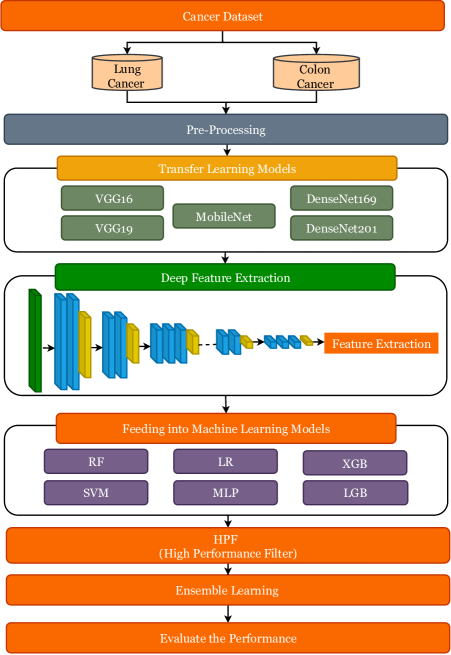
- 采用五种预训练的迁移学习模型——VGG16、VGG19、MobileNet、DenseNet169和DenseNet201——从组织病理学图像中提取深度特征。
- 应用k折交叉验证(10折)以确保模型评估的稳健性与泛化能力。
- 使用高性能过滤(HPF)从随机森林(RF)、支持向量机(SVM)、逻辑回归(LR)、多层感知机(MLP)、XGBoost(XGB)和LightGBM(LGB)中筛选表现最佳的机器学习模型。
- 将表现最佳的模型整合为集成软投票分类器,以提升预测准确率与稳定性。
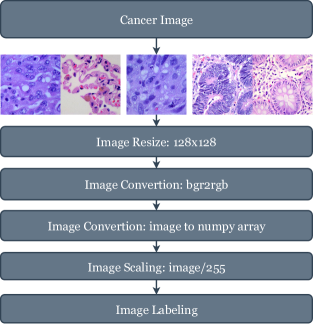
- 应用广泛的图像预处理技术,以提高特征质量与模型输入的一致性。
- 采用多种指标评估模型性能:准确率、精确率、召回率、F1分数、AUC-ROC、MAE、MSE、RMSE以及混淆矩阵。
实验结果
研究问题
- RQ1混合深度学习与集成学习框架能否提升从组织病理学图像中检测肺癌和结肠癌的准确率?
- RQ2在癌症分类任务中,哪种迁移学习模型(VGG16、VGG19、MobileNet、DenseNet169、DenseNet201)在特征提取方面表现最佳?
- RQ3与单个模型相比,采用软投票的集成学习在分类鲁棒性与准确率方面表现如何?
- RQ4与标准机器学习模型相比,所提出的模型在计算效率(时间与空间复杂度)方面表现如何?
- RQ5所提出的模型能否在保持极短预测时间的同时实现接近完美的准确率,从而具备临床部署的可行性?
主要发现
- 所提出的模型在LC25000数据集上检测肺癌的准确率达到99.05%。
- 该模型在结肠癌检测中达到100%的准确率,表明在该类别上表现极为出色。
- 在联合检测肺癌与结肠癌时,模型准确率达到99.30%,展现出强大的泛化能力。
- MobileNet因其性能与效率的平衡,被选为最优的迁移学习模型用于特征提取。
- 集成软投票分类器优于单个模型,证实了模型堆叠在癌症分类中的有效性。
- 预测时间极短——肺癌检测仅需2秒,结肠癌检测为0秒,联合检测为14秒,表明其具备临床可行性。
更好的研究,从现在开始
从阅读论文到最终审阅,大幅缩短您的研究时间。
无需绑定信用卡
本解读由 AI 生成,并经人工编辑审核。