
[Paper Review] MACM: Utilizing a Multi-Agent System for Condition Mining in Solving Complex Mathematical Problems
This paper proposes MACM, a multi-agent system that enhances large language models (LLMs) for complex mathematical problem-solving by iteratively mining logical conditions from problems. By abstracting objectives and dynamically expanding known conditions through agent collaboration, MACM boosts GPT-4 Turbo’s accuracy on level 5 MATH dataset problems from 54.68% to 76.73%, demonstrating superior generalization and error correction over existing prompting methods.
Recent advancements in large language models, such as GPT-4, have demonstrated remarkable capabilities in processing standard queries. Despite these advancements, their performance substantially declines in extbf{advanced mathematical problems requiring complex, multi-step logical reasoning}. To enhance their inferential capabilities, current research has delved into extit{prompting engineering}, exemplified by methodologies such as the Tree of Thought and Graph of Thought. Nonetheless, these existing approaches encounter two significant limitations. Firstly, their effectiveness in tackling complex mathematical problems is somewhat constrained. Secondly, the necessity to design distinct prompts for individual problems hampers their generalizability. In response to these limitations, this paper introduces the extit{Multi-Agent System for conditional Mining} ( extbf{MACM}) prompting method. It not only resolves intricate mathematical problems but also demonstrates strong generalization capabilities across various mathematical contexts. With the assistance of MACM, the accuracy of GPT-4 Turbo on the most challenging level five mathematical problems in the MATH dataset increase from $\mathbf{54.68\%} ext{ to } \mathbf{76.73\%}$. The code is available in \url{https://github.com/bin123apple/MACM}.
Motivation & Objective
- To address the limited reasoning capability of LLMs in solving complex, multi-step mathematical problems.
- To overcome the poor generalizability of existing prompting methods that require problem-specific prompt engineering.
- To develop a prompting framework that abstracts problems into conditions and objectives for reusable, scalable reasoning.
- To improve error correction and accuracy in LLM-based mathematical problem solving without fine-tuning.
- To enable a general-purpose prompting method applicable across diverse mathematical domains.
Proposed method
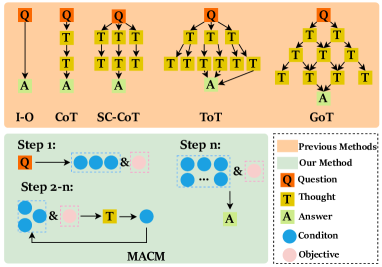
- MACM introduces a multi-agent system that extracts and iteratively expands known conditions from a problem’s objective and initial constraints.
- It abstracts each problem into a set of initial conditions and a target objective, decoupling reasoning from problem-specific prompt structures.
- Agents collaboratively generate new logical inferences from existing conditions, progressively building toward a solution.
- The method avoids hierarchical reasoning structures (e.g., trees or graphs) by compressing reasoning paths into evolving condition sets.
- MACM uses iterative condition mining and validation, enabling error detection and correction through repeated reasoning cycles.
- The system dynamically updates the condition set, allowing richer interconnections between inferences than traditional prompting methods.
Experimental results
Research questions
- RQ1Can a multi-agent system improve the reasoning accuracy of LLMs on complex mathematical problems without fine-tuning?
- RQ2How does MACM’s condition-mining approach generalize across diverse mathematical problem types compared to existing prompting methods?
- RQ3To what extent can MACM correct errors made by base LLMs like GPT-4 Turbo in challenging problem sets?
- RQ4What is the trade-off between inference cost (number of LLM calls) and accuracy improvement in MACM versus other prompting techniques?
- RQ5Does MACM outperform state-of-the-art prompting frameworks like Tree of Thought and Graph of Thought in both accuracy and generalization?
Key findings
- MACM increased GPT-4 Turbo’s accuracy on level 5 MATH dataset problems from 54.68% to 76.73%, a 22.05 percentage point improvement.
- On the 24-point game, MACM achieved 17% higher accuracy than Tree of Thought using the same GPT-4 model.
- MACM outperformed SC-CoT by 7.8 percentage points on the MATH dataset, demonstrating superior generalization and error correction.
- In number sequence sorting (64 elements), MACM achieved 92% accuracy with GPT-3.5, outperforming GoT’s estimated 89.06%.
- MACM showed a higher accuracy ceiling than I-O, CoT, and SC-CoT when increasing the number of LLM responses, correcting nearly 90% of original GPT-4 Turbo errors at scale.
- The method’s iterative condition expansion enables deeper logical inference and better error detection than hierarchical prompting methods.

Read this paper
Open the full text in the Nubint reader and ask about any passage as you read.
Read this paper on NubintThis review was generated by AI from the original paper. Please check the paper before citing it.