
[Paper Review] Magic phase transition and non-local complexity in generalized $W$ State
This paper introduces a novel quantum phase transition in topologically frustrated spin chains, characterized not by entanglement but by a discontinuous jump in Stabilizer Rényi Entropy (SRE), signaling a 'pure magic transition' due to non-stabilizer resources. Using a Clifford circuit mapping, the authors show that generalized $W$-states with finite momentum exhibit this SRE jump, while entanglement entropy remains continuous, establishing SRE as a detector of unconventional phase transitions in deterministic quantum systems.
We employ the Stabilizer Renyi Entropy (SRE) to characterize a quantum phase transition that has so far eluded any standard description and can thus now be explained in terms of the interplay between its non-stabilizer properties and entanglement. The transition under consideration separates a region with a unique ground state from one with a degenerate ground state manifold spanned by states with finite and opposite (intensive) momenta. We show that SRE has a jump at the crossing points, while the entanglement entropy remains continuous. Moreover, by leveraging on a Clifford circuit mapping, we connect the observed jump in SRE to that occurring between standard and generalized $W$-states with finite momenta. This mapping allows us to quantify the SRE discontinuity analytically.
Motivation & Objective
- To identify and characterize a quantum phase transition in the frustrated XYZ spin chain that lacks conventional order parameters and is undetected by entanglement entropy.
- To investigate whether Stabilizer Rényi Entropy (SRE) can detect phase transitions driven by topological frustration and non-Clifford resources.
- To establish a connection between the SRE discontinuity and the emergence of finite-momentum ground states in generalized $W$-states via Clifford circuit mappings.
- To demonstrate that SRE, unlike entanglement entropy, exhibits a finite jump at the transition point, signaling a first-order magic transition.
- To show that SRE captures non-local complexity arising from topological frustration, even when correlation functions decay in the thermodynamic limit.
Proposed method
- Employing Stabilizer Rényi Entropy (SRE) with Rényi index 2 as a measure of quantum complexity and non-Clifford resources.
- Using a Clifford circuit mapping to relate generalized $W$-states with finite momentum to the low-energy states of the frustrated XYZ model near the classical Ising point.
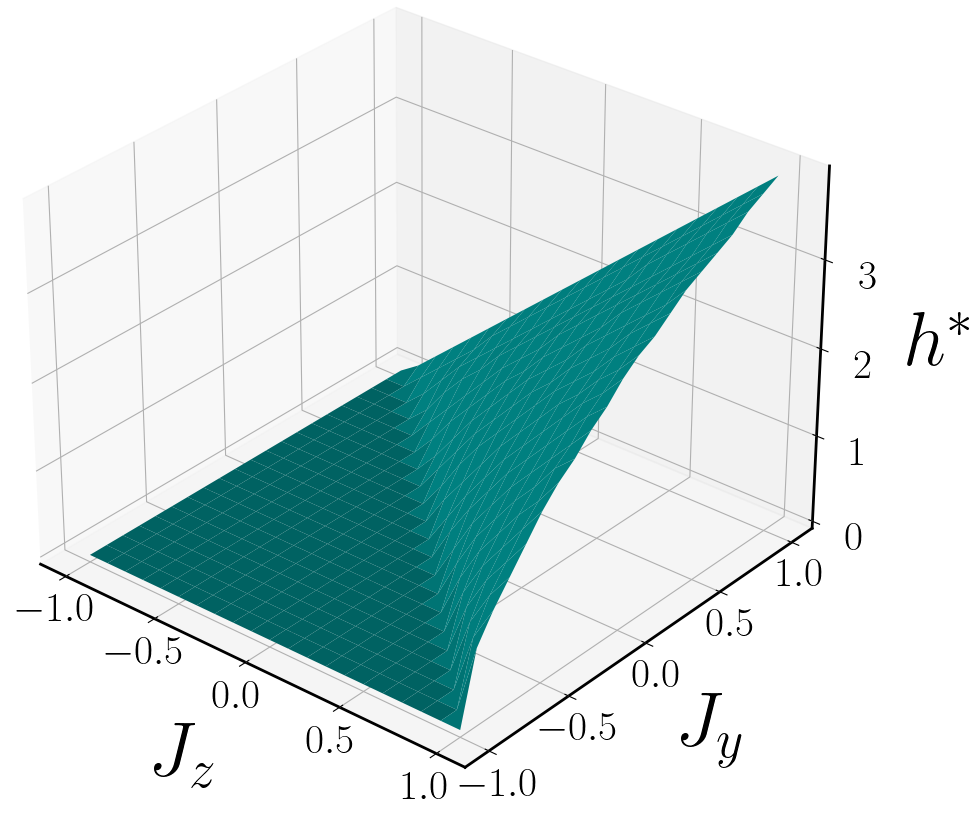
- Performing finite-size scaling analysis of the SRE discontinuity at the critical magnetic field $h^*$, comparing with entanglement entropy behavior.
- Numerically computing the SRE for ground states under Frustrated Boundary Conditions (FBCs) in the 1D XYZ chain with odd $L$.
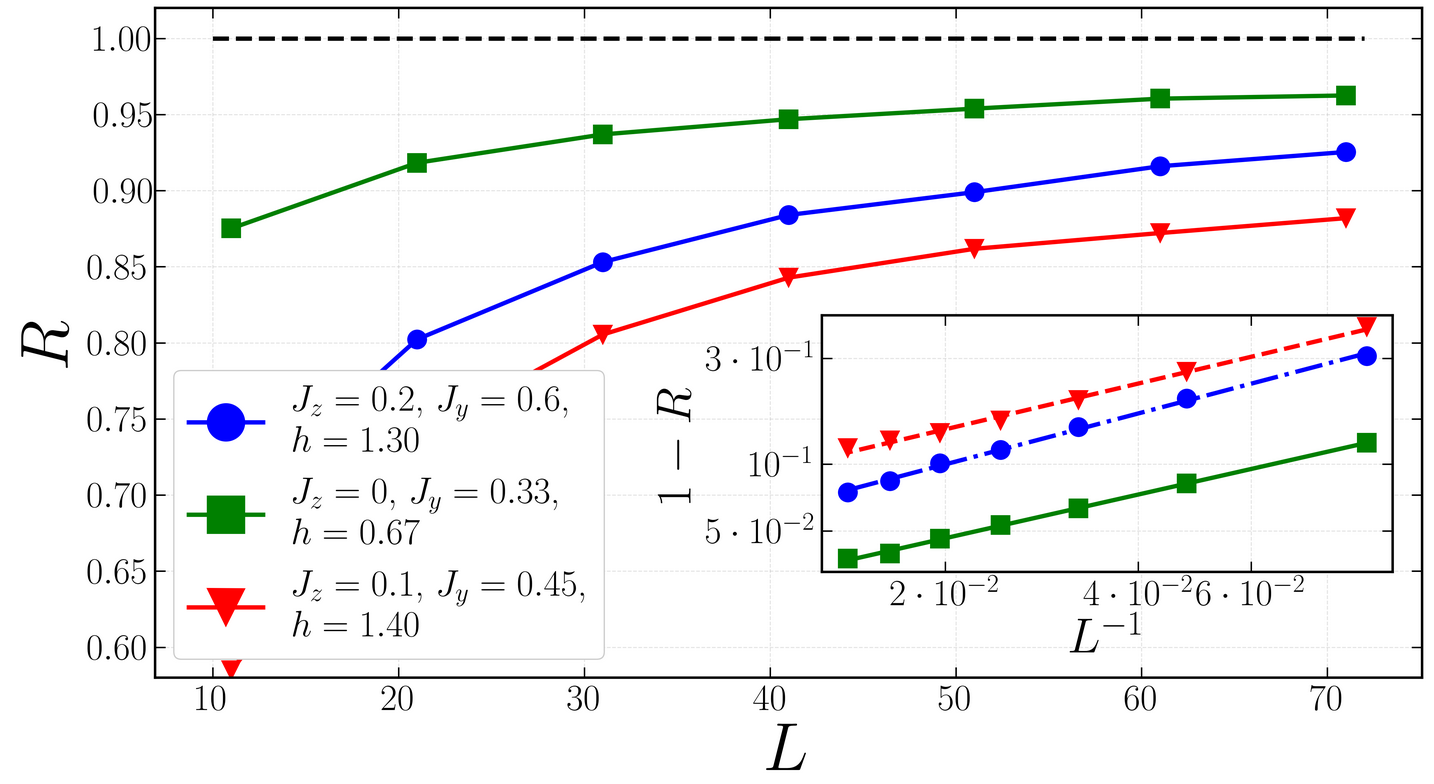
- Analyzing the convergence of the SRE jump amplitude to the analytical value $\log_2(7/6)$ in the thermodynamic limit.
- Evaluating the bipartite entanglement entropy via 2-Rényi entropy to contrast its continuous behavior with the discontinuous SRE.
Experimental results
Research questions
- RQ1Can Stabilizer Rényi Entropy (SRE) detect a quantum phase transition that is invisible to standard entanglement measures in a deterministic many-body system?
- RQ2What is the role of non-Clifford resources (magic) in driving a phase transition when entanglement remains continuous?
- RQ3How does the SRE of generalized $W$-states with finite momentum relate to the ground state structure of topologically frustrated spin chains?
- RQ4Why does the SRE exhibit a finite jump at the transition point while entanglement entropy does not, despite both being entropic measures?
- RQ5Can the SRE discontinuity be analytically quantified and numerically verified in the thermodynamic limit?
Key findings
- The Stabilizer Rényi Entropy (SRE) exhibits a finite discontinuity at the phase transition point, with amplitude converging to $\log_2(7/6)$ in the thermodynamic limit.
- Entanglement entropy remains continuous across the transition, showing no discontinuity even in finite-size systems, indicating it cannot detect this phase transition.
- The SRE jump is analytically linked to the transition between standard and generalized $W$-states with finite momentum via a Clifford circuit mapping.
- Generalized $W$-states with finite momentum preserve the same entanglement as standard $W$-states but exhibit higher non-local complexity, as measured by SRE.
- The transition is classified as a first-order 'magic transition'—a pure SRE discontinuity not accompanied by entanglement or energy gap changes.
- The SRE detects the transition due to its sensitivity to the sum of exponentially many correlation functions, which can remain finite even when individual correlations decay as $L^{-1}$.
Read this paper
Open the full text in the Nubint reader and ask about any passage as you read.
Read this paper on NubintThis review was generated by AI from the original paper. Please check the paper before citing it.