
[Paper Review] Magnetic catalysis in weakly interacting hyperbolic Dirac materials
This paper proposes that external magnetic fields induce a finite density of states near zero energy in weakly interacting hyperbolic Dirac materials (HDMs), enabling magnetic catalysis of charge-density-wave (CDW) order even for infinitesimal nearest-neighbor Coulomb repulsion. The mechanism operates via magnetic flux-induced gap generation, leading to spontaneous sublattice symmetry breaking and correlated insulator formation at half-filling, valid for both uniform and inhomogeneous magnetic fields.
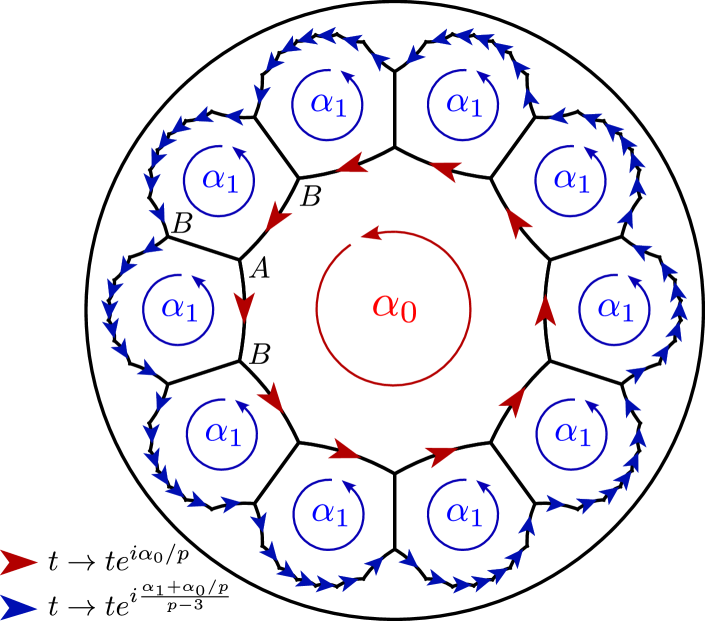
Due to the linearly vanishing density of states, emergent massless Dirac quasiparticles resulting from the free fermion motion in a family of two-dimensional half-filled bipartite hyperbolic lattices feature dynamic mass generation through quantum phase transitions only for sufficiently strong finite-range Coulomb repulsion. As such, strong nearest-neighbor Coulomb repulsion ($V$) favors the nucleation of a charge-density-wave (CDW) order with a staggered pattern of average fermionic density between two sublattices of bipartite hyperbolic lattices. Considering a collection of spinless fermions (for simplicity), here we show that application of strong external magnetic fields by virtue of producing a \emph{finite} density of states near the zero energy triggers the condensation of the CDW order even for \emph{infinitesimal} $V$. The proposed curved space magnetic catalysis mechanism is operative for uniform and inhomogeneous (bell-shaped) magnetic fields. We present scaling of the CDW order with the total flux enclosed by hyperbolic Dirac materials for a wide range of (especially subcritical) $V$.
Motivation & Objective
- To investigate whether magnetic fields can trigger dynamic mass generation and CDW order in hyperbolic Dirac materials (HDMs) with vanishing density of states at half-filling.
- To determine if subcritical Coulomb repulsion (V < V_c) can nucleate CDW order when magnetic fields induce a finite density of states near zero energy.
- To examine the role of magnetic flux—uniform and inhomogeneous—on the emergence of CDW order in HDMs with open boundary conditions.
- To establish the scaling behavior of the CDW order parameter with total enclosed magnetic flux across different HDMs (10,3), (14,3), and (18,3).
Proposed method
- Numerical self-consistent Hartree-Fock solutions of the CDW order parameter on (10,3), (14,3), and (18,3) hyperbolic lattices with open boundaries.
- Application of Peierls substitution to model uniform and bell-shaped magnetic flux profiles via phase factors on nearest-neighbor hopping terms.
- Use of a two-component superspinor basis (c_A, c_B) to represent sublattice degrees of freedom and diagonalize the effective Hamiltonian with CDW mass term Δ.
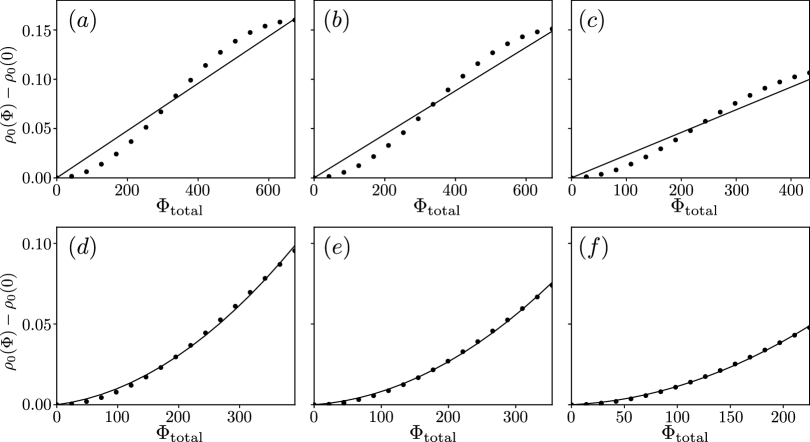
- Calculation of the density of states (DOS) near zero energy, ρ(0), with and without magnetic fields, subtracting baseline DOS to isolate flux-induced effects.
- Fitting the CDW order parameter δ to an exponential scaling form δ = a exp(–b / [Φ_total – Φ_th]) for Φ_total > Φ_th to extract critical flux thresholds.
- Analysis of the anticommutation between the non-interacting Hamiltonian h₀ and the CDW Hamiltonian h_CDW, confirming the CDW order acts as a mass gap for Dirac fermions.
Experimental results
Research questions
- RQ1Can magnetic fields induce a finite density of states near zero energy in HDMs with linearly vanishing DOS, enabling CDW order at subcritical V?
- RQ2Does magnetic catalysis of CDW order persist under inhomogeneous (bell-shaped) magnetic fields, and how does it compare to uniform fields?
- RQ3How does the CDW order parameter scale with the total enclosed magnetic flux Φ_total for different HDMs and subcritical V?
- RQ4What is the role of finite-size effects in determining the critical flux threshold Φ_th for CDW nucleation?
- RQ5Can the CDW order parameter be described by a universal scaling law across different HDMs and V values?
Key findings
- Magnetic fields induce a finite density of states near zero energy in HDMs, enabling magnetic catalysis of CDW order even for infinitesimal nearest-neighbor Coulomb repulsion (V < V_c).
- The CDW order parameter δ scales exponentially with total magnetic flux as δ = a exp(–b / [Φ_total – Φ_th]) for Φ_total > Φ_th, with fitting parameters (a, b, Φ_th) depending on the HDM and V.
- For V = 0.55, the fitting parameters are (0.071, 70, 260) for uniform and (0.090, 175, 215) for inhomogeneous fields in the (10,3) HDM, showing a strong dependence on field profile.
- The critical flux threshold Φ_th decreases monotonically with increasing V, indicating that weaker magnetic fields suffice to trigger CDW order as V approaches V_c.
- The CDW order parameter is positive definite for all V < V_c and Φ_total, confirming the stability of the catalyzed phase.
- Spontaneous sublattice symmetry breaking via CDW order opens a gap at half-filling, transforming HDMs into correlated insulators, as confirmed by the anticommutation of h₀ and h_CDW.
Read this paper
Open the full text in the Nubint reader and ask about any passage as you read.
Read this paper on NubintThis review was generated by AI from the original paper. Please check the paper before citing it.