
[Paper Review] Magnification Prior: A Self-Supervised Method for Learning Representations on Breast Cancer Histopathological Images
This paper proposes Magnification Prior Contrastive Similarity (MPCS), a self-supervised representation learning method for breast cancer histopathology images that leverages magnification factors as a data-derived supervisory signal to create positive pairs without human-annotated labels. MPCS achieves state-of-the-art performance on malignancy classification with only 20% labeled data, outperforming fully supervised methods and demonstrating that reducing human-induced priors enhances representation learning efficiency.
This work presents a novel self-supervised pre-training method to learn efficient representations without labels on histopathology medical images utilizing magnification factors. Other state-of-theart works mainly focus on fully supervised learning approaches that rely heavily on human annotations. However, the scarcity of labeled and unlabeled data is a long-standing challenge in histopathology. Currently, representation learning without labels remains unexplored for the histopathology domain. The proposed method, Magnification Prior Contrastive Similarity (MPCS), enables self-supervised learning of representations without labels on small-scale breast cancer dataset BreakHis by exploiting magnification factor, inductive transfer, and reducing human prior. The proposed method matches fully supervised learning state-of-the-art performance in malignancy classification when only 20% of labels are used in fine-tuning and outperform previous works in fully supervised learning settings. It formulates a hypothesis and provides empirical evidence to support that reducing human-prior leads to efficient representation learning in self-supervision. The implementation of this work is available online on GitHub - https://github.com/prakashchhipa/Magnification-Prior-Self-Supervised-Method
Motivation & Objective
- To address the scarcity of labeled data in histopathology image analysis by enabling self-supervised pre-training without human annotations.
- To explore whether data-derived priors—specifically magnification factors—can serve as effective supervision signals for contrastive representation learning.
- To investigate the hypothesis that reducing human-induced priors in self-supervised learning improves representation quality and generalization.
- To evaluate the effectiveness of MPCS on small-scale, public breast cancer datasets including BreakHis, BACH, and Breast Cancer Cell Dataset.
- To demonstrate label efficiency by matching or exceeding fully supervised SOTA performance with only 20% of labels.
Proposed method
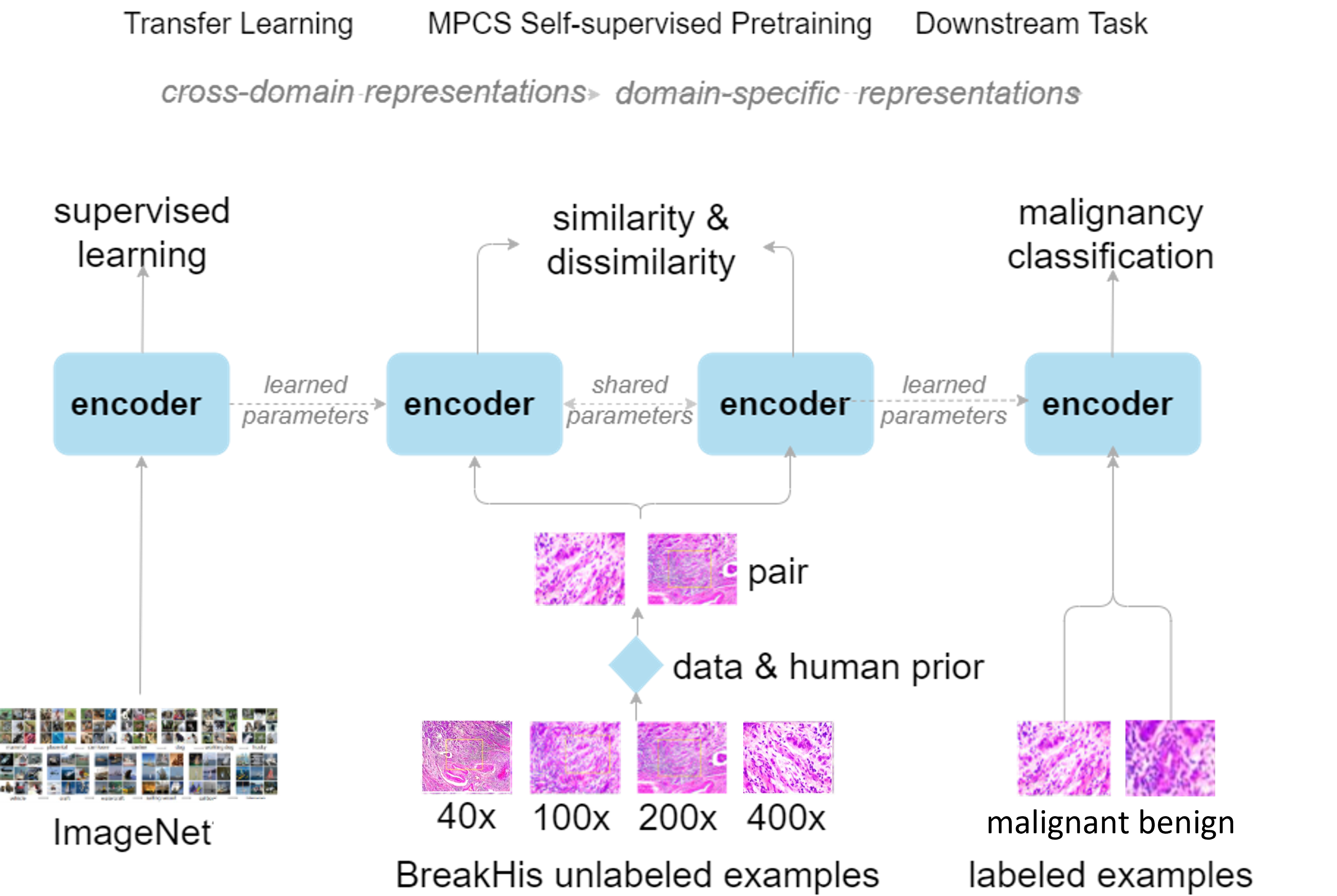
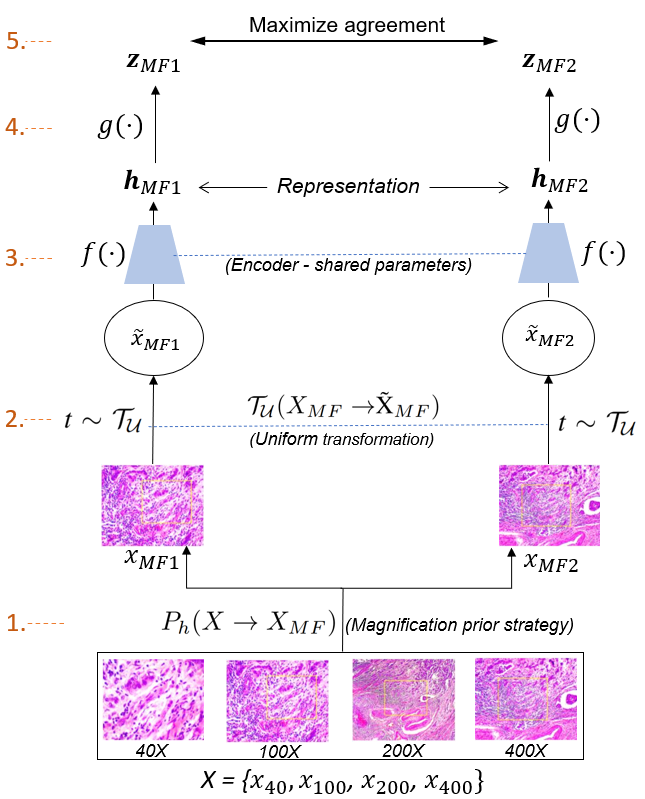
- MPCS uses magnification factors (40X, 100X, 200X, 400X) as a data prior to generate positive pairs for contrastive learning, eliminating reliance on human-designed augmentations.
- The method employs three variants: MPCS-Random Pair (random view sampling), MPCS-Ordered Pair (ordered sampling), and MPCS-Fixed Pair (fixed 200X–400X pairs), varying degrees of human prior induction.
- Contrastive learning is applied using a Siamese network architecture with feature encoders pre-trained on ImageNet (EfficientNet and dilated ResNet-50).
- Self-supervised pre-training is performed on unlabeled BreakHis images before fine-tuning on downstream malignancy classification tasks.
- The model is evaluated via linear evaluation and fine-tuning on three public datasets: BreakHis, BACH, and Breast Cancer Cell Dataset.
- Class activation mapping (CAM) is used to qualitatively validate that MPCS models learn to attend to biologically relevant regions in histopathology images.
Experimental results
Research questions
- RQ1Can magnification factors serve as a reliable data prior to enable self-supervised contrastive learning in histopathology without human-annotated labels?
- RQ2Does reducing human-induced prior in pair sampling improve the quality of learned representations in self-supervised representation learning?
- RQ3How does MPCS perform in terms of label efficiency compared to fully supervised state-of-the-art methods?
- RQ4Can MPCS learn discriminative features across benign and malignant classes without access to ground-truth labels during pre-training?
- RQ5Does cross-magnification evaluation confirm that MPCS representations are magnification-invariant and robust?
Key findings
- MPCS outperforms fully supervised SOTA methods on three public datasets, including BreakHis, when fine-tuned with only 20% of the labels.
- On the Breast Cancer Cell Dataset, MPCS achieves 98.18% accuracy in fine-tuning and 96.36% in linear evaluation, significantly outperforming prior methods.
- With only 20% labeled data, MPCS fine-tuned models achieve a 2.52% absolute improvement over ImageNet pre-trained models (p < 0.01), matching SOTA performance trained on 100% labels.
- The MPCS-Ordered Pair variant, which induces weaker human prior, outperforms both the fixed-pair (stronger human prior) and random-pair (no human prior) variants under low-label regimes.
- t-SNE visualization confirms that MPCS pre-trained features are highly discriminative and separable across benign and malignant classes across all magnification levels.
- CAM analysis shows that MPCS-fine-tuned models activate regions of interest (e.g., nuclei) more effectively than ImageNet-pretrained models on BreakHis and BACH datasets.
Better researchstarts right now
From reading papers to final review, dramatically reduce your research time.
No credit card · Free plan available
This review was created by AI and reviewed by human editors.