
[Paper Review] Mamba in Speech: Towards an Alternative to Self-Attention
This paper investigates bidirectional Mamba (BiMamba) as an alternative to self-attention in Transformer and Conformer for speech processing, showing BiMamba (especially ExtBiMamba) excels in speech enhancement and speech recognition tasks by incorporating higher nonlinearity.
Transformer and its derivatives have achieved success in diverse tasks across computer vision, natural language processing, and speech processing. To reduce the complexity of computations within the multi-head self-attention mechanism in Transformer, Selective State Space Models (i.e., Mamba) were proposed as an alternative. Mamba exhibited its effectiveness in natural language processing and computer vision tasks, but its superiority has rarely been investigated in speech signal processing. This paper explores solutions for applying Mamba to speech processing by discussing two typical speech processing tasks: speech recognition, which requires semantic and sequential information, and speech enhancement, which focuses primarily on sequential patterns. The experimental results confirm that bidirectional Mamba (BiMamba) consistently outperforms vanilla Mamba, highlighting the advantages of a bidirectional design for speech processing. Moreover, experiments demonstrate the effectiveness of BiMamba as an alternative to the self-attention module in the Transformer model and its derivates, particularly for the semantic-aware task. The crucial technologies for transferring Mamba to speech are then summarized in ablation studies and the discussion section, offering insights for extending this research to a broader scope of tasks.
Motivation & Objective
- Motivate replacing multi-head self-attention (MHSA) with state-space based Mamba in speech tasks.
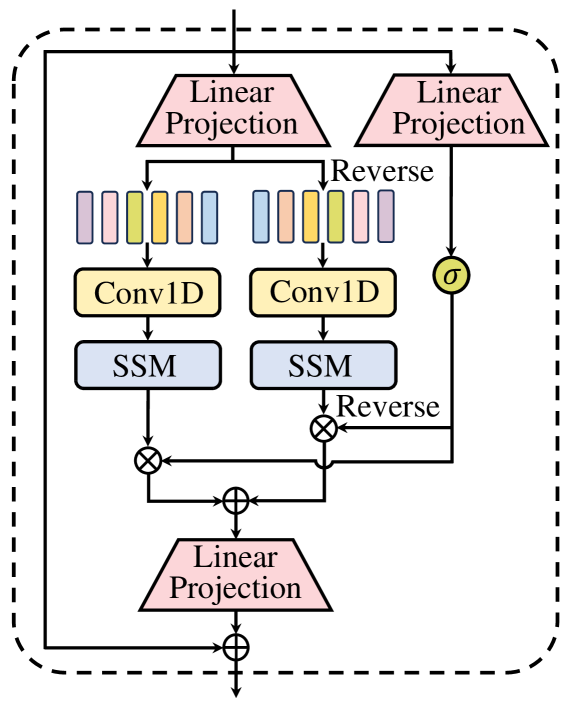
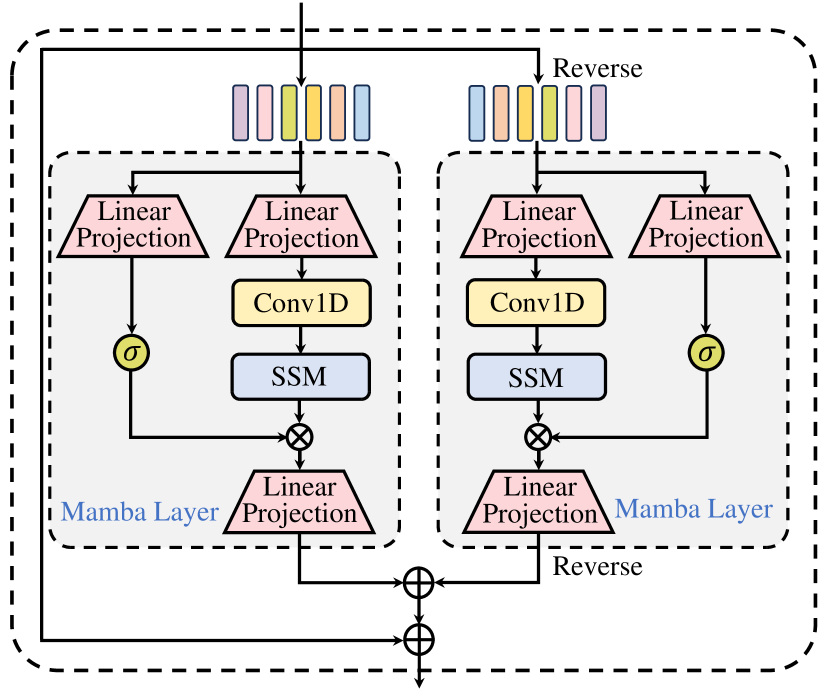
- Examine bidirectional Mamba variants (InnBiMamba and ExtBiMamba) for global dependency Modeling in speech.
- Evaluate Mamba/BiMamba as replacements for MHSA in Transformer and Conformer architectures across ASR and SE datasets.
- Identify when BiMamba’s nonlinearities improve high-level semantic information capture in speech.
Proposed method
- Review and adapt the Selective State Space Model (Mamba) for bidirectional processing to model global dependencies in speech.
- Propose two BiMamba designs: Inner Bidirectional Mamba (InnBiMamba) and External Bidirectional Mamba (ExtBiMamba).
- Replace MHSA with Mamba/BiMamba in Transformer and Conformer encoders to assess performance on SE and ASR tasks.
- Incorporate additional nonlinearities (FFN residuals, Swish activation, Macaron-style FFN) to enable high-level semantic representation.
- Conduct ablations to study the role of nonlinearity, FFN, and residual connections for ASR performance.
Experimental results
Research questions
- RQ1Can bidirectional Mamba capture global dependencies in speech as effectively as or better than MHSA in SE and ASR tasks?
- RQ2Does ExtBiMamba consistently outperform InnBiMamba across datasets and architectures when replacing MHSA?
- RQ3What nonlinearities and architectural augmentations are required for BiMamba to learn high-level semantic information in speech tasks?
- RQ4How does replacing MHSA with Mamba/BiMamba affect training/inference speed and parameter efficiency compared to Transformers/Conformers?
- RQ5Is BiMamba advantageous for semantic-aware tasks (ASR) more than for low-level spectral tasks (SE)?
Key findings
- Bidirectional BiMamba variants outperform vanilla Mamba and often surpass MHSA-equipped baselines in speech tasks.
- ExtBiMamba generally yields slightly better performance than InnBiMamba and improves training and inference speeds.
- Replacing MHSA with ExtBiMamba in Conformer (ConExtBiMamba) matches or exceeds state-of-the-art Branchformer results on ASR benchmarks.
- Independent BiMamba models are strong for SE (low-level spectral info) but underperform for ASR without interaction with FFN and residual connections.
- Ablation studies show that nonlinearity (FFN, Swish, residual connections) and Gaussian noise in the A matrix enhance ConExtBiMamba performance and robustness, especially on small datasets.
- Overall, BiMamba-based replacements for MHSA are most effective when higher abstraction (semantic) information is required, rather than solely low-level processing.
Read this paper
Open the full text in the Nubint reader and ask about any passage as you read.
Read this paper on NubintThis review was generated by AI from the original paper. Please check the paper before citing it.