
[Paper Review] Mathify: Evaluating Large Language Models on Mathematical Problem Solving Tasks
This paper introduces MathQuest, a high-school math dataset from NCERT and benchmarks fine-tuned LLMs (MAmmoTH, LLaMA-2, WizardMath) on NCERT-style problems, showing MAmmoTH-13B as the best performer among the tested models.
The rapid progress in the field of natural language processing (NLP) systems and the expansion of large language models (LLMs) have opened up numerous opportunities in the field of education and instructional methods. These advancements offer the potential for tailored learning experiences and immediate feedback, all delivered through accessible and cost-effective services. One notable application area for this technological advancement is in the realm of solving mathematical problems. Mathematical problem-solving not only requires the ability to decipher complex problem statements but also the skill to perform precise arithmetic calculations at each step of the problem-solving process. However, the evaluation of the arithmetic capabilities of large language models remains an area that has received relatively little attention. In response, we introduce an extensive mathematics dataset called "MathQuest" sourced from the 11th and 12th standard Mathematics NCERT textbooks. This dataset encompasses mathematical challenges of varying complexity and covers a wide range of mathematical concepts. Utilizing this dataset, we conduct fine-tuning experiments with three prominent LLMs: LLaMA-2, WizardMath, and MAmmoTH. These fine-tuned models serve as benchmarks for evaluating their performance on our dataset. Our experiments reveal that among the three models, MAmmoTH-13B emerges as the most proficient, achieving the highest level of competence in solving the presented mathematical problems. Consequently, MAmmoTH-13B establishes itself as a robust and dependable benchmark for addressing NCERT mathematics problems.
Motivation & Objective
- Motivate improved evaluation of arithmetic and multi-step reasoning in LLMs for high-school math.
- Create MathQuest, a NCERT-derived math problem dataset spanning multiple domains.
- Assess the impact of fine-tuning LLMs with augmented Math-401 data on performance across datasets.
- Establish baselines and compare models (LLaMA-2, WizardMath, MAmmoTH) on MathQuest and other benchmarks.
Proposed method
- Assemble MathQuest, a NCERT-based math problem corpus with 14 domains and 223 samples.
- Augment the existing Math-401 dataset with additional arithmetic problems via SymPy to increase diversity.
- Fine-tune three LLM families (LLaMA-2, WizardMath, MAmmoTH) using QLora with 4-bit quantization and LoRA adapters.
- Train for 10 epochs with AdamW, learning rate 3e-4, on a train/val/test split (241,600 / 30,200 / 30,200).
- Evaluate exact-match accuracy on GSM-8K, DeepMind, NumGLUE, SimulEq, Math-401* and MathQuest before and after fine-tuning.
- Compare 7B and 13B variants to assess scale effects.
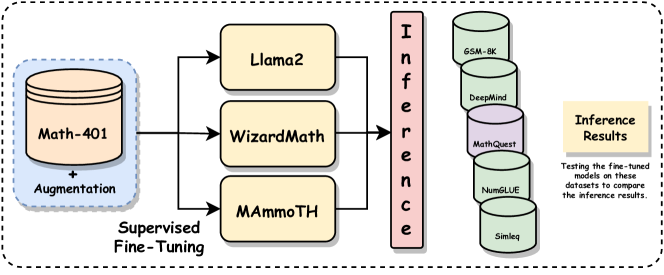
Experimental results
Research questions
- RQ1How do NCERT-derived math problems challenge current open-source LLMs (7B/13B)?
- RQ2What gains occur when LLMs are fine-tuned on augmented math datasets (Math-401) for NCERT-style problems?
- RQ3Which model and size best address high-school level mathematical problem solving on MathQuest and other benchmarks?
Key findings
- MAmmoTH-13B achieves the highest post-fine-tuning accuracy on MathQuest among the tested models (24.0%).
- 13B models generally outperform 7B counterparts after fine-tuning across benchmarks.
- MathQuest poses greater challenge than other datasets, yielding lower accuracies overall post fine-tuning.
- All models show notable accuracy gains after fine-tuning, with post-tuning results improving from pre-tuning baselines.
Read this paper
Open the full text in the Nubint reader and ask about any passage as you read.
Read this paper on NubintThis review was generated by AI from the original paper. Please check the paper before citing it.