
[Paper Review] Metacognitive Capabilities of LLMs: An Exploration in Mathematical Problem Solving
This paper demonstrates that large language models (LLMs) possess metacognitive capabilities by identifying and organizing their own problem-solving skills in mathematical reasoning. Using a two-stage prompting framework—skill labeling followed by semantic clustering—LLMs generate interpretable, coarse-grained skill labels that, when used as in-context exemplars, significantly improve accuracy on GSM8K and MATH benchmarks across multiple strong LLMs, including code-assisted models.
Metacognitive knowledge refers to humans' intuitive knowledge of their own thinking and reasoning processes. Today's best LLMs clearly possess some reasoning processes. The paper gives evidence that they also have metacognitive knowledge, including ability to name skills and procedures to apply given a task. We explore this primarily in context of math reasoning, developing a prompt-guided interaction procedure to get a powerful LLM to assign sensible skill labels to math questions, followed by having it perform semantic clustering to obtain coarser families of skill labels. These coarse skill labels look interpretable to humans. To validate that these skill labels are meaningful and relevant to the LLM's reasoning processes we perform the following experiments. (a) We ask GPT-4 to assign skill labels to training questions in math datasets GSM8K and MATH. (b) When using an LLM to solve the test questions, we present it with the full list of skill labels and ask it to identify the skill needed. Then it is presented with randomly selected exemplar solved questions associated with that skill label. This improves accuracy on GSM8k and MATH for several strong LLMs, including code-assisted models. The methodology presented is domain-agnostic, even though this article applies it to math problems.
Motivation & Objective
- To investigate whether large language models (LLMs) possess metacognitive knowledge—specifically, awareness of their own reasoning skills—beyond basic reasoning capabilities.
- To develop a domain-agnostic, prompt-based methodology for LLMs to autonomously discover and organize their internal problem-solving skills into interpretable, coarse-grained categories.
- To validate that these self-identified skill labels are meaningful and useful by integrating them into in-context learning for improved zero-shot generalization on math reasoning tasks.
- To improve the performance of LLMs on mathematical reasoning benchmarks by leveraging a curated repository of skill exemplars derived from the LLM’s own skill taxonomy.
Proposed method
- First, a powerful LLM is prompted to assign fine-grained skill labels to each training example in math datasets like GSM8K and MATH, based on the reasoning process required.
- Second, the same LLM performs semantic clustering on the labeled examples to group similar fine-grained skills into broader, interpretable skill families, reducing 5,000+ labels to ~117 coarse skills.
- A skill exemplar repository is constructed, containing each coarse skill label paired with representative question-answer pairs from the training set.
- During inference, a target LLM is prompted to identify the most relevant coarse skill for a new test question from the repository.
- The LLM is then provided with in-context exemplars from the selected skill category to guide its reasoning, mimicking human-style example-based learning.
- The method is applied to multiple strong LLMs, including GPT-4 and code-assisted models, across two major math benchmarks.
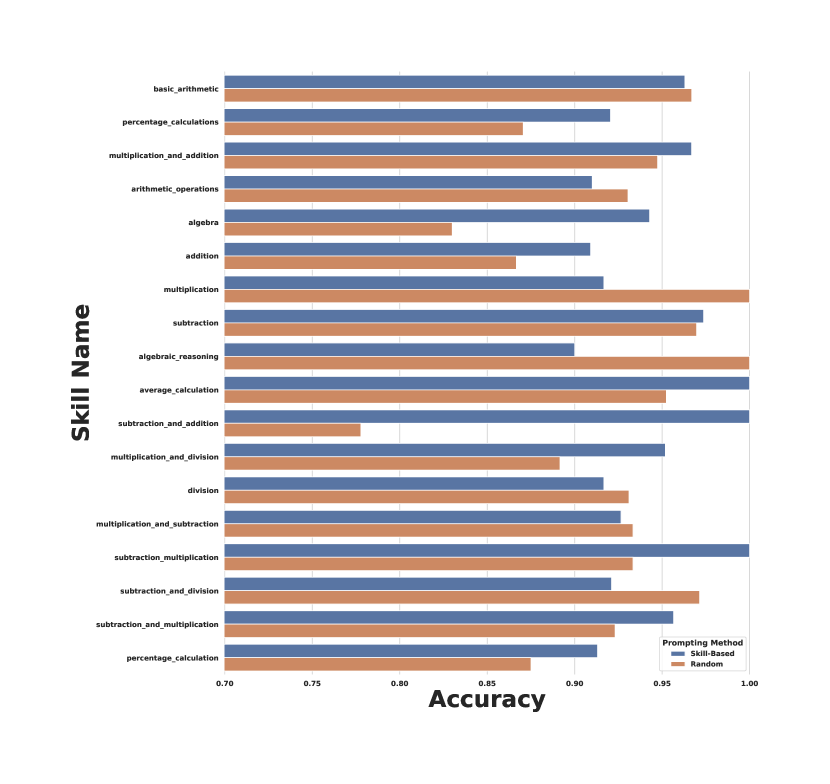
Experimental results
Research questions
- RQ1Can LLMs autonomously identify and label the specific reasoning skills required to solve mathematical problems?
- RQ2Do the skill labels generated by LLMs form coherent, interpretable clusters that reflect meaningful reasoning categories?
- RQ3Can the use of self-identified skill exemplars improve the accuracy of LLMs on unseen math problems?
- RQ4Is the performance gain from using skill exemplars robust across different LLM architectures and prompting strategies?
Key findings
- LLMs can generate fine-grained, task-specific skill labels for math problems, with approximately 5,000 unique labels identified in the MATH dataset before clustering.
- Semantic clustering reduces the number of skill labels from over 5,000 to 117 interpretable, coarse-grained skill families, demonstrating the LLM’s ability to organize its own reasoning knowledge.
- Using the skill exemplar repository as in-context examples improves zero-shot accuracy on the GSM8K and MATH benchmarks across multiple strong LLMs, including GPT-4 and code-assisted models.
- The performance gain is consistent across different LLMs, indicating that the method is robust and not model-specific.
- The skill exemplar repository is human-interpretable and reflects meaningful reasoning categories, such as 'vector_operations', 'trigonometric_calculations', and 'combinatorics_knowledge'.
- The method is domain-agnostic, suggesting potential for broader application beyond mathematical reasoning.
Better researchstarts right now
From reading papers to final review, dramatically reduce your research time.
No credit card · Free plan available
This review was created by AI and reviewed by human editors.