
[Paper Review] MGTBench: Benchmarking Machine-Generated Text Detection
MGTBench proposes a modular benchmark framework to evaluate machine-generated text detection methods against powerful LLMs, comparing metric-based and model-based approaches, assessing transferability, robustness, and text attribution.
Nowadays, powerful large language models (LLMs) such as ChatGPT have demonstrated revolutionary power in a variety of tasks. Consequently, the detection of machine-generated texts (MGTs) is becoming increasingly crucial as LLMs become more advanced and prevalent. These models have the ability to generate human-like language, making it challenging to discern whether a text is authored by a human or a machine. This raises concerns regarding authenticity, accountability, and potential bias. However, existing methods for detecting MGTs are evaluated using different model architectures, datasets, and experimental settings, resulting in a lack of a comprehensive evaluation framework that encompasses various methodologies. Furthermore, it remains unclear how existing detection methods would perform against powerful LLMs. In this paper, we fill this gap by proposing the first benchmark framework for MGT detection against powerful LLMs, named MGTBench. Extensive evaluations on public datasets with curated texts generated by various powerful LLMs such as ChatGPT-turbo and Claude demonstrate the effectiveness of different detection methods. Our ablation study shows that a larger number of words in general leads to better performance and most detection methods can achieve similar performance with much fewer training samples. Moreover, we delve into a more challenging task: text attribution. Our findings indicate that the model-based detection methods still perform well in the text attribution task. To investigate the robustness of different detection methods, we consider three adversarial attacks, namely paraphrasing, random spacing, and adversarial perturbations. We discover that these attacks can significantly diminish detection effectiveness, underscoring the critical need for the development of more robust detection methods.
Motivation & Objective
- Create a comprehensive, modular benchmark framework for MGT detection and attribution against powerful LLMs.
- Evaluate a broad set of metric-based and model-based detection methods on multiple datasets and LLMs.
- Analyze transferability across datasets and LLMs, robustness under adversarial perturbations, and practical detection efficiency.
- Provide insights on how text length and training data size affect detection performance.
Proposed method
- Modular design with input, detection, and evaluation modules.
- Integration of ten detection methods (eight metric-based, five model-based integrations available).
- Use of public LLMs (e.g., ChatGPT-turbo, Claude, ChatGLM, Dolly, GPT4All, StableLM) to generate MGTs from human-written texts.
- Evaluation metrics including accuracy, precision, recall, F1-score, and AUC with sample-level logging.
- Analysis of text length, training-set size, cross-dataset and cross-LLM transfer, and robustness under adversarial attacks.
Experimental results
Research questions
- RQ1How do metric-based and model-based MGT detection methods perform across diverse datasets and LLMs?
- RQ2What are the transferability characteristics of detection methods when trained on one dataset or one LLM and tested on another?
- RQ3How robust are detection methods to adversarial attacks such as paraphrasing, random spacing, and adversarial perturbations?
- RQ4How does text length influence detection performance and how many training samples are needed for reliable detection?
- RQ5Can detection methods be extended to text attribution, i.e., identifying the originating model of a text?
Key findings
- LM Detector generally yields the best detection performance across datasets and LLMs. For example, it achieves high F1-scores across tasks (e.g., 0.993 on Essay vs ChatGPT-turbo).
- Metric-based methods (e.g., Log-Likelihood, Log-Rank, GLTR, LRR) provide solid performance and often offer better transferability across LLMs than some model-based methods.
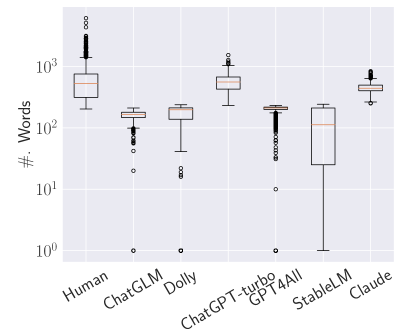
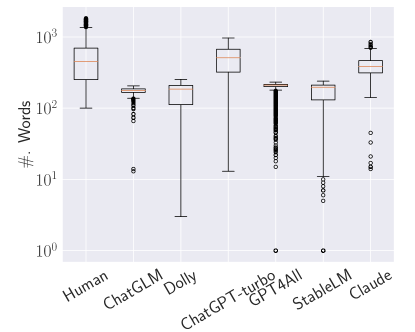
- Longer text generally improves detection performance, with 200 words often sufficient for near-optimal results.
- Model-based detectors show stronger performance in text attribution tasks compared to metric-based methods.
- All methods show significant vulnerability to paraphrasing, spacing, and perturbation attacks, underscoring the need for more robust approaches.
Better researchstarts right now
From reading papers to final review, dramatically reduce your research time.
No credit card · Free plan available
This review was created by AI and reviewed by human editors.