
[Paper Review] Microscopic Examination of SRF-quality Nb Films through Local Nonlinear Microwave Response
This study uses a near-field magnetic microwave microscope to map local nonlinear microwave responses—specifically third harmonic power (P₃f)—in SRF-quality niobium films grown by DCMS and HiPIMS. It identifies a persistent low-Tc surface defect (6.3–6.8 K) in HiPIMS films, likely due to oxidized grain boundaries, and demonstrates that P₃f measurements combined with TDGL simulations can quantitatively probe vortex nucleation depth and defect density, enabling identification of optimal films for SRF applications.
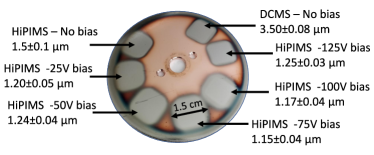
The performance of superconducting radio-frequency (SRF) cavities is sometimes limited by local defects. To investigate the RF properties of these local defects, especially those that nucleate RF magnetic vortices, a near-field magnetic microwave microscope is employed. Local third harmonic response (P3f) and its temperature-dependence and RF power-dependence are measured for one Nb/Cu film grown by Direct Current Magnetron Sputtering (DCMS) and six Nb/Cu films grown by High Power Impulse Magnetron Sputtering (HiPIMS) with systematic variation of deposition conditions. Five out of the six HiPIMS Nb/Cu films show a strong third harmonic response that is likely coming from RF vortex nucleation due to a low-Tc surface defect with a transition temperature between 6.3 K and 6.8 K, suggesting that this defect is a generic feature of air-exposed HiPIMS Nb/Cu films. A phenomenological model of surface defect grain boundaries hosting a low-Tc impurity phase is introduced and studied with Time-Dependent Ginzburg-Landau (TDGL) simulations of probe/sample interaction to better understand the measured third harmonic response. The simulation results show that the third harmonic response of RF vortex nucleation caused by surface defects exhibits the same general features as the data, including peaks in third harmonic response with temperature, and their shift and broadening with higher microwave amplitude. We find that the parameters of the phenomenological model (the density of surface defects that nucleate RF vortices and the depth an RF vortex travels through these surface defects) vary systematically with film deposition conditions. From the point of view of these two properties, the Nb/Cu film that is most effective at reducing the nucleation of RF vortices associated with surface defects can be identified.
Motivation & Objective
- To investigate the local RF properties of defects in superconducting radio-frequency (SRF) niobium films that limit cavity performance.
- To identify the origin and characteristics of persistent third harmonic microwave responses (P₃f) in HiPIMS-grown Nb/Cu films.
- To develop a method using local P₃f measurements and TDGL simulations to quantify defect-induced vortex nucleation and surface defect density.
- To identify the optimal Nb film for SRF applications based on defect-related nonlinear microwave response.
Proposed method
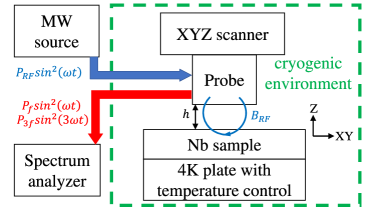
- Employed a scanned-loop near-field magnetic microwave microscope to measure local third harmonic microwave response (P₃f) on Nb/Cu films.
- Systematically varied deposition conditions in HiPIMS-grown Nb films and compared with a DCMS-grown film.
- Measured P₃f as a function of temperature (2–10 K) and RF power (0.1–10 mW) to probe defect behavior.
- Performed Time-Dependent Ginzburg-Landau (TDGL) simulations to model vortex nucleation at surface defects.
- Simulated two defect models: a grain boundary with a low-Tc impurity and a localized surface defect with reduced Tc.
- Used simulated P₃f response to qualitatively extract vortex penetration depth and defect density from experimental data.
Experimental results
Research questions
- RQ1What causes the strong, persistent third harmonic microwave response (P₃f) observed in most HiPIMS-grown Nb films?
- RQ2How do the temperature and RF power dependence of P₃f reveal the nature of local defects in SRF-quality Nb films?
- RQ3Can TDGL simulations quantitatively explain the observed P₃f response from surface defects?
- RQ4To what extent can P₃f measurements be used to infer the density and penetration depth of vortices nucleated at defects?
- RQ5Which Nb film among the seven tested exhibits the most favorable local RF properties for SRF cavity applications?
Key findings
- Five out of six HiPIMS-grown Nb/Cu films exhibit a strong, temperature-dependent P₃f response with a transition temperature between 6.3 K and 6.8 K, indicating a common low-Tc surface defect.
- The P₃f response is attributed to a surface defect with reduced Tc, likely due to oxidized niobium or grain boundaries hosting impurities.
- TDGL simulations show that RF vortex nucleation at such defects can quantitatively explain the measured P₃f response as a function of temperature and RF field.
- The simulations reveal that vortex penetration depth increases with RF field amplitude, reaching ~93.5 nm at 56.6 mT and ~110.6 nm at 67.9 mT at 5.4 K.
- The P₃f response allows qualitative extraction of both the density of surface defects that nucleate vortices and the depth to which vortices penetrate.
- The DCMS-grown Nb film shows no significant P₃f response, indicating it is superior in terms of local defect suppression compared to the HiPIMS films.
Read this paper
Open the full text in the Nubint reader and ask about any passage as you read.
Read this paper on NubintThis review was generated by AI from the original paper. Please check the paper before citing it.