
[Paper Review] Microwave shielding of bosonic NaRb molecules
This paper demonstrates microwave shielding using a blue-detuned, circularly polarized microwave field to suppress two-body losses in ultracold bosonic 23Na87Rb molecules by two orders of magnitude, reducing the inelastic loss rate coefficient to $3 \times 10^{-12}~\mathrm{cm^3/s}$. The technique enhances elastic collisions and enables efficient evaporative cooling, increasing phase-space density by a factor of 10, paving the way for Bose-Einstein condensation of ultracold polar molecules.
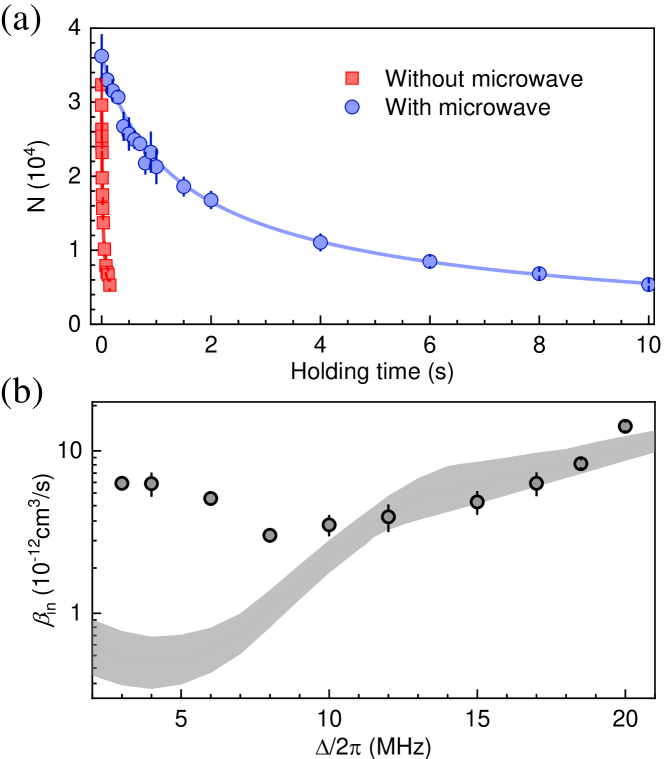
Recent years have witnessed tremendous progresses in creating and manipulating ground-state ultracold polar molecules. However, the two-body loss regardless of the chemical reactivities is still a hurdle for many future explorations. Here, we investigate the loss suppression of non-reactive bosonic $^{23}$Na$^{87}$Rb molecules with a circular polarized microwave blue-detuned to the rotational transition. We achieve suppression of the loss by two orders of magnitude with the lowest two-body loss rate coefficient reduced to $3 imes10^{-12}~ m{cm^3/s}$. Meanwhile, the elastic collision rate coefficient is increased to the $10^{-8}~ m{cm^3/s}$ level. The large good-to-bad collision ratio has allowed us to carry out evaporative cooling of $^{23}$Na$^{87}$Rb with an efficiency of 1.7(2), increasing the phase-space density by a factor of 10. With further improvements, this technique holds great promises for creating a Bose-Einstein condensate of ultracold polar molecules.
Motivation & Objective
- To suppress rapid two-body losses in non-reactive bosonic 23Na87Rb molecules, which hinder the formation of quantum degenerate samples.
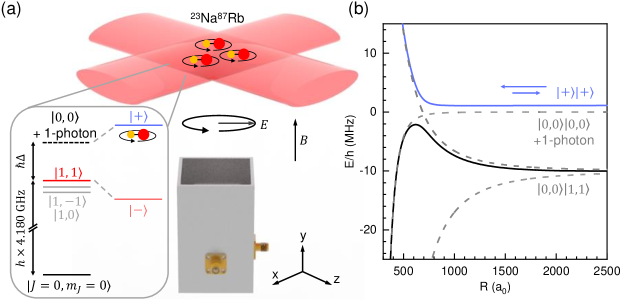
- To implement microwave shielding via a blue-detuned, circularly polarized microwave field to create a long-range potential barrier that prevents short-range complex formation.
- To enhance elastic collision rates to enable efficient evaporative cooling and increase phase-space density.
- To demonstrate a viable pathway toward achieving a Bose-Einstein condensate of ultracold polar molecules using loss suppression techniques.
Proposed method
- Application of a circularly polarized microwave field detuned below the $J=0 \leftrightarrow J=1$ rotational transition of 23Na87Rb molecules to induce dressed states with effective dipole moments.
- Use of a blue-detuned microwave field to generate a long-range repulsive potential barrier that suppresses molecules from approaching the short-range region where $\mathrm{Na_2Rb_2}$ complexes form.
- Employment of a double-well optical dipole trap with a 346 G magnetic field to confine the molecules and enable controlled microwave coupling.
- Measurement of cross-dimensional rethermalization dynamics to extract the elastic collision rate coefficient $\beta_{\mathrm{el}}$ from the number of collisions per thermalization $N_{\mathrm{col}}$.
- Numerical computation of scattering cross sections using multichannel quantum defect theory and $S$-matrix formalism to model inelastic and elastic processes.
- Validation of collisional dynamics using direct numerical integration of Enskog equations and cross-checked with DSMC simulations to determine $N_{\mathrm{col}}$ and $\beta_{\mathrm{el}}$.
Experimental results
Research questions
- RQ1Can microwave shielding via a blue-detuned, circularly polarized microwave field effectively suppress two-body inelastic losses in ultracold bosonic 23Na87Rb molecules?
- RQ2To what extent can the elastic collision rate be enhanced relative to inelastic loss rates under microwave shielding?
- RQ3Is the resulting good-to-bad collision ratio sufficient to enable efficient evaporative cooling in a trapped molecular sample?
- RQ4What is the quantitative reduction in the inelastic loss rate coefficient $\beta_{\mathrm{in}}$ achieved through microwave shielding?
- RQ5Can the phase-space density of ultracold 23Na87Rb molecules be increased via evaporative cooling under microwave shielding?
Key findings
- The two-body inelastic loss rate coefficient $\beta_{\mathrm{in}}$ was suppressed to $3.0(3) \times 10^{-12}~\mathrm{cm^3/s}$, representing a two-order-of-magnitude reduction compared to unshielded conditions.
- The elastic collision rate coefficient $\beta_{\mathrm{el}}$ was measured to be at the $10^{-8}~\mathrm{cm^3/s}$ level, indicating a high good-to-bad collision ratio favorable for evaporative cooling.
- Evaporative cooling was successfully demonstrated with an efficiency of 1.7(2), increasing the phase-space density by a factor of 10.
- The number of collisions per rethermalization $N_{\mathrm{col}}$ was found to be above 10 even at large detunings, confirming sufficient collisional thermalization for accurate rate coefficient extraction.
- DSMC simulations confirmed the numerical calculations, showing consistent trends with a 15% lower $N_{\mathrm{col}}$ than direct integration, validating the theoretical model.
- The effective dipole moment $d_{\mathrm{eff}}$ was reduced with increasing detuning $\Delta$, leading to a decrease in $N_{\mathrm{col}}$, but the system retained sufficient collisional activity for cooling.
Better researchstarts right now
From reading papers to final review, dramatically reduce your research time.
No credit card · Free plan available
This review was created by AI and reviewed by human editors.