
[Paper Review] Mid-circuit qubit measurement and rearrangement in a $^{171}$Yb atomic array
The paper demonstrates nondestructive, state-selective mid-circuit measurement in a single-species 171Yb tweezer-array, using narrow-line imaging and site hiding to protect data qubits, and shows conditional ancilla refilling and MOT loading with preserved data-qubit coherence.
Measurement-based quantum error correction relies on the ability to determine the state of a subset of qubits (ancillae) within a processor without revealing or disturbing the state of the remaining qubits. Among neutral-atom based platforms, a scalable, high-fidelity approach to mid-circuit measurement that retains the ancilla qubits in a state suitable for future operations has not yet been demonstrated. In this work, we perform imaging using a narrow-linewidth transition in an array of tweezer-confined $^{171}$Yb atoms to demonstrate nondestructive state-selective and site-selective detection. By applying site-specific light shifts, selected atoms within the array can be hidden from imaging light, which allows a subset of qubits to be measured while causing only percent-level errors on the remaining qubits. As a proof-of-principle demonstration of conditional operations based on the results of the mid-circuit measurements, and of our ability to reuse ancilla qubits, we perform conditional refilling of ancilla sites to correct for occasional atom loss, while maintaining the coherence of data qubits. Looking towards true continuous operation, we demonstrate loading of a magneto-optical trap with a minimal degree of qubit decoherence.
Motivation & Objective
- Demonstrate nondestructive, state-selective and site-selective mid-circuit qubit readout in a 171Yb neutral-atom array.
- Show that selected ancilla qubits can be measured while data qubits remain coherent.
- Demonstrate conditional operations based on mid-circuit measurements, including refilling of ancilla sites after atom loss.
- Illustrate sustained data-qubit coherence during mid-circuit measurement and ancilla rearrangement.
- Explore loading a magneto-optical trap (MOT) while preserving coherence in the data qubits.
Proposed method
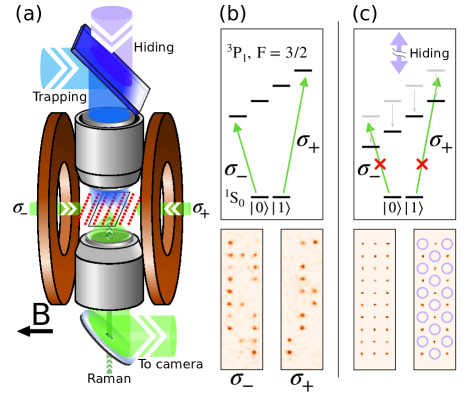
- Use a narrow-linewidth imaging transition in 171Yb to enable state-selective imaging of qubit states 1 and 0 via coupling to 3P1 mF states.
- Apply large Zeeman shifts (500 G field) to achieve high state selectivity and suppress leakage.
- Employ site-selective hiding light to shield selected qubits from imaging light and enable parallel readout of ancilla qubits.
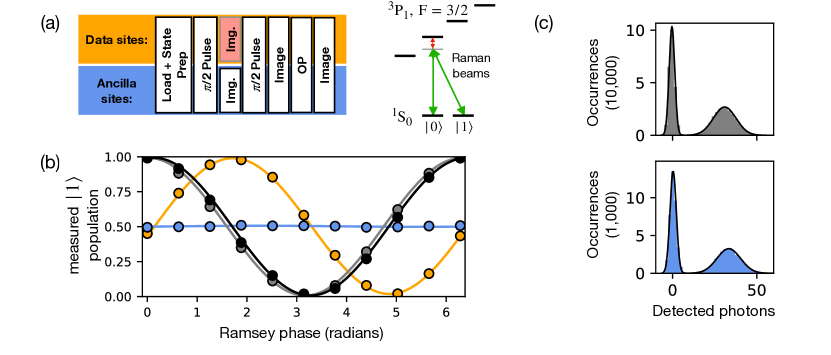
- Perform mid-circuit measurements within Ramsey sequences to quantify coherence preservation and phase shifts.
- Rearrange atoms with a movable tweezer to create a fully filled sub-array and demonstrate conditional refilling of ancilla sites from a reservoir.
- Demonstrate MOT loading during the experiment to assess coherence during continuous operation.
Experimental results
Research questions
- RQ1Can mid-circuit, state-selective measurements be performed on a subset of qubits in a single-species neutral-atom array without disturbing the rest of the qubits?
- RQ2Does site-selective hiding allow high-fidelity, nondestructive readout of ancilla qubits while preserving data-qubit coherence?
- RQ3Can ancilla qubits be reliably refilled after loss without degrading data-qubit coherence over multiple cycles?
- RQ4Is it feasible to load a MOT during computation without introducing prohibitive decoherence to data qubits?
- RQ5What are the limiting error channels and how do imaging, hiding light, and atom loss scale with system size?
Key findings
- High-fidelity, state-resolved imaging of 171Yb qubits with nondestructive readout; typical imaging yields about 30 photons in 5 ms per site.
- Hiding light provides up to 74 MHz differential shift, enabling site-selective masking with percent-level loss on data qubits and minimal impact on ancilla imaging.
- Mid-circuit measurement of ancilla qubits induces a small coherence impact on data qubits, e.g., Ramsey fringe phase shift of 1.59(2) rad and contrast reduction of 1.3(8)% under imaging and hiding light.
- Ancilla qubits can be refilled from a reservoir to maintain ancilla-filling >98% for up to 16 imaging/rearrangement cycles, with data-qubit contrast loss around 0.9(1)% per cycle.
- Coherence of data qubits is preserved during MOT loading, with an additional decoherence rate of 0.03(2)/s attributed to MOT scattering light.
- demonstrated that a magneto-optical trap can be loaded with limited decoherence, enabling pathways toward continuous operation.
Better researchstarts right now
From reading papers to final review, dramatically reduce your research time.
No credit card · Free plan available
This review was created by AI and reviewed by human editors.