
[Paper Review] Mid-circuit operations using the omg-architecture in neutral atom arrays
The paper demonstrates mid-circuit operations in a 48-site neutral-atom array using the omg architecture in 171Yb, achieving high-fidelity control across ground, metastable, and optical qubits and performing non-destructive readout, resets, and mid-circuit measurements and resets.
We implement mid-circuit operations in a 48-site array of neutral atoms, enabled by new methods for control of the $ extit{omg}$ (optical-metastable-ground state qubit) architecture present in ${}^{171}$Yb. We demonstrate laser-based control of ground, metastable and optical qubits with average single-qubit fidelities of $F_{g} = 99.968(3)$, $F_{m} = 99.12(4)$ and $F_{o} = 99.804(8)$. With state-sensitive shelving between the ground and metastable states, we realize a non-destructive state-detection for $^{171}$Yb, and reinitialize in the ground state with either global control or local feed-forward operations. We use local addressing of the optical clock transition to perform mid-circuit operations, including measurement, spin reset, and motional reset in the form of ground-state cooling. In characterizing mid-circuit measurement on ground-state qubits, we observe raw errors of $1.8(6)\%$ on ancilla qubits and $4.5(1.0)\%$ on data qubits, with the former (latter) uncorrected for $1.0(2)\%$ ($2.0(2)\%$) preparation and measurement error; we observe similar performance for mid-circuit reset operations. The reported realization of the $ extit{omg}$ architecture and mid-circuit operations are door-opening for many tasks in quantum information science, including quantum error-correction, entanglement generation, and metrology.
Motivation & Objective
- Demonstrate mid-circuit operations (MCOs) in a neutral-atom array using the omg architecture in 171Yb.
- Achieve high-fidelity control on ground (g), metastable (m), and optical (o) qubits.
- Realize non-destructive state-detection and reinitialization for data qubits.
- Implement local addressing to perform mid-circuit measurements and resets.
- Assess performance of mid-circuit measurements and resets and identify error sources.
Proposed method
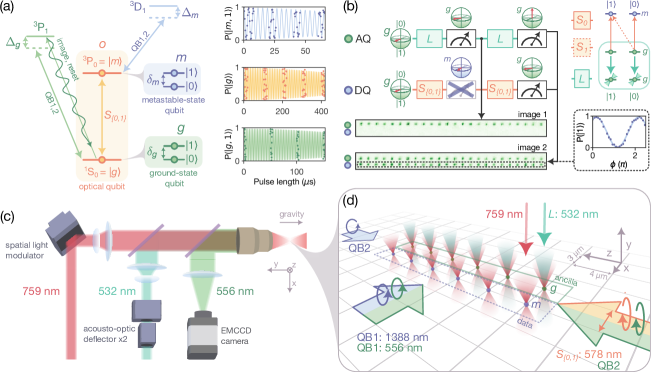
- Use a 48-site tweezer array of 171Yb with magic-wavelength 759 nm tweezers for uniform clock shifts.
- Implement shelving operations S0 and S1 to move qubits between g and m manifolds and control optical qubits on the clock transition.
- Perform local light-shifting with 532 nm tweezers to enable site-resolved shelving and MCOs.
- Carry out global and local optical qubit operations with high fidelities (Fg=99.968(3)%, Fm=99.12(4)%, Fo=99.804(8)%).
- Characterize mid-circuit operations with Ramsey experiments, randomized benchmarking, and quantum process tomography to extract fidelities and process fidelities.
Experimental results
Research questions
- RQ1What fidelity can be achieved for single-qubit gates in g, m, and o manifolds in the omg architecture?
- RQ2Can mid-circuit measurements and resets be performed with data qubits preserved coherence in a neutral-atom array?
- RQ3What are the dominant error sources during mid-circuit operations and how can they be mitigated?
- RQ4How does non-destructive state readout affect the duty cycle and reusability of ancilla qubits in mid-circuit schemes?
Key findings
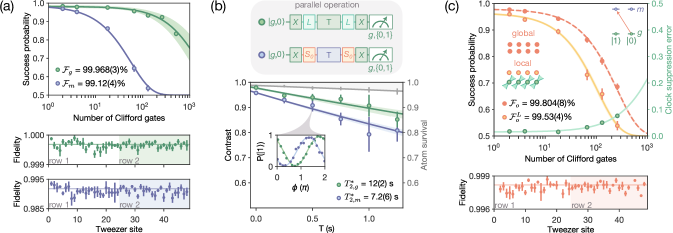
- Single-qubit gate fidelities: Fg=99.968(3)%, Fm=99.12(4)%, Fo=99.804(8)% (RB).
- Coherence times: Tg* = 12(2) s for g and Tm* = 7.2(6) s for m (Ramsey).
- Mid-circuit measurement: ancilla MCM contrast 98.2(6)% and data qubit MCM contrast 95.5(1.0)%, with SPAM-corrected considerations.
- Mid-circuit reset: ancilla contrast 97.7(5)% and data qubit contrast 95.2(8)% after motional cooling and cooling sequences.
- Non-destructive readout achieved via clock-based shelving with high readout fidelities and potential for >99% reset/readout with improvements.
- Motional-state preserving pulse (MPP) reduces shelving error from ~0.21-1.33% to ~0.28% per operation and minimizes heating.
Read this paper
Open the full text in the Nubint reader and ask about any passage as you read.
Read this paper on NubintThis review was generated by AI from the original paper. Please check the paper before citing it.