
[Paper Review] Milky Way and Andromeda analogs from the TNG50 simulation
The paper defines and catalogs Milky Way- and Andromeda-like galaxies in the TNG50 simulation, providing a fiducial selection, data products, and comparisons to the real MW and M31.
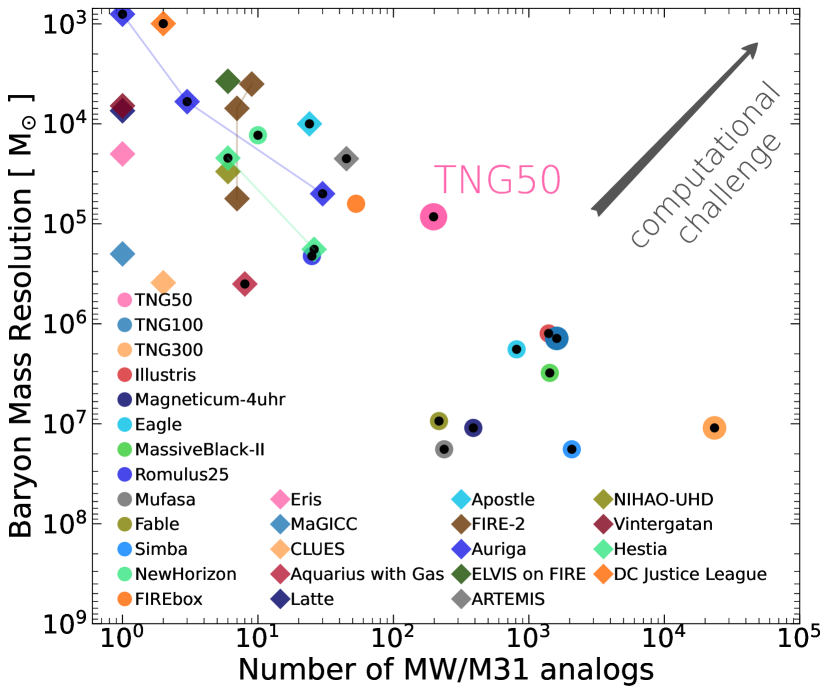
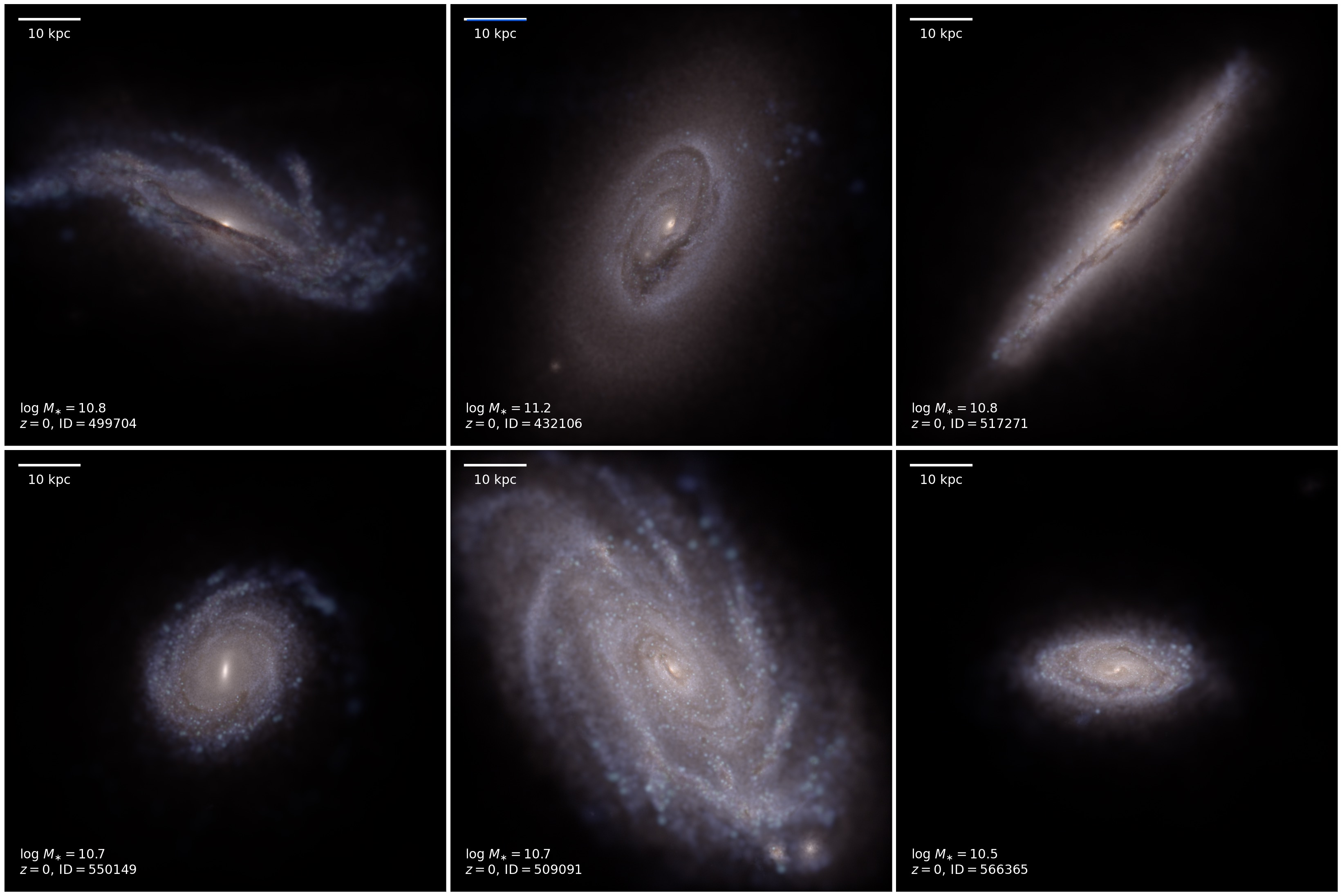
We present the properties of Milky Way- and Andromeda-like (MW/M31-like) galaxies simulated within TNG50, the highest-resolution run of the IllustrisTNG suite of $Λ$CDM magneto-hydrodynamical simulations. We introduce our fiducial selection for MW/M31 analogs, which we propose for direct usage as well as for reference in future analyses. TNG50 contains 198 MW/M31 analogs, i.e. galaxies with stellar disky morphology, with a stellar mass in the range of $M_* = 10^{10.5 - 11.2}$ Msun, and within a MW-like Mpc-scale environment at z=0. These are resolved with baryonic (dark matter) mass resolution of $8.5 imes10^4$ Msun ($4.5 imes10^5$ Msun) and $\sim150$ pc of average spatial resolution in the star-forming regions: we therefore expand by many factors (2 orders of magnitude) the sample size of cosmologically-simulated analogs with similar ($ imes 10$ better) numerical resolution. The majority of TNG50 MW/M31 analogs at $z=0$ exhibit a bar, 60 per cent are star-forming, the sample includes 3 Local Group (LG)-like systems, and a number of galaxies host one or more satellites as massive as e.g. the Magellanic Clouds. Even within such a relatively narrow selection, TNG50 reveals a great diversity in galaxy and halo properties, as well as in past histories. Within the TNG50 sample, it is possible to identify several simulated galaxies whose integral and structural properties are consistent, one or more at a time, with those measured for the Galaxy and Andromeda. With this paper, we document and release a series of broadly applicable data products that build upon the IllustrisTNG public release and aim to facilitate easy access and analysis by public users. These include datacubes across snapshots ($0 \le z \le 7$) for each TNG50 MW/M31-like galaxy, and a series of value-added catalogs that will be continually expanded to provide a convenient and up to date community resource.
Motivation & Objective
- Define a fiducial, observable-property based selection of MW/M31 analogs in TNG50.
- Quantify the diversity and properties of MW/M31-like galaxies in a cosmological volume.
- Assess how well MW/M31 analogs in TNG50 match the actual Galaxy and Andromeda.
- Release data products and catalogs to facilitate public use and future analyses.
Proposed method
- Use the TNG50 cosmological MHD simulation with ~150 pc resolution in star-forming regions and SMBH feedback.
- Identify MW/M31-like galaxies at z=0 by stellar mass, disk-like morphology, and MW-like environment criteria.
- Define a fiducial MW/M31 analog subset of 198 galaxies satisfying mass, morphology, and environmental constraints.
- Provide datacubes across snapshots (0≤z≤7) and value-added catalogs building on the IllustrisTNG release.
Experimental results
Research questions
- RQ1What observable-property based criteria can robustly select MW/M31 analogs in a cosmological simulation?
- RQ2How diverse are MW/M31-like galaxies in TNG50 in terms of environment, structure, and history?
- RQ3To what extent do TNG50 MW/M31 analogs resemble the Milky Way and Andromeda in integral and structural properties?
- RQ4What data products and catalogs best enable public analysis of these analogs?
Key findings
- TNG50 contains 198 MW/M31 analogs defined by M*>10^{10.5-11.2} Msun, disky morphology, and MW-like environment at z=0.
- The sample shows diverse environmental, integral, and structural properties, including some with satellites as massive as the Magellanic Clouds.
- A majority of the MW/M31 analogs are star-forming and many host bars, illustrating variety within a relatively narrow stellar-mass range.
- Several simulated galaxies are consistent with the Galaxy and Andromeda in different properties, demonstrating useful analogues for targeted comparisons.
Read this paper
Open the full text in the Nubint reader and ask about any passage as you read.
Read this paper on NubintThis review was generated by AI from the original paper. Please check the paper before citing it.