
[Paper Review] Modelling Large Dimensional Datasets with Markov Switching Factor Models
This paper proposes a novel large-dimensional approximate factor model with Markov-switching loadings driven by a latent first-order Markov process. It combines Principal Component Analysis for factor estimation with an EM algorithm using a modified Baum-Lindgren-Hamilton-Kim filter and smoother, enabling closed-form estimation without requiring prior knowledge of the true number of factors, and demonstrates strong finite-sample performance and theoretical consistency in Monte Carlo and empirical stock portfolio applications.
We study a novel large dimensional approximate factor model with regime changes in the loadings driven by a latent first order Markov process. By exploiting the equivalent linear representation of the model, we first recover the latent factors by means of Principal Component Analysis. We then cast the model in state-space form, and we estimate loadings and transition probabilities through an EM algorithm based on a modified version of the Baum-Lindgren-Hamilton-Kim filter and smoother that makes use of the factors previously estimated. Our approach is appealing as it provides closed form expressions for all estimators. More importantly, it does not require knowledge of the true number of factors. We derive the theoretical properties of the proposed estimation procedure, and we show their good finite sample performance through a comprehensive set of Monte Carlo experiments. The empirical usefulness of our approach is illustrated through three applications to large U.S. datasets of stock returns, macroeconomic variables, and inflation indexes.
Motivation & Objective
- To address the gap in modeling large-dimensional datasets with recurrent regime shifts in loadings, which existing literature largely overlooks in high-dimensional settings.
- To develop a method that estimates factors, loadings, and transition probabilities without requiring prior knowledge of the true number of factors.
- To provide a theoretically grounded, computationally feasible estimation procedure for large-dimensional Markov-switching factor models.
- To demonstrate the method's robustness and finite-sample performance through extensive Monte Carlo simulations and an empirical application to stock returns.
Proposed method
- The model is cast in state-space form using an equivalent linear representation, enabling factor recovery via Principal Component Analysis (PCA).
- The estimation procedure employs an EM algorithm based on a modified version of the Baum-Lindgren-Hamilton-Kim filter and smoother, which incorporates the PCA-estimated factors.
- The algorithm iteratively updates state probabilities, loadings, and transition probabilities, ensuring closed-form expressions for all estimators.
- The method is robust to unknown factor dimensionality, as it does not require pre-specification of the number of factors.
- Theoretical properties of the estimators are derived under regularity conditions, including consistency and asymptotic normality.
- The approach is validated through Monte Carlo experiments and applied to a large portfolio of stock returns to illustrate empirical relevance.
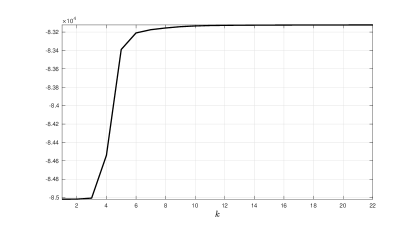
Experimental results
Research questions
- RQ1Can a large-dimensional factor model with Markov-switching loadings be estimated consistently when the number of factors is unknown?
- RQ2How does the proposed EM-based estimation procedure with a modified filter and smoother perform in finite samples compared to alternative methods?
- RQ3What is the impact of regime shifts in loadings on factor estimation and forecasting accuracy in high-dimensional financial datasets?
- RQ4To what extent does the method remain robust when the true number of factors is not known a priori?
- RQ5How well does the model capture time-varying risk and return comovement in stock portfolios under different market regimes?
Key findings
- The proposed estimation procedure achieves consistent estimation of factors, loadings, and transition probabilities without requiring knowledge of the true number of factors.
- The method delivers closed-form expressions for all estimators, enhancing computational efficiency and interpretability.
- Monte Carlo experiments confirm good finite-sample performance, with estimators converging to true values as sample size increases.
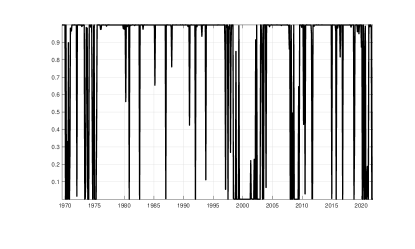
- The model successfully captures regime shifts in stock return comovement, as demonstrated in the empirical application to a large portfolio.
- Theoretical results establish asymptotic normality and consistency of the estimators under standard regularity conditions.
- The modified Baum-Lindgren-Hamilton-Kim filter and smoother enable accurate state probability estimation, even in high-dimensional settings.
Read this paper
Open the full text in the Nubint reader and ask about any passage as you read.
Read this paper on NubintThis review was generated by AI from the original paper. Please check the paper before citing it.