
[Paper Review] Modelling self-consistently beyond General Relativity
This paper presents a self-consistent numerical framework to study higher-derivative gravity theories beyond General Relativity, particularly focusing on a curvature-squared EFT extension with unclassifiable PDE character. By introducing regularization and advection terms to stabilize evolution, the authors achieve fourth-order convergence and demonstrate that physical observables—like gravitational wave strain peak times—extrapolate reliably to the limit of vanishing regularization, showing a time delay of ≈30M for the peak amplitude in the modified theory.
The majority of extensions to General Relativity display mathematical pathologies (higher derivatives, character change in equations that can be classified within PDE theory, and even unclassifiable ones) that cause severe difficulties to study them, especially in dynamical regimes. We present here an approach that enables their consistent treatment and extraction of physical consequences. We illustrate this method in the context of single and merging black holes in a highly challenging beyond GR theory.
Motivation & Objective
- To address the mathematical pathologies—such as unclassifiable PDE character and loss of hyperbolicity—in higher-derivative extensions of General Relativity that hinder dynamical simulations.
- To develop a consistent, stable, and convergent numerical approach for simulating single and binary black hole mergers in a specific EFT gravity model with curvature-squared terms.
- To assess whether physical predictions, such as gravitational waveforms, remain robust under regularization and can be reliably extrapolated to the physical limit as regularization parameters vanish.
- To test the viability of the theory in strong-field, dynamical regimes by monitoring constraints and convergence, ensuring the solution remains within the regime of validity.
Proposed method
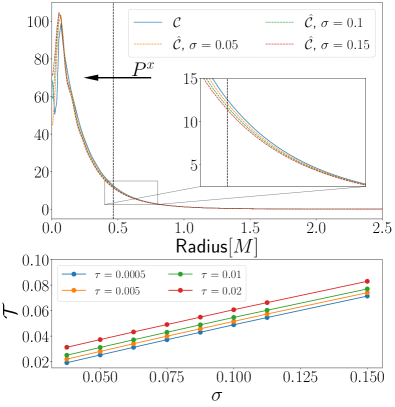
- The authors employ a regularization technique by introducing a modified curvature scalar $\hat{\mathcal{C}}$ that smoothly transitions to the true $\mathcal{C}$ via a parameter $\sigma$, ensuring numerical stability in high-curvature regions.
- They implement an advection vector $\beta^i$ to guide the evolution of $\hat{\mathcal{C}}$ toward the black hole horizon, preventing unphysical oscillations and maintaining causality.
- The equations of motion are solved using a high-order finite-difference code with adaptive mesh refinement, achieving fourth-order convergence in amplitude and phase of the gravitational wave strain.
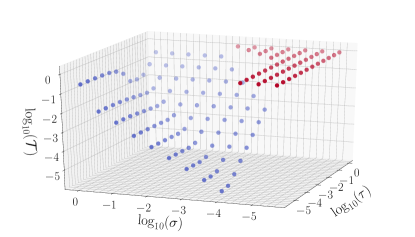
- A time-dependent regularization parameter $\tau$ controls the smoothing of the evolution, allowing for controlled convergence studies and extrapolation to the physical limit as $\tau, \sigma \to 0$.
- The method is validated by monitoring constraints, convergence rates, and axisymmetry of the final black hole remnant, ensuring the solution remains physically meaningful.
Experimental results
Research questions
- RQ1Can a higher-derivative gravity theory with unclassifiable PDE character be stably simulated in strong-field, dynamical regimes such as black hole mergers?
- RQ2How do regularization parameters $\sigma$ and $\tau$ affect the evolution and physical observables, and can results be reliably extrapolated to the limit $\sigma, \tau \to 0$?
- RQ3Does the final black hole remnant exhibit axisymmetry, and how quickly does the system relax toward this state?
- RQ4What is the convergence behavior of the numerical scheme, and does it achieve high-order accuracy in both amplitude and phase of the gravitational wave signal?
Key findings
- The numerical method achieves approximately fourth-order convergence in both the amplitude and phase of the gravitational wave strain $h^{+}_{22}$, confirming high accuracy and stability.
- The peak amplitude of the gravitational wave strain in the modified theory is delayed by approximately 30M compared to GR, with a linear dependence on $\sigma$ that allows reliable extrapolation to $\sigma \to 0$.
- The relative error in the Kretschmann scalar between $\sigma = 0.1$ and $\sigma = 0.05$ accumulates slowly, reaching $\mathcal{O}(1)$ only after about $t \approx 10^6 M$, indicating long-term stability.
- The final black hole remnant exhibits strong axisymmetry, as shown by the decreasing relative difference in $\hat{\mathcal{C}}$ and the conformal factor $\chi$ across azimuthal angles on the apparent horizon.
- The dependence on $\tau$ is weak, supporting the robustness of the results and the validity of extrapolating to $\tau \to 0$.
- The method successfully stabilizes the evolution of a theory with unclassifiable PDE character, enabling the extraction of physical consequences in the strong-field regime.
Read this paper
Open the full text in the Nubint reader and ask about any passage as you read.
Read this paper on NubintThis review was generated by AI from the original paper. Please check the paper before citing it.