
[Paper Review] Morphological Prototyping for Unsupervised Slide Representation Learning in Computational Pathology
This paper proposes Panther, a prototype-based unsupervised representation learning framework for whole-slide images (WSIs) in computational pathology, leveraging a Gaussian Mixture Model (GMM) to identify morphological prototypes from patch embeddings. By estimating mixture component parameters via EM, Panther generates compact, interpretable slide representations that outperform supervised MIL baselines on 13 datasets across subtyping and survival tasks, while enabling per-prototype interpretability through posterior probability maps.
Representation learning of pathology whole-slide images (WSIs) has been has primarily relied on weak supervision with Multiple Instance Learning (MIL). However, the slide representations resulting from this approach are highly tailored to specific clinical tasks, which limits their expressivity and generalization, particularly in scenarios with limited data. Instead, we hypothesize that morphological redundancy in tissue can be leveraged to build a task-agnostic slide representation in an unsupervised fashion. To this end, we introduce PANTHER, a prototype-based approach rooted in the Gaussian mixture model that summarizes the set of WSI patches into a much smaller set of morphological prototypes. Specifically, each patch is assumed to have been generated from a mixture distribution, where each mixture component represents a morphological exemplar. Utilizing the estimated mixture parameters, we then construct a compact slide representation that can be readily used for a wide range of downstream tasks. By performing an extensive evaluation of PANTHER on subtyping and survival tasks using 13 datasets, we show that 1) PANTHER outperforms or is on par with supervised MIL baselines and 2) the analysis of morphological prototypes brings new qualitative and quantitative insights into model interpretability.
Motivation & Objective
- To address the limited generalization and expressivity of task-specific, weakly supervised MIL methods in whole-slide image representation learning.
- To develop an unsupervised, task-agnostic framework that captures morphological redundancy and mixture patterns in tissue.
- To enable interpretable slide representations by identifying and quantifying morphological prototypes.
- To evaluate the framework on diverse downstream tasks, including subtyping and survival prediction, across 13 datasets.
- To provide per-prototype interpretability through posterior probability maps and morphological annotations.
Proposed method
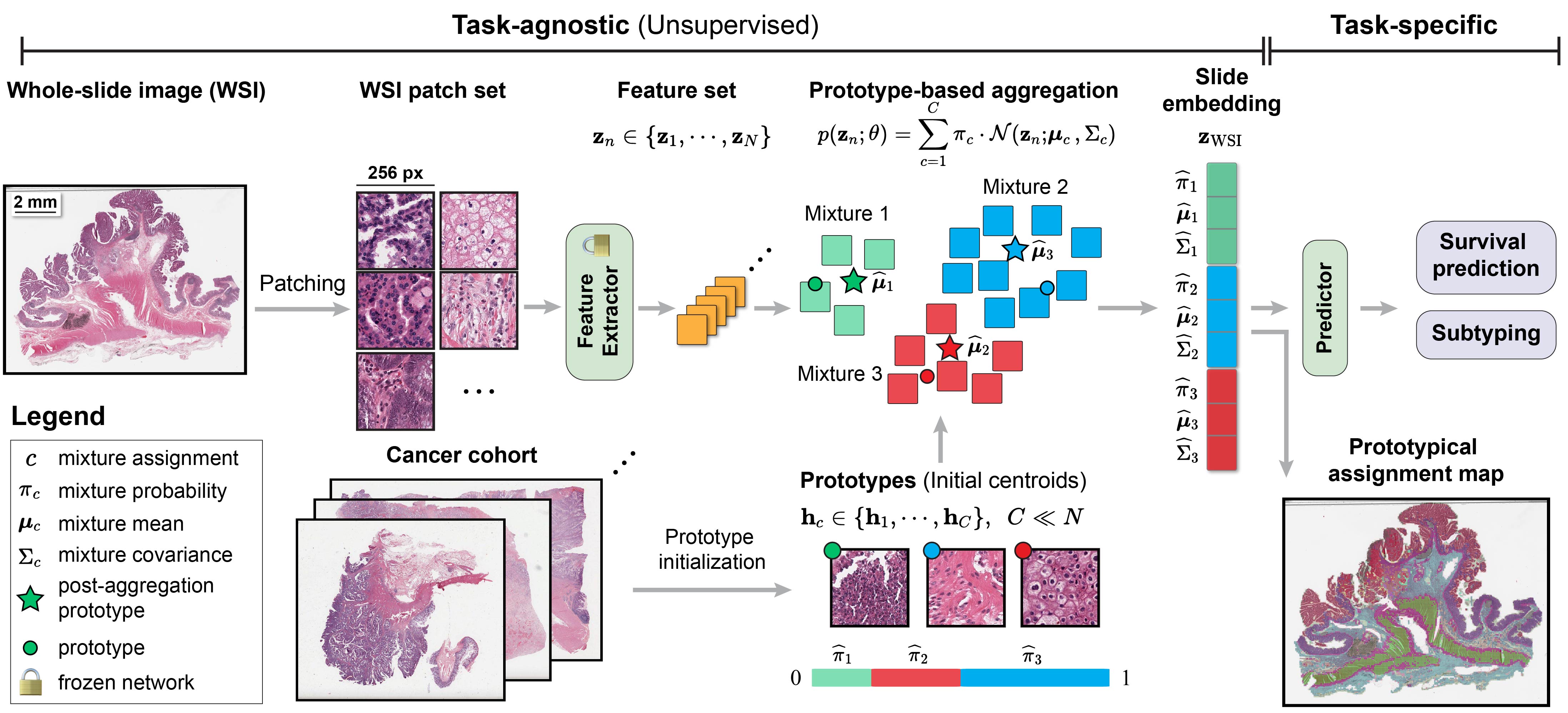
- Modeling WSI patch embeddings as generated from a Gaussian Mixture Model (GMM), where each mixture component corresponds to a morphological prototype.
- Using the Expectation-Maximization (EM) algorithm to estimate GMM parameters: mixture weights (cardinality), means (prototype representation), and covariances (variability).
- Constructing a slide-level representation as a concatenation of estimated GMM parameters across all prototypes.
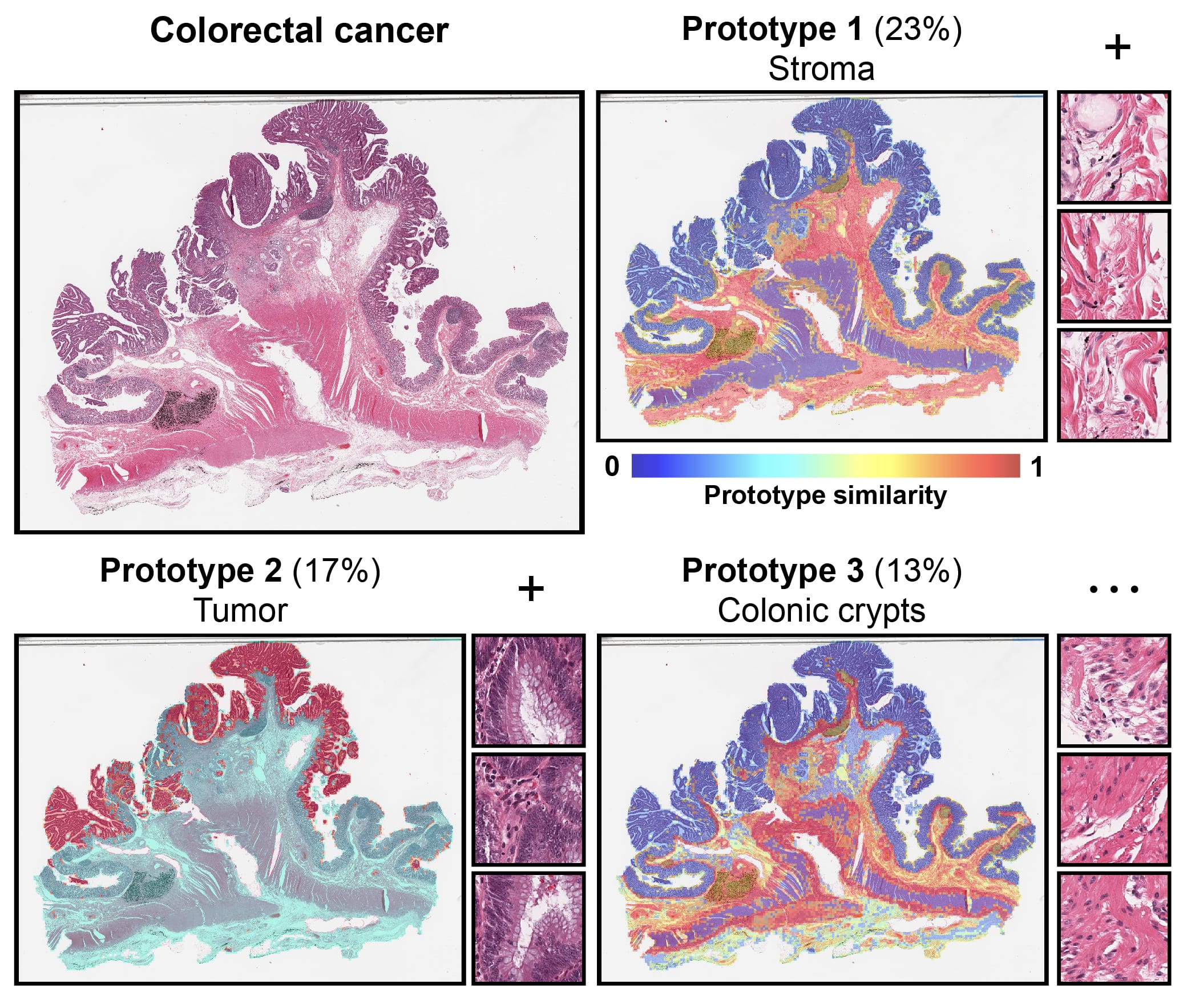
- Assigning each patch to a prototype via posterior probability, enabling prototype-aware interpretation and heatmap visualization.
- Training the framework in an unsupervised manner using only patch embeddings from a pretrained vision encoder.
- Applying the learned representations to downstream tasks with simple linear heads or MLPs for classification and survival prediction.
Experimental results
Research questions
- RQ1Can morphological redundancy in whole-slide images be leveraged to learn task-agnostic, unsupervised slide representations?
- RQ2Does a prototype-based GMM approach outperform existing unsupervised and supervised MIL baselines in downstream diagnostic and prognostic tasks?
- RQ3Can the identified morphological prototypes provide qualitative and quantitative interpretability for slide-level representations?
- RQ4How do the prototype distributions and assignments correlate with known histopathological patterns and clinical outcomes?
- RQ5To what extent does the framework generalize across diverse cancer types and slide characteristics?
Key findings
- Panther outperforms or matches supervised MIL baselines on 13 datasets across both subtyping and survival prediction tasks, demonstrating strong generalization.
- The method achieves a mean AUC of 0.671 ± 0.09 on survival prediction (Cox) and 0.651 ± 0.04 on subtyping, outperforming unsupervised baselines like OT and ProtoCounts.
- Prototype-based heatmap interpretation shows strong concordance with supervised patch-level classifiers, validating morphological relevance in BLCA, BRCA, and KIRC.
- The prototype distribution $π_c$ per slide captures biologically meaningful tissue proportions, confirmed by pathologist annotations.
- Visualizations of posterior probabilities reveal spatial patterns aligned with tumor regions, immune infiltrates, and stromal components.
- The framework enables per-prototype nonlinear modeling and interpretation, offering new insights into tissue microenvironment complexity.
Read this paper
Open the full text in the Nubint reader and ask about any passage as you read.
Read this paper on NubintThis review was generated by AI from the original paper. Please check the paper before citing it.