
[Paper Review] Multiple-Input Multiple-Output Gaussian Broadcast Channels with Confidential Messages
This paper characterizes the secrecy capacity region of a two-user MIMO Gaussian broadcast channel with confidential messages under a matrix power constraint. It shows that both messages can be transmitted simultaneously at their individual maximal secrecy rates using a novel coding scheme based on artificial noise and random binning, resolving a long-standing open problem in MIMO information-theoretic security.
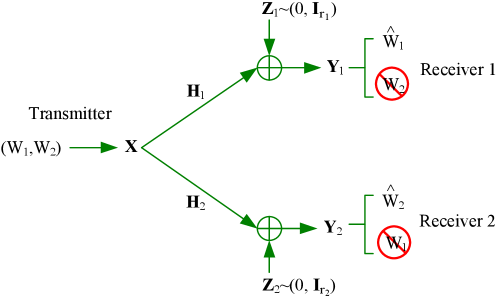
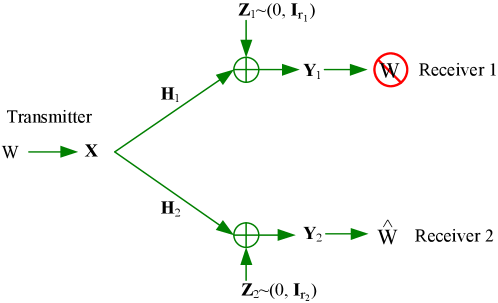
This paper considers the problem of secret communication over a two-receiver multiple-input multiple-output (MIMO) Gaussian broadcast channel. The transmitter has two independent messages, each of which is intended for one of the receivers but needs to be kept asymptotically perfectly secret from the other. It is shown that, surprisingly, under a matrix power constraint both messages can be simultaneously transmitted at their respective maximal secrecy rates. To prove this result, the MIMO Gaussian wiretap channel is revisited and a new characterization of its secrecy capacity is provided via a new coding scheme that uses artificial noise and random binning.
Motivation & Objective
- To resolve the open problem of characterizing the secrecy capacity region for two-receiver MIMO Gaussian broadcast channels with two independent confidential messages.
- To establish conditions under which both confidential messages can be transmitted simultaneously at their respective maximal secrecy rates.
- To develop a new coding scheme that ensures perfect secrecy from unintended receivers while maximizing reliable transmission rates.
- To generalize prior results on MIMO wiretap channels and broadcast channels with confidential messages to the full MIMO setting under a general matrix power constraint.
Proposed method
- Proposes a novel coding scheme based on artificial noise injection and random binning to enhance secrecy in MIMO broadcast channels.
- Revisits the MIMO Gaussian wiretap channel and provides a new characterization of its secrecy capacity using the proposed scheme.
- Applies channel enhancement techniques to transform the original MIMO broadcast channel into an equivalent form amenable to secrecy rate analysis.
- Uses matrix optimization over positive semidefinite beamforming matrices to maximize the difference between desired and eavesdropper channel capacities.
- Employs singular value decomposition and matrix transformations to decouple the secrecy rate expressions into eigenvalue-dependent components.
- Derives the secrecy capacity region by maximizing the difference of log-determinants of channel-dependent matrices under the matrix power constraint.
Experimental results
Research questions
- RQ1Can both confidential messages be transmitted simultaneously at their individual maximal secrecy rates over a MIMO Gaussian broadcast channel?
- RQ2What is the precise characterization of the secrecy capacity region under a general matrix power constraint?
- RQ3How can artificial noise and random binning be jointly used to achieve perfect secrecy in MIMO broadcast channels?
- RQ4Does the secrecy capacity region depend on the relative channel strength between intended and unintended receivers in the MIMO setting?
- RQ5Can the secrecy capacity of the MIMO broadcast channel be achieved using a single-user-like coding strategy with artificial noise?
Key findings
- The secrecy capacity region is fully characterized as the set of rate pairs (R₁, R₂) satisfying R₁ ≤ max_{0⪯B⪯S} [½ log|I + H₁BH₁ᵀ| − ½ log|I + H₂BH₂ᵀ|] and R₂ ≤ max_{0⪯B⪯S} [½ log|I + H₂BH₂ᵀ| − ½ log|I + H₁BH₁ᵀ|], respectively.
- Surprisingly, both messages can be transmitted simultaneously at their respective maximal secrecy rates under the matrix power constraint, even when the channels are not degraded.
- The secrecy capacity is achieved via a coding scheme that combines artificial noise beamforming and random binning, ensuring asymptotic perfect secrecy from unintended receivers.
- The optimal beamforming matrix B* is derived as the solution to a matrix optimization problem involving the channel matrices and the power constraint.
- The secrecy rate is expressed in terms of the eigenvalues of a transformed channel matrix, with the capacity equal to ½ ∑_{j=1}^{ρ} log φ_j, where φ_j are the eigenvalues of a specific matrix related to the channel gains.
- The result generalizes prior findings on MISO and single-antenna wiretap channels, confirming that artificial noise can effectively create a secrecy advantage in MIMO settings.
Read this paper
Open the full text in the Nubint reader and ask about any passage as you read.
Read this paper on NubintThis review was generated by AI from the original paper. Please check the paper before citing it.