
[Paper Review] MV-Swin-T: Mammogram Classification with Multi-view Swin Transformer
This paper proposes MV-Swin-T, a pure transformer-based multi-view network for mammogram classification that leverages a novel Multi-Headed Dynamic Attention (MDA) block to fuse features from mediolateral-oblique (MLO) and cranial-caudal (CC) views. By integrating cross-view information through dynamic attention in shifted window configurations, the model achieves state-of-the-art performance on CBIS-DDSM and VinDr-Mammo datasets, with AUC improvements of up to 11.11% over single-view Swin-T.
Traditional deep learning approaches for breast cancer classification has predominantly concentrated on single-view analysis. In clinical practice, however, radiologists concurrently examine all views within a mammography exam, leveraging the inherent correlations in these views to effectively detect tumors. Acknowledging the significance of multi-view analysis, some studies have introduced methods that independently process mammogram views, either through distinct convolutional branches or simple fusion strategies, inadvertently leading to a loss of crucial inter-view correlations. In this paper, we propose an innovative multi-view network exclusively based on transformers to address challenges in mammographic image classification. Our approach introduces a novel shifted window-based dynamic attention block, facilitating the effective integration of multi-view information and promoting the coherent transfer of this information between views at the spatial feature map level. Furthermore, we conduct a comprehensive comparative analysis of the performance and effectiveness of transformer-based models under diverse settings, employing the CBIS-DDSM and Vin-Dr Mammo datasets. Our code is publicly available at https://github.com/prithuls/MV-Swin-T
Motivation & Objective
- To address the limitation of single-view deep learning models in mammogram classification by leveraging multi-view analysis.
- To overcome the loss of inter-view correlations in existing multi-view methods that rely on separate convolutional branches or simple fusion.
- To develop a pure transformer-based architecture that effectively captures long-range dependencies and cross-view relationships in mammographic images.
- To improve diagnostic accuracy by fusing information from both CC and MLO views of the same breast using a novel attention mechanism.
- To validate the model’s performance on publicly available datasets, including CBIS-DDSM and VinDr-Mammo, under diverse settings.
Proposed method
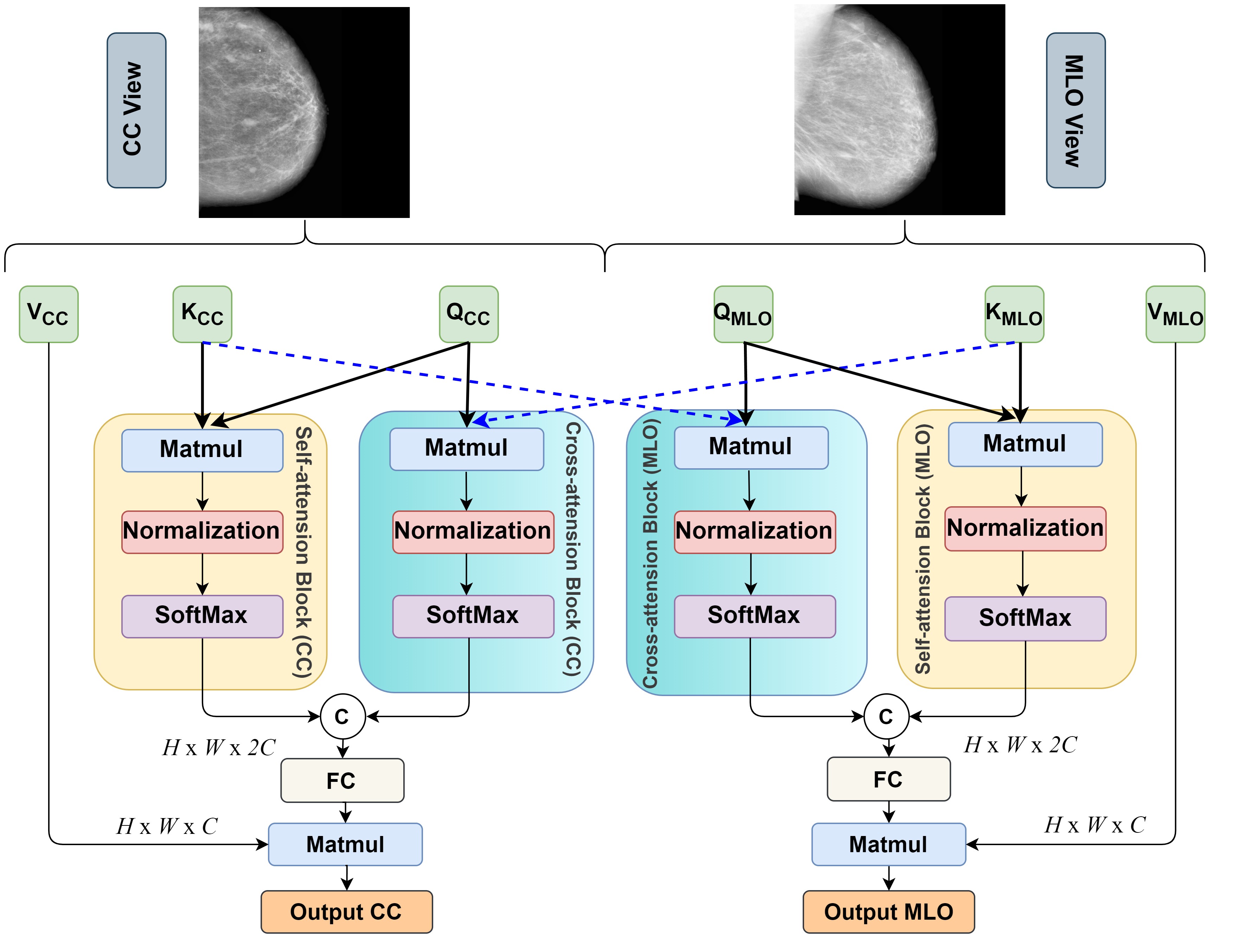
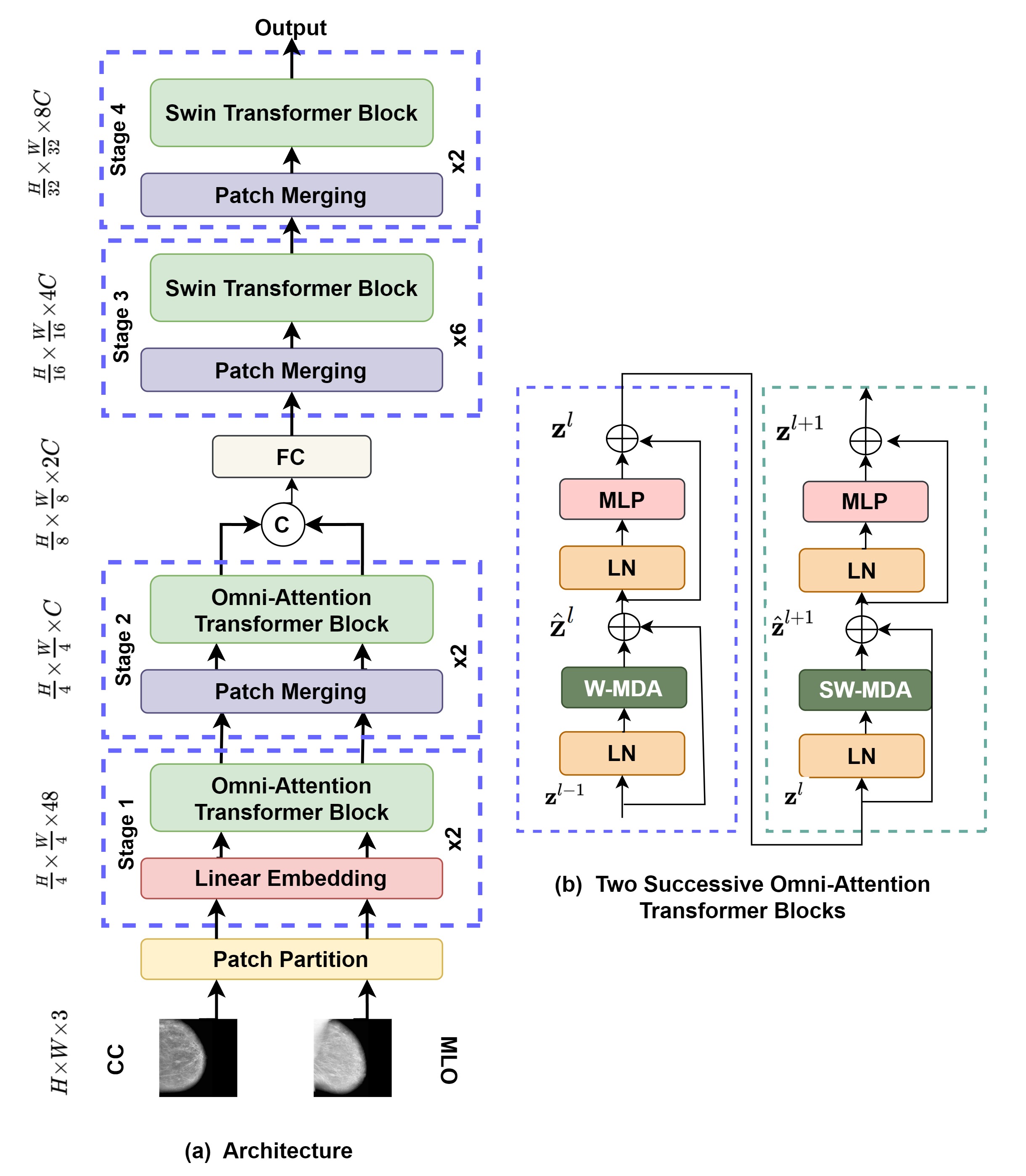
- Proposes a novel Multi-Headed Dynamic Attention (MDA) block that combines self-attention and cross-attention between CC and MLO views using fixed and shifted window configurations.
- Adapts the Swin Transformer architecture with shifted windows to enable local and global feature learning while reducing computational complexity.
- Employs early fusion of multi-view features after the second stage of the network to preserve contextual coherence and enhance representation learning.
- Uses weighted addition and concatenation strategies to fuse attention maps from both views, with concatenation yielding the best performance.
- Trains the model on image resolutions of 224×224 and 384×384, finding that larger input size improves boundary localization and classification accuracy.
- Conducts ablation studies to evaluate the impact of architectural components, including attention fusion strategies and input resolution, on model performance.
Experimental results
Research questions
- RQ1Can a pure transformer-based architecture outperform single-view and hybrid CNN-transformer models in multi-view mammogram classification?
- RQ2How effective is the proposed Multi-Headed Dynamic Attention (MDA) block in fusing cross-view information from CC and MLO views?
- RQ3What is the impact of input image size (224×224 vs. 384×384) on the model’s ability to localize and classify breast masses?
- RQ4Does early fusion of multi-view features lead to better performance than late or late-stage fusion in mammogram classification?
- RQ5How does the model perform across different datasets with varying image quality and data size, such as CBIS-DDSM and VinDr-Mammo?
Key findings
- MV-Swin-T achieves an AUC of 71.37% and accuracy of 68.63% on the CBIS-DDSM mass classification task, representing a 11.11% improvement in AUC over the single-view Swin-T baseline (60.26%).
- On the CBIS-DDSM dataset including both mass and calcification cases, MV-Swin-T achieves an AUC of 66.43% and accuracy of 65.37%, outperforming the single-view Swin-T (AUC: 61.28%, Acc: 60.46%).
- On the VinDr-Mammo dataset, MV-Swin-T achieves an AUC of 96.08% and accuracy of 95.50%, slightly outperforming the single-view Swin-T (AUC: 95.88%, Acc: 95.50%), demonstrating robustness on high-quality, larger datasets.
- The concatenation-based attention fusion strategy outperforms weighted addition, with the latter showing optimal results at a 0.9:0.1 ratio (same view: cross-view).
- Increasing input resolution from 224×224 to 384×384 improves model performance, indicating that higher resolution enhances boundary localization and feature representation.
- The model’s superior performance on VinDr-Mammo is attributed to its larger size and higher image quality, suggesting that data scale and quality significantly influence transformer-based model generalization.
Read this paper
Open the full text in the Nubint reader and ask about any passage as you read.
Read this paper on NubintThis review was generated by AI from the original paper. Please check the paper before citing it.