
[Paper Review] Nemotron-4 340B Technical Report
The Nemotron-4-340B model family (Base, Instruct, Reward) is open-sourced, with a strong emphasis on synthetic data for alignment, achieving top scores on RewardBench and competitive results on standard benchmarks.
We release the Nemotron-4 340B model family, including Nemotron-4-340B-Base, Nemotron-4-340B-Instruct, and Nemotron-4-340B-Reward. Our models are open access under the NVIDIA Open Model License Agreement, a permissive model license that allows distribution, modification, and use of the models and its outputs. These models perform competitively to open access models on a wide range of evaluation benchmarks, and were sized to fit on a single DGX H100 with 8 GPUs when deployed in FP8 precision. We believe that the community can benefit from these models in various research studies and commercial applications, especially for generating synthetic data to train smaller language models. Notably, over 98% of data used in our model alignment process is synthetically generated, showcasing the effectiveness of these models in generating synthetic data. To further support open research and facilitate model development, we are also open-sourcing the synthetic data generation pipeline used in our model alignment process.
Motivation & Objective
- Release a 340B-scale open-access language model family under a permissive license.
- Demonstrate strong performance on instruction-following, chat capabilities, and reward-based alignment.
- Showcase the efficacy of synthetic data generation for model alignment and data efficiency.
- Provide detailed training data, pipelines, and code to promote reproducibility and community use.
Proposed method
- Multistream pretraining on 9T tokens with English, multilingual, and code data."
- Decoder-only Transformer architecture with RoPE, SentencePiece, grouped query attention, and no bias terms."
- Two-stage alignment: supervised fine-tuning (SFT) followed by preference fine-tuning (DPO and RPO).
- Extensive use of synthetic data (>98%) for alignment, with a synthetic data generation pipeline and HelpSteer2 reward data.
- Iterative weak-to-strong alignment to continuously improve generator quality and model capabilities.
- Release of the Nemotron-4-340B-Reward as a high-quality reward model to guide alignment and data filtering.
Experimental results
Research questions
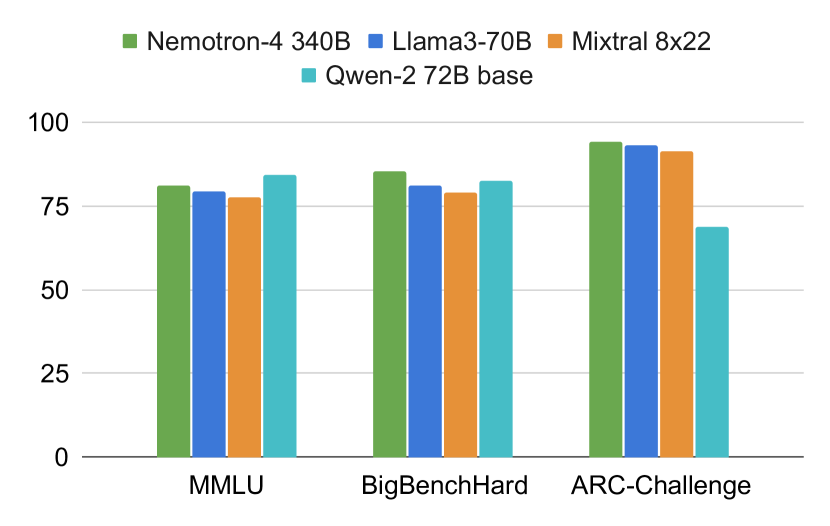
- RQ1How does Nemotron-4-340B-Base compare to open-access baselines on standard reasoning and benchmark tasks?
- RQ2What is the effectiveness of synthetic data generation in aligning large language models compared with human-annotated data alone?
- RQ3How do reward modeling and reinforcement learning with human feedback (RLHF) impact instruction following and safety?
- RQ4Can iterative weak-to-strong alignment improve data quality and model performance beyond traditional single-pass alignment?
- RQ5What is the impact of a two-stage SFT, specifically codemodel-focused SFT followed by general SFT, on downstream tasks?
Key findings
- Nemotron-4-340B-Base achieves the strongest accuracy on commonsense reasoning tasks and BBH among listed open-access bases.
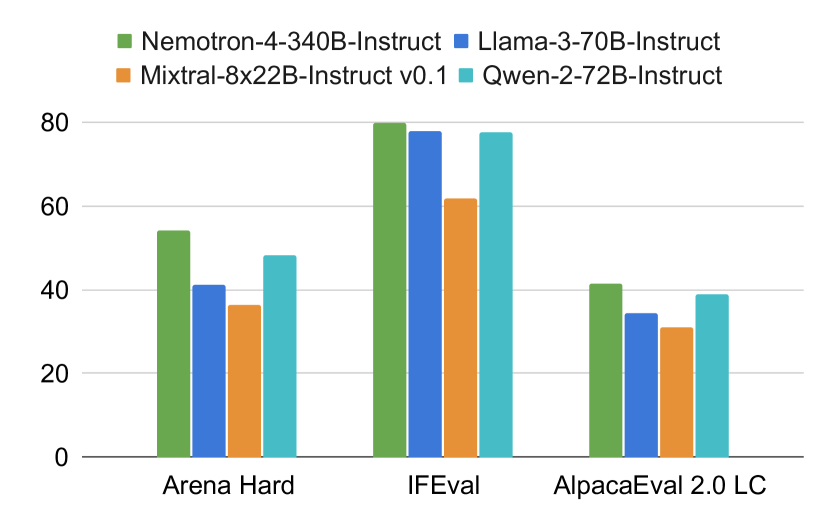
- Nemotron-4-340B-Instruct surpasses corresponding instruct models in instruction following and chat capabilities.
- Nemotron-4-340B-Reward achieves top accuracy on RewardBench, outperforming several proprietary models at the time of publication.
- Over 98% of alignment data are synthetically generated, demonstrating effective synthetic data generation for model alignment.
- The authors release the synthetic data pipeline, generation prompts, and the reward model to support open research and reproducibility.
- Base model includes 9.4B embedding parameters and 331.6B non-embedding parameters, trained with 9T tokens across a 96-layer Transformer.
Read this paper
Open the full text in the Nubint reader and ask about any passage as you read.
Read this paper on NubintThis review was generated by AI from the original paper. Please check the paper before citing it.