
[Paper Review] NeuroGraph: Benchmarks for Graph Machine Learning in Brain Connectomics
NeuroGraph creates static and dynamic brain graph benchmarks, exploring 35 datasets and 15 baselines to benchmark graph neural networks on fMRI-derived connectomes for demographic, task, and cognitive trait prediction.
Machine learning provides a valuable tool for analyzing high-dimensional functional neuroimaging data, and is proving effective in predicting various neurological conditions, psychiatric disorders, and cognitive patterns. In functional magnetic resonance imaging (MRI) research, interactions between brain regions are commonly modeled using graph-based representations. The potency of graph machine learning methods has been established across myriad domains, marking a transformative step in data interpretation and predictive modeling. Yet, despite their promise, the transposition of these techniques to the neuroimaging domain has been challenging due to the expansive number of potential preprocessing pipelines and the large parameter search space for graph-based dataset construction. In this paper, we introduce NeuroGraph, a collection of graph-based neuroimaging datasets, and demonstrated its utility for predicting multiple categories of behavioral and cognitive traits. We delve deeply into the dataset generation search space by crafting 35 datasets that encompass static and dynamic brain connectivity, running in excess of 15 baseline methods for benchmarking. Additionally, we provide generic frameworks for learning on both static and dynamic graphs. Our extensive experiments lead to several key observations. Notably, using correlation vectors as node features, incorporating larger number of regions of interest, and employing sparser graphs lead to improved performance. To foster further advancements in graph-based data driven neuroimaging analysis, we offer a comprehensive open-source Python package that includes the benchmark datasets, baseline implementations, model training, and standard evaluation.
Motivation & Objective
- Explore graph-based representations of fMRI data for ML tasks.
- Create a large benchmark suite (NeuroGraph) of static and dynamic brain graphs.
- Evaluate diverse GNNs and baselines to identify effective pipelines.
- Provide an open-source toolkit with datasets, models, and evaluation protocols.
Proposed method
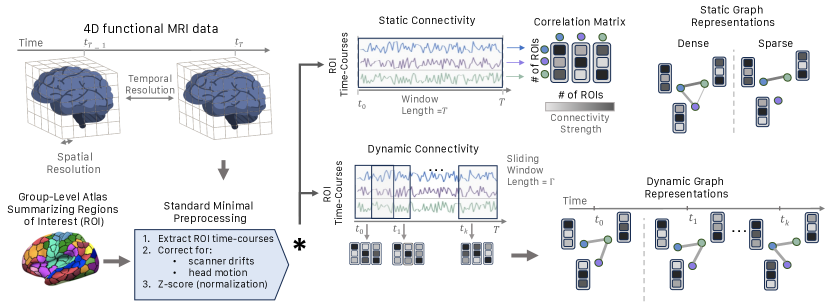
- Convert fMRI data to graph representations using ROIs and correlation-based edges.
- Construct both static and dynamic brain graphs with varying ROIs and sparsity.
- Evaluate 15 baseline models including 10 GNNs and 5 non-GNN baselines on 35 datasets.
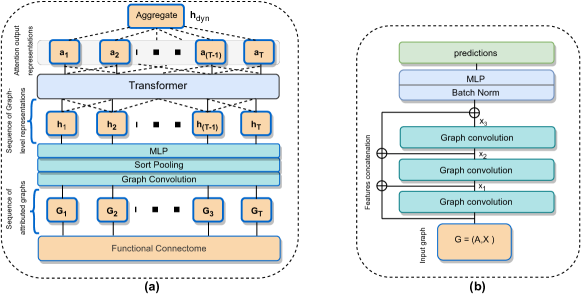
- Propose a GNN∗ architecture with residual connections and concatenated multi-layer representations.
- Integrate a dynamic graph processing module combining GNNs with a transformer for overall representation.
Experimental results
Research questions
- RQ1Which node feature configurations (CORR, BOLD, or both) yield best predictive performance?
- RQ2How does the number of ROIs (100, 400, 1000) affect model accuracy and generalization?
- RQ3What edge-sparsification thresholds (top 5/10/20%) optimally balance signal and sparsity?
- RQ4Which graph convolution methods are most effective for brain graphs across tasks?
Key findings
- Correlation-based node features consistently improve performance across ROIs and tasks.
- Using 1000 ROIs with sparse graphs often yields strong results across datasets.
- GNN∗ with residual connections and MLP fusion generally outperforms other baselines on static datasets.
- Dynamic graphs show competitive but sometimes lower performance due to dataset constraints; UniMP remains robust.
- Large ROIs and sparsity with correlation features emerge as favorable settings in the benchmark.
- The study provides an open-source NeuroGraph toolkit with datasets, baselines, and training/evaluation pipelines.
Better researchstarts right now
From reading papers to final review, dramatically reduce your research time.
No credit card · Free plan available
This review was created by AI and reviewed by human editors.