
[Paper Review] Non-Coplanar Magnetic Orders in Classical Square-Kagome Antiferromagnets
This paper investigates non-coplanar magnetic orders in classical Heisenberg models on the square-kagome lattice, revealing extensive degeneracies, order-by-disorder effects, and a rich phase diagram featuring incommensurate spin spirals and chiral states. Using extensive numerical simulations, it identifies key thermodynamic signatures such as multi-step specific heat anomalies and provides a symmetry-based classification of non-coplanar orders, setting the stage for quantum analogs like chiral spin liquids and spin nematics in S=1/2 systems.
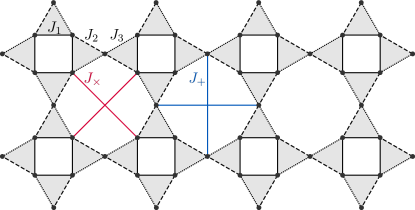
Motivated by the recent synthesis of a number of Mott insulating square-kagome materials, we explore the rich phenomenology of frustrated magnetism induced by this lattice geometry, also referred to as the squagome or shuriken lattice. On the classical level, square-kagome antiferromagnets are found to exhibit extensive degeneracies, order-by-disorder, and non-coplanar ordering tendencies, which we discuss for an elementary, classical Heisenberg model with nearest-neighbor and cross-plaquette interactions. Having in mind that upon introducing quantum fluctuations non-coplanar order can melt into chiral quantum spin liquids, we provide detailed information on the multitude of non-coplanar orders, including some which break rotational symmetry (possibly leading to nematic quantum orders), as well as a number of (incommensurate) spin spiral phases. Using extensive numerical simulations, we also discuss the thermodynamic signatures of these phases, which often show multi-step thermal ordering. Our comprehensive discussion of the classical square-kagome Heisenberg model, often drawing comparisons to the conventional kagome antiferromagnet, sets the stage for future explorations of quantum analogs of the various phases, either conceptually such as in quantum spin-1/2 generalizations of our model or experimentally such as in the Cu-based candidate materials.
Motivation & Objective
- To systematically explore the classical magnetic phase diagram of the square-kagome Heisenberg antiferromagnet with nearest-neighbor and cross-plaquette interactions.
- To identify and classify non-coplanar magnetic orders, including chiral and nematic states, using symmetry analysis.
- To characterize thermodynamic signatures such as multi-step specific heat transitions and entropy plateaus.
- To establish a foundation for understanding quantum analogs, including chiral spin liquids and spin nematics, in low-spin systems.
- To guide material synthesis by identifying chemical pathways to enhance cross-plaquette couplings (e.g., via cation or anion substitutions).
Proposed method
- Numerical simulations using Monte Carlo and heat-bath algorithms on finite-size square-kagome lattices with periodic boundary conditions.
- Implementation of a classical Heisenberg Hamiltonian with nearest-neighbor J+ and diagonal cross-plaquette J× interactions.
- Computation of thermodynamic observables: specific heat, scalar spin chirality, and structure factors to detect incommensensurate order.
- Symmetry analysis of spin configurations to classify non-coplanar states, including time-reversal breaking and nematic order parameters.
- Use of order parameter analysis and finite-size scaling to identify phase transitions and crossover behavior.
- Comparison with the conventional kagome lattice to highlight unique features of the square-kagome geometry.
Experimental results
Research questions
- RQ1What types of non-coplanar magnetic orders emerge in the classical square-kagome Heisenberg model with cross-plaquette interactions?
- RQ2How do thermodynamic signatures such as specific heat anomalies distinguish between different magnetic phases?
- RQ3Which non-coplanar states break rotational symmetry and may lead to nematic quantum orders upon quantization?
- RQ4How do the phase diagrams of the square-kagome and conventional kagome lattices differ in terms of degeneracy and order-by-disorder effects?
- RQ5What chemical modifications can enhance cross-plaquette couplings to stabilize chiral spin liquid phases in real materials?
Key findings
- The model exhibits extensive classical degeneracy and order-by-disorder effects, stabilizing non-coplanar spin configurations despite the absence of long-range order in the classical limit.
- A variety of non-coplanar states are identified, including umbrella-like double cone states interpolating between ferromagnetic and octagonal order, with finite scalar spin chirality.
- Incommensurate spin spiral phases are found, characterized by modulated structure factors and distinct specific heat anomalies.
- Thermodynamic signatures include multi-step specific heat peaks, indicating sequential ordering transitions, and entropy plateaus suggestive of cooperative paramagnetic phases.
- The symmetry analysis reveals that certain non-coplanar states break time-reversal and rotational symmetry, potentially leading to chiral and nematic quantum spin liquids in S=1/2 systems.
- Chemical pathways such as replacing Na with Cs or substituting SO₄²⁻ with SeO₄²⁻ are predicted to enhance J× couplings, promoting chiral order in candidate materials.
![Figure 2: The nearest-neighbor model. (a) Zero-temperature phase diagram as a function of nearest-neighbor couplings $J_{2}$ and $J_{3}$ , reproduced from Ref. [ 26 ] . (b) Specific heat traces for three representative points along the $J_{2}=J_{3}$ diagonal in the phase diagram of panel (a). The on](https://ar5iv.labs.arxiv.org/html/2302.04171/assets/x2.png)
Better researchstarts right now
From reading papers to final review, dramatically reduce your research time.
No credit card · Free plan available
This review was created by AI and reviewed by human editors.