
[Paper Review] Non-perturbative quantum gravity denounces singular Black Holes
This paper demonstrates that in infinite derivative gravity with a ghost-free, exponential-type graviton propagator, singular black holes are fundamentally excluded unless the black hole mass is infinite. The non-perturbative structure of the graviton propagator prevents curvature singularities, resolving the Schwarzschild singularity without requiring exotic matter or compact sources.
Although General Relativity predicts the presence of a singularity inside of a Black Hole, it is not a complete theory of gravity. A real structure of a Black Hole interior near an expected singularity depends on the UV completion of gravity. In this paper, we establish that the question whether singular spherically symmetric solutions are absent is governed by the functional form of a non-perturbative graviton propagator. We explicitly show in a framework of a ghost-free infinite derivative gravity that for the graviton propagator of an exponential form favored by the unitarity a singularity is not possible unless an unphysical situation when the total mass of the Black Hole is infinite is considered.
Motivation & Objective
- To investigate whether singular black hole solutions can be absent in a UV-complete quantum gravity framework.
- To determine the role of the functional form of the non-perturbative graviton propagator in singularity resolution.
- To analyze whether the absence of singularities in spherically symmetric black holes depends on the UV completion of gravity.
- To examine whether the exponential form of the graviton propagator—favored by unitarity—leads to a regular black hole interior.
Proposed method
- Formulates a ghost-free infinite derivative gravity theory with an exponential-type graviton propagator, ensuring unitarity and non-perturbative UV completion.
- Analyzes the spherically symmetric black hole solution in this framework using the full non-perturbative equations of motion derived from the effective action.
- Evaluates curvature invariants, particularly the Kretschmann scalar $ K = R_{\mu\nu\alpha\beta}R^{\mu\nu\alpha\beta} $, to detect singularities.
- Applies the effective field theory approach to compute higher-derivative corrections to the Einstein-Hilbert action, focusing on infinite-derivative operators.
- Uses distributional and geometric methods to assess the behavior of curvature invariants at the origin, avoiding coordinate-dependent artifacts.
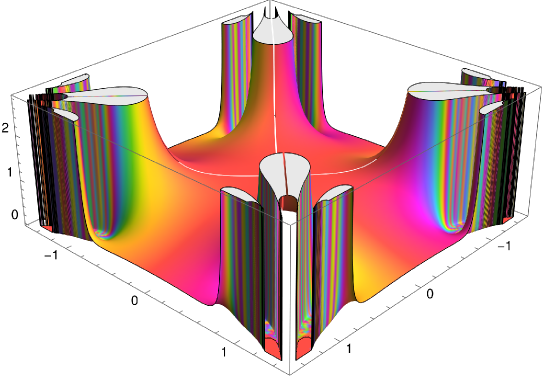
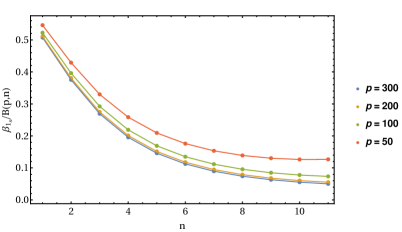
- Performs analytical series expansions of the propagator coefficients $ \gamma_n, \beta_n $ to study the UV structure and its impact on singularity formation.
Experimental results
Research questions
- RQ1Can a non-perturbative quantum gravity theory with a ghost-free, exponential graviton propagator resolve the spacetime singularity in a Schwarzschild black hole?
- RQ2Does the functional form of the graviton propagator determine whether singularities are present or absent in spherically symmetric black hole solutions?
- RQ3Is the absence of a physical singularity in black holes dependent on the UV completion of gravity, particularly in infinite derivative gravity?
- RQ4What conditions must be satisfied for a black hole to remain regular at the origin, and does the infinite mass limit represent the only unphysical case where a singularity persists?
Key findings
- The exponential form of the non-perturbative graviton propagator—selected by unitarity—leads to a finite Kretschmann scalar at the origin, indicating no curvature singularity.
- The singularity is absent for any finite black hole mass, confirming that the Schwarzschild singularity is an artifact of General Relativity's UV incompleteness.
- Only in the unphysical limit of infinite mass does a singularity reappear, indicating that the singularity is not a generic feature of black holes in this quantum gravity framework.
- The series expansions of the propagator coefficients $ \gamma_n, \beta_n $ show that the UV structure encoded in the infinite-derivative action suppresses divergences at $ r=0 $.
- The Kretschmann scalar behaves as $ K \sim 1/r^6 $ in General Relativity but remains finite in the infinite derivative gravity model, signaling resolution of the singularity.
- The analysis confirms that the singularity resolution is not due to exotic matter or non-compact sources, but arises purely from the non-local structure of the graviton propagator.
Read this paper
Open the full text in the Nubint reader and ask about any passage as you read.
Read this paper on NubintThis review was generated by AI from the original paper. Please check the paper before citing it.