
[Paper Review] Nonequilibrium Seebeck and spin Seebeck effects in nanoscale junctions
This study investigates nonequilibrium thermoelectric and spin Seebeck effects in a quantum dot coupled asymmetrically to ferromagnetic leads, using numerical renormalization group (NRG) for strong coupling and perturbation theory for weak coupling. It reveals new sign changes in the Seebeck coefficient due to Kondo resonance splitting by exchange fields, with distinct signatures under finite voltage and temperature gradients, and identifies spin bias-induced sign changes in the spin Seebeck coefficient linked to spectral function features beyond the Kondo peak.
The spin-resolved thermoelectric transport properties of correlated nanoscale junctions, consisting of a quantum dot/molecule asymmetrically coupled to external ferromagnetic contacts, are studied theoretically in the far-from-equilibrium regime. One of the leads is assumed to be strongly coupled to the quantum dot resulting in the development of the Kondo effect. The spin-dependent current flowing through the system, as well as the thermoelectric properties, are calculated by performing a perturbation expansion with respect to the weakly coupled electrode, while the Kondo correlations are captured accurately by using the numerical renormalization group method. In particular, we determine the differential and nonequilibrium Seebeck effects of the considered system in different magnetic configurations and uncover the crucial role of spin-dependent tunneling on the device performance. Moreover, by allowing for spin accumulation in the leads, which gives rise to finite spin bias, we shed light on the behavior of the nonequilibrium spin Seebeck effect.
Motivation & Objective
- To understand the interplay between Kondo correlations and spin-dependent transport in strongly correlated nanoscale junctions under nonequilibrium conditions.
- To investigate how exchange fields from ferromagnetic leads modify the Kondo resonance and influence thermoelectric responses.
- To analyze the differential and nonequilibrium Seebeck coefficients under finite voltage and temperature gradients.
- To examine the role of spin accumulation and spin bias in generating a nonlinear spin Seebeck effect.
- To identify signatures of Kondo resonance splitting and suppression in thermopower and spin Seebeck responses.
Proposed method
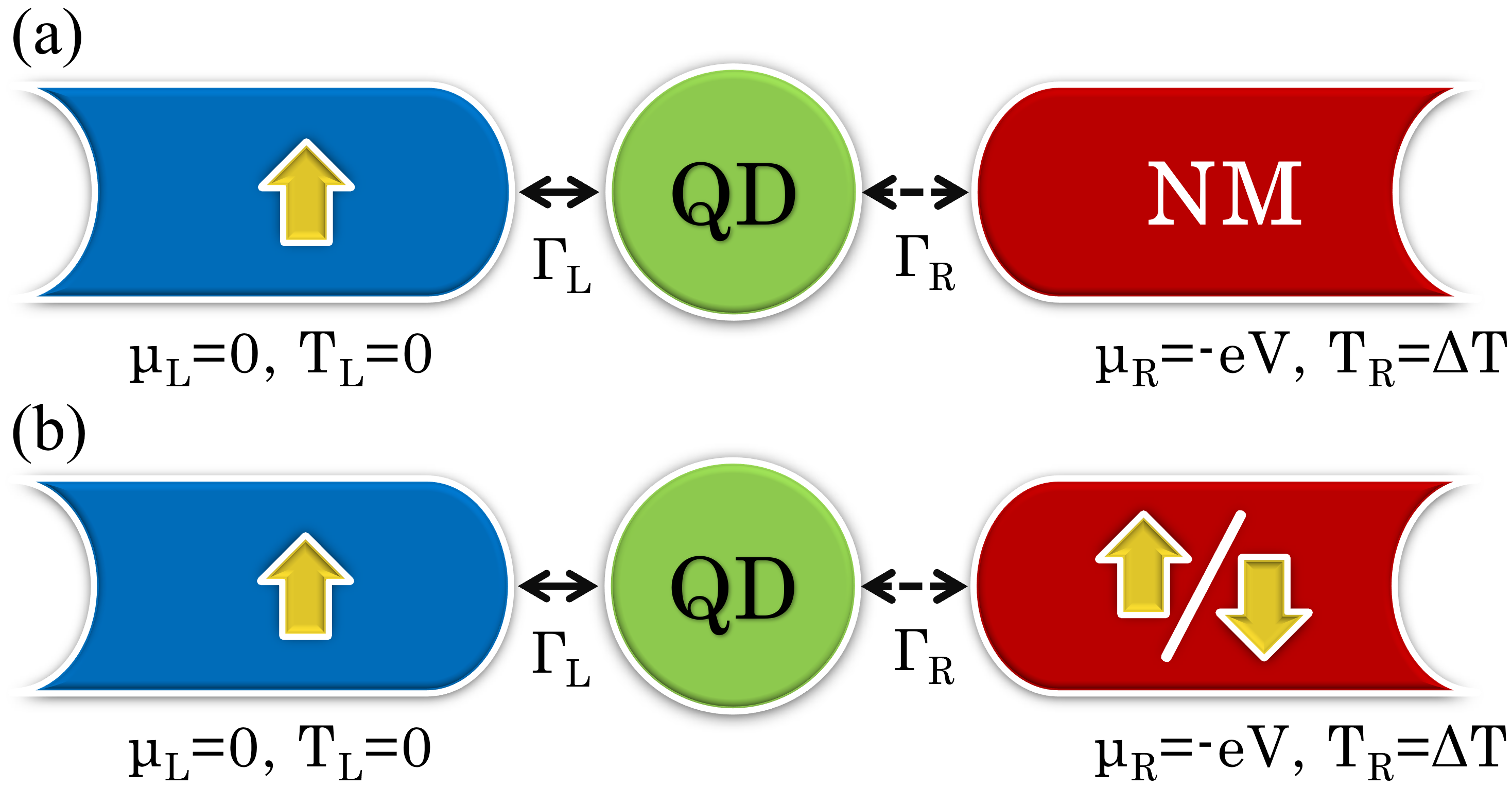
- A quantum dot is asymmetrically coupled to a strongly coupled ferromagnetic lead (where Kondo physics dominates) and a weakly coupled lead (nonmagnetic or ferromagnetic).
- The strongly coupled subsystem is treated with the numerical renormalization group (NRG) method to accurately capture Kondo correlations.
- The weakly coupled lead is treated via perturbation expansion in the tunneling amplitude, allowing for nonlinear response calculations.
- The Seebeck coefficient is calculated as a function of bias voltage, temperature gradient, and spin bias, using spin-resolved transport formalism.
- The spectral function and transport coefficients are derived from the full Hamiltonian, including on-site Coulomb interaction and exchange splitting.
- Spin Seebeck and charge Seebeck coefficients are analyzed in both parallel and antiparallel magnetic configurations of the leads.
Experimental results
Research questions
- RQ1How does the Kondo resonance splitting due to an exchange field affect the differential and nonequilibrium Seebeck coefficients under finite bias?
- RQ2What are the signatures of Kondo suppression and resonance splitting in the thermopower under temperature gradients?
- RQ3How does spin bias, arising from spin accumulation in the leads, influence the nonlinear spin Seebeck effect?
- RQ4What role does the magnetic configuration (parallel vs. antiparallel) of the ferromagnetic leads play in the sign changes of the Seebeck coefficient?
- RQ5How do the interplay of Kondo correlations and spin-dependent tunneling manifest in the nonlinear response regime?
Key findings
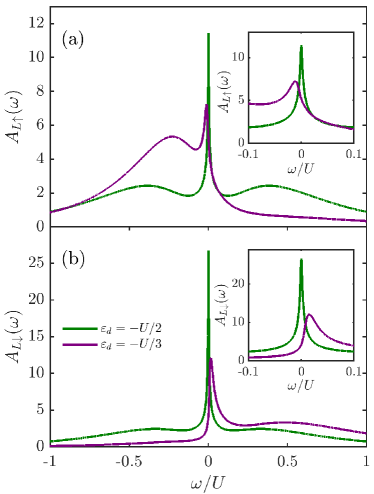
- The Seebeck coefficient exhibits new sign changes as a function of bias voltage, which are directly linked to the splitting of the Kondo resonance by the exchange field from the ferromagnetic lead.
- These sign changes persist for temperature gradients on the order of the Kondo temperature, indicating robust nonequilibrium signatures of Kondo physics.
- A second set of sign changes in the charge Seebeck coefficient emerges as a function of spin bias $V_s$, occurring at $V_s \approx -0.15U$ and $V_s \approx 0.03U$, and shift apart with increasing $\Delta T$.
- The spin Seebeck coefficient shows a single sign change in the positive spin bias regime around $V_s \approx U/4$, which shifts toward higher values with increasing $\Delta T$.
- An additional small region of sign change appears in the parallel configuration around $V_s \approx 0.2U$ to $V_s \approx U/2$, attributed to spectral features between the Kondo and Hubbard peaks.
- The behavior of the spin Seebeck coefficient is largely independent of magnetic configuration, except for minor amplitude differences, indicating it is dominated by non-Kondo spectral features.
Better researchstarts right now
From reading papers to final review, dramatically reduce your research time.
No credit card · Free plan available
This review was created by AI and reviewed by human editors.